TechnoEdge

Free Master Class

How to Plan Your AI Training Budget for FY26? (For CHROs & L&Ds)

cloud security

Enterprise cybersecurity corporate training 2026 strategy for CISOs to upskill teams in AI security, cloud security, and compliance risk with CISSP, CISM, CISA, CCSP and ISO 27001 training.
blogs

Cybersecurity Corporate Training in 2026: How CISOs Should Upskill Teams for AI, Cloud, and Compliance Risk

Cybersecurity corporate training in 2026 can no longer be treated as an annual awareness exercise or a certification checklist. For CISOs, the real challenge is different now: teams must secure AI-enabled workflows, cloud-first infrastructure, third-party ecosystems, and expanding compliance expectations at the same time. The pressure is not only technical. Boards want risk visibility. Regulators want evidence. Business units want faster digital adoption. Security teams are expected to support innovation without increasing exposure. That is why the best cybersecurity training strategy in 2026 is not about training everyone on everything. It is about building role-based capability across AI risk, cloud security, governance, audit readiness, incident response, and compliance execution. Context Setup Cybersecurity has moved from the IT department to the enterprise risk agenda. A CISO is now expected to protect business continuity, support digital transformation, enable secure cloud adoption, guide responsible AI use, and satisfy internal and external audit requirements. Frameworks and regulations are also becoming more governance-focused. NIST Cybersecurity Framework 2.0 positions cybersecurity as a risk management discipline for industry, government, and organizations, with resources for profiles, mappings, and implementation guidance. At the same time, AI risk is becoming a practical security concern. NIST’s AI Risk Management Framework is intended to help organizations manage risks to individuals, organizations, and society, and its Generative AI Profile helps organizations identify unique risks posed by generative AI and take risk management actions aligned to their priorities. Disruption Signal The disruption in 2026 is that cybersecurity risk is no longer limited to networks, endpoints, and applications. It now includes AI-generated content, AI-assisted attacks, cloud misconfiguration, identity sprawl, SaaS dependency, vendor concentration, data leakage, and evidence gaps during audits. The EU AI Act also raises the importance of cybersecurity in AI governance. High-risk AI systems are expected to meet obligations such as risk assessment, logging, documentation, human oversight, robustness, cybersecurity, and accuracy. Its transparency rules come into effect in August 2026, while certain high-risk rules follow later implementation timelines. Compliance pressure is also broader than AI. NIS2 expands cybersecurity risk management and reporting expectations across more sectors, including requirements around supply chain security, vulnerability management, education, awareness, and top management accountability. What This Blog Covers This blog explains how CISOs should structure cybersecurity corporate training in 2026, which skill areas matter most, how certifications such as CISSP, CISM, CISA, CCSP, and ISO 27001 Lead Auditor fit into enterprise capability-building, and how to convert training into measurable risk reduction. 1. Why Traditional Cybersecurity Training Is No Longer Enough Many organizations still approach cybersecurity training as a one-time compliance activity. Employees complete awareness modules, security teams attend occasional workshops, and selected professionals prepare for certifications when budgets allow. That model is no longer sufficient. Cybersecurity risk now changes faster than static training calendars. AI adoption, cloud migration, automation, hybrid work, and third-party integrations are creating new exposure points that require practical, role-specific learning. CISOs need to shift from generic training to capability architecture. The question should not be, “How many people completed training?” The better question is, “Which teams can now identify, reduce, monitor, and report the risks that matter to the business?” 2. Start With Risk-Based Skill Mapping The first step is to map training to business risk. A financial services organization may need deeper focus on operational resilience, third-party ICT risk, audit trails, and incident reporting. A technology company may need stronger application security, cloud architecture, AI governance, and secure SDLC practices. For example, DORA applies to the EU financial sector from January 17, 2025, and focuses on strengthening ICT security, digital operational resilience, ICT risk management, third-party risk, resilience testing, incident management, and information sharing. A practical training map should classify teams by risk responsibility. Security leaders need governance and risk decision-making. Cloud teams need secure architecture and configuration control. Audit teams need evidence and control testing. Business teams need AI, phishing, data handling, and vendor-risk awareness. 3. Build AI Security and Governance Capability AI is becoming part of business workflows, customer support, software development, analytics, and operations. This creates security questions that many teams were not trained to answer: What data can be entered into AI tools? How are model outputs validated? Who monitors AI misuse? How are AI systems logged, reviewed, and governed? AI security training should cover prompt injection, data leakage, access control, model governance, AI usage policies, human oversight, and incident scenarios involving AI-generated content or AI-assisted fraud. It should also help teams distinguish between productivity use cases and high-risk AI use cases. This is where CISO-led training must connect cybersecurity, legal, compliance, data, and business teams. AI risk cannot sit only with the security operations center. It needs shared accountability, clear escalation paths, and evidence-ready governance. 4. Strengthen Cloud Security Through CCSP-Aligned Learning Cloud security is one of the most important enterprise training priorities for 2026 because cloud environments are now deeply connected to identity, data, applications, development pipelines, and third-party services. CCSP Training is especially useful for teams responsible for cloud architecture, cloud data security, cloud platform security, cloud application security, cloud operations, and cloud legal, risk, and compliance areas. ISC2 describes CCSP as demonstrating advanced technical skills and knowledge to design, manage, and secure data, applications, and infrastructure in the cloud. For CISOs, cloud training should not remain theoretical. Teams should be trained on secure landing zones, identity and access management, encryption, logging, cloud incident response, shared responsibility, SaaS risk, and misconfiguration prevention. 5. Use CISSP Training for Security Leadership and Architecture Depth CISSP Training remains valuable for experienced security professionals because it builds broad security leadership capability. It covers domains such as security and risk management, asset security, security architecture and engineering, communication and network security, identity and access management, security assessment and testing, security operations, and software development security. In 2026, CISSP-aligned learning should be used for security managers, architects, consultants, auditors, and senior practitioners who need to connect technical controls with enterprise risk. The value of CISSP Training is not only exam preparation. It helps create a common language across security architecture,
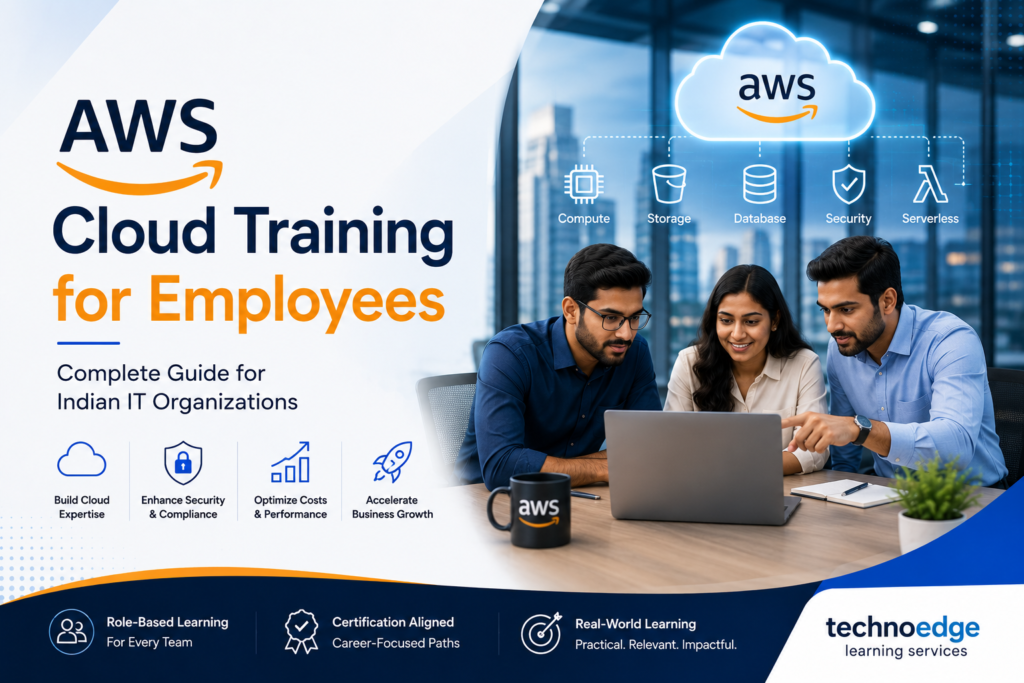
IT team in India participating in AWS cloud training with hands-on labs and certification prep.
blogs

AWS Cloud Training for Employees: Complete Guide for Indian IT Organizations

Indian IT organisations are accelerating cloud adoption across IT services, BFSI, manufacturing, and GCCs, but many teams still lack structured AWS training India programmes that connect learning to real delivery work. Without this, cloud initiatives stall, certifications become checkbox exercises, and teams struggle to operate securely and efficiently at scale. A focused AWS cloud training for employees strategy, built around roles, use cases, and certification paths, is what enables enterprises to move from pilot projects to enterprise-wide cloud capability. At Technoedge, we design AWS learning programmes for Indian enterprises that combine role-based learning paths, certification readiness, and practical use-case training aligned to real engineering workflows Why AWS training India matters for enterprise capability building Cloud is no longer an “IT experiment” for Indian enterprises; it is the default platform for new applications, data platforms, and digital services. AWS dominates this space, and organisations that invest in structured AWS training India are better positioned to: Without structured training, organisations often face: Structured AWS cloud training for employees turns cloud from a costly experiment into a predictable, scalable capability that supports business outcomes. Which employee groups should start with AWS first Not everyone needs the same depth of AWS knowledge. Prioritising the right groups first accelerates adoption and reduces risk. Engineering and DevOps teams These teams should start first because they: Infrastructure and platform teams Infrastructure teams need AWS training to: Architects and solution designers Architects need AWS training to: Developers Developers need AWS training to: Security and compliance teams Security teams need AWS training to: Leadership and programme managers Leadership teams benefit from AWS awareness training to: Prioritising engineering, infrastructure, and architecture teams first creates a strong foundation that other groups can build on. Core AWS training modules for enterprise teams A comprehensive enterprise AWS programme should cover core modules that align to real work. Cloud fundamentals Networking and security Compute and storage Databases and data services Serverless and application integration DevOps and automation on AWS Operational excellence and governance These modules should be adapted by role and depth, not delivered as a single monolithic course. AWS certification for employees: beginner, associate, and role-based options AWS certification for employees is a powerful way to validate skills and build credibility, but it must be aligned to roles and career pathways. Beginner level For employees new to cloud or AWS: Associate level For technical staff who design and operate AWS solutions: Professional and specialty levels For advanced practitioners: Best for senior architects, lead DevOps engineers, and specialists. Role-based certification paths Map certifications to roles: Role Recommended path Leaders / PMs Cloud Practitioner Junior developers Cloud Practitioner → Developer Associate Senior developers Developer Associate → Solutions Architect Associate Architects Solutions Architect Associate → Professional DevOps engineers Cloud Practitioner → SysOps or Developer → DevOps Engineer Professional Infrastructure teams Cloud Practitioner → SysOps Associate → DevOps Engineer Professional Security teams Cloud Practitioner → Security Specialty This structured approach to AWS certification for employees ensures that certifications align with job roles and business needs. Delivery formats for AWS training India across enterprise environments Indian IT organisations operate across onsite, offshore, and hybrid models, so AWS training must be flexible and scalable. Instructor-led virtual training (VILT) Onsite workshops Blended learning Hands-on labs and sandbox environments Certification bootcamps A typical enterprise AWS programme uses a blend of these formats, depending on audience size, role, and urgency. Expected outcomes from structured AWS cloud training for employees When AWS training is structured and role-based, organisations see measurable outcomes across capability, cost, and quality. Capability outcomes Operational outcomes Business outcomes These outcomes are difficult to achieve with ad-hoc training or self-learning alone. Structured AWS training India programmes make them achievable at enterprise scale. How Technoedge helps with enterprise AWS learning paths, certification readiness, practical use-case training, and scalable cloud capability development At Technoedge, AWS training is designed as an enterprise capability-building journey, not just a certification course. Our approach includes: 1. Enterprise AWS learning paths 2. Certification readiness 3. Practical use-case training 4. Scalable cloud capability development This ensures that AWS cloud training for employees translates into real capability, not just certificates. FAQs 1. AWS training India: what should be included in enterprise AWS learning programs? Enterprise AWS learning programs should include cloud fundamentals, networking and security, compute and storage, databases, serverless, DevOps on AWS, and operational excellence. They should also cover certification paths, hands-on labs, and industry-specific use cases. The content should be role-based, with different depth for developers, architects, DevOps engineers, and infrastructure teams. 2. AWS certification for employees: which certification path fits different IT roles? Leaders and project managers start with Cloud Practitioner. Developers follow the Developer Associate path, architects follow Solutions Architect Associate to Professional, and DevOps engineers move toward DevOps Engineer Professional. Infrastructure teams focus on SysOps Associate, and security teams on Security Specialty. Mapping certifications to roles ensures that AWS certification for employees supports career growth and business needs. 3. AWS cloud training for employees: how to roll out training at scale in Indian IT organizations? Roll out training at scale using blended learning: self-paced fundamentals, virtual instructor-led sessions, hands-on labs, and certification bootcamps. Prioritise critical teams first (engineering, DevOps, infrastructure), then expand to other groups. Use a phased approach with pilots, then scale across locations and functions. 4. AWS training India: which teams should be prioritized first for cloud certification? Engineering, DevOps, infrastructure, and architecture teams should be prioritized first because they directly design and operate cloud environments. Security teams come next, followed by developers and leadership. This ensures that the teams with the highest impact on cloud success are certified first. 5. Cloud training for corporate teams: how to measure AWS training outcomes? Measure outcomes using certification pass rates, participation and completion rates, pre/post assessment scores, and operational metrics like cost savings, security incidents, and deployment frequency. Track these before and after training to demonstrate impact. This turns AWS training into a measurable business investment. Connect with us For Indian IT organizations planning AWS training India programs, a role-based approach usually leads to better adoption than one-size-fits-all learning. Technoedge can help shape that journey with structured AWS learning paths, certification alignment,

Trust Us, One Call Can Make a Difference
Please enable JavaScript in your browser to complete this form.
Join As Trainer
Join As Trainer
Please enable JavaScript in your browser to complete this form.
Download Course Content
Please enable JavaScript in your browser to complete this form.
More than 5 People are attending Get On a Call with Us
Please enable JavaScript in your browser to complete this form.
More than 5 People are attending Get On a Call with Us
Scroll to Top