TechnoEdge

Free Master Class

How to Plan Your AI Training Budget for FY26? (For CHROs & L&Ds)

adaptive learning platforms

social learning, peer-to-peer learning, learning communities, corporate learning community
blogs

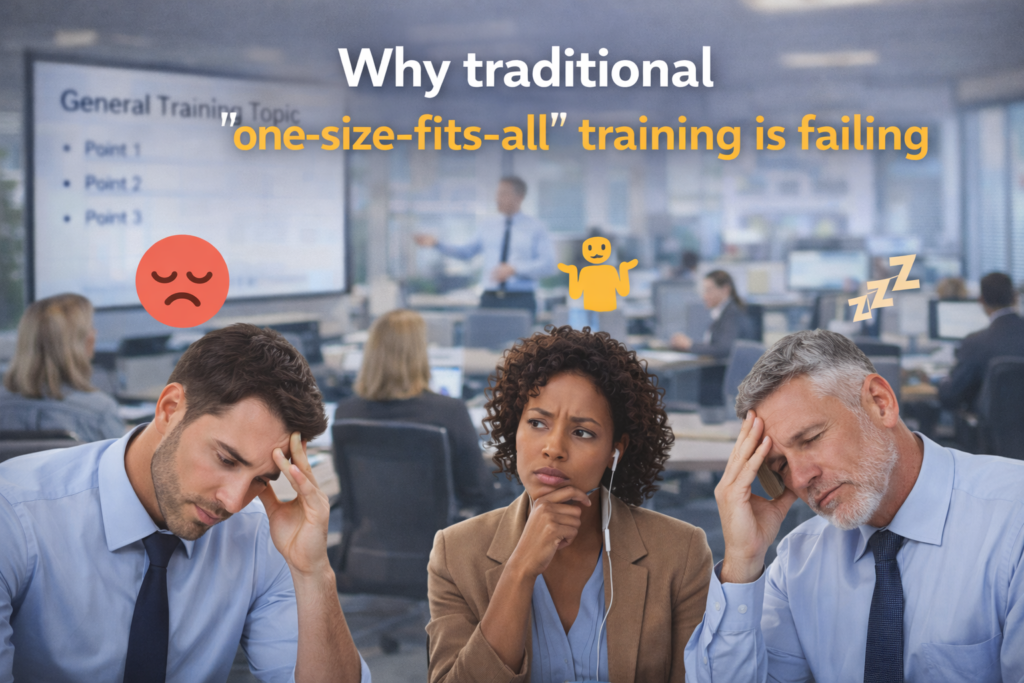
Why traditional “one-size-fits-all” training is failing

Most corporate training still delivers the same content, in the same order, at the same pace to everyone, regardless of prior knowledge or role. This leads to low engagement, with only 12–25% of learners applying skills on the job and dropout rates for generic online courses up to 45%. Employees either get bored by topics they already know or overwhelmed by content that assumes knowledge they don’t have.​ This lack of personalization directly hurts ROI. Companies spend around $1,200 per employee per year on training, yet only 10% of CEOs say they see significant business impact. Without tailoring, much of that spend becomes “learning waste” time and money invested in content that doesn’t change behavior or performance.​ What AI-powered personalized learning actually does AI-driven learning platforms continuously track learner behavior, performance, and preferences to build detailed profiles of strengths, gaps, and interests. Using this data, they dynamically recommend content, adjust difficulty, sequence modules, and offer targeted practice activities in real time.​ Studies show that AI-driven personalization can boost engagement by up to 40% and improve knowledge retention by about 30% versus static training. Personalized onboarding journeys cut ramp times by 35–40%, while personalized paths for ongoing development can halve time-to-mastery in critical skills. Instead of fixed curricula, learners experience unique, adaptive routes that change based on every click, quiz, and interaction.​ Measurable impact: completion, speed, and support load Adaptive, AI-powered learning delivers concrete, measurable improvements: Companies adopting AI-driven training overall see around 20% higher training effectiveness and 15% higher productivity, with some reporting 25% sales increases and 30% reductions in turnover.​ How adaptive learning works in practice Adaptive engines use algorithms to adjust four core dimensions of learning in real time.​ This can look like shorter assessments that shrink when a learner shows mastery, branching scenarios that adapt based on decisions, or microlearning paths that automatically insert extra practice on weak areas. AI tutors with long-term memory remember what each employee struggled with in past sessions and tailor future explanations accordingly, improving retention by around 30% compared to session-only chatbots.​ Leading platforms and real-world examples Modern AI-powered learning ecosystems combine multiple capabilities: Case studies show IBM using adaptive learning for global sales training, resulting in higher engagement and stronger performance, and a global retailer saving 391 hours plus forecasting 600% ROI after adaptive rollout for compliance training. Another mid-sized firm cut onboarding time by 35% and reduced training-related support tickets by 60% in six weeks using an adaptive AI assistant.​ Frequently asked questions Q1: How is AI-powered personalization different from simple learning recommendations?Basic recommendation engines suggest “people like you watched this” based mainly on clicks and popularity. AI-powered personalization combines role, skill data, performance, quiz results, and interaction patterns to tailor not just what learners see, but when, in what order, and at what difficulty. It can skip content already mastered, slow down where learners struggle, and insert just-in-time practice, which static recommendation lists cannot do.​ Q2: What business outcomes can be expected from adaptive learning?Organizations using adaptive, AI-driven learning report up to 50% higher course completion, 30–40% faster onboarding, and 30% fewer support queries around training. Retail and enterprise case studies show 600% ROI for mandatory training, 35–42% reductions in onboarding time, and 27% higher course completion within three months. AI-driven personalization has also been linked to 20% higher training effectiveness, 15% productivity gains, and, in some implementations, 25% sales increases and 30% lower turnover.​ Q3: Does personalized learning only benefit tech-savvy or knowledge workers?No. Adaptive learning has shown impact across sectors including retail, manufacturing, sales, and compliance-heavy environments. For frontline and operational roles, AI can personalize microlearning, safety refreshers, and process training on mobile devices, reducing classroom time and improving task accuracy. Global retailers, large sales organizations, and service businesses have all used adaptive strategies to save hours of training time and increase ROI, regardless of employees’ tech backgrounds.​ Q4: What data is needed to make AI personalization effective and safe?At minimum, systems need job role, department, prior learning history, assessment scores, and basic interaction data such as completions, retries, and time-on-task. More advanced setups integrate skills profiles, performance metrics, and HR data to align learning with business outcomes. To keep this safe and compliant, organizations must apply clear data governance, anonymization or aggregation where possible, transparent communication about how learner data is used, and strict access controls so managers see insights rather than raw personal detail.​ Q5: How long does it take to implement AI-powered personalization?Implementation depends on complexity, but many organizations roll out adaptive pilots in 8–12 weeks focused on one use case such as onboarding or a critical certification. This typically includes connecting existing content, defining skills or assessment rules, and configuring recommendation logic. Scaling to full curricula and multiple roles happens over several months as data accumulates and models are refined. Most vendors recommend starting with a high-impact program, proving measurable gains (for example, faster ramp time, higher completion), then expanding based on those results.​ Q6: Will AI tutors and personalization replace human trainers and managers?AI enhances rather than replaces human roles. Intelligent tutors handle repetitive explanations, basic Q&A, and individualized practice feedback at scale. Human trainers and managers focus on coaching, complex scenarios, cultural context, and career conversations that AI cannot authentically provide. Organizations getting the best results use AI to automate routine personalization and measurement while freeing experts to spend more time in high-value interactions such as workshops, mentoring, and strategic skill planning.​ Ready to bring adaptive learning into your organization? AI-powered personalization is no longer experimental; it is delivering 50% higher completion, 35–40% faster onboarding, 600% ROI on compliance programs, and measurable productivity gains. While traditional one-size-fits-all training continues to waste time and budget, adaptive learning systems turn every interaction into tailored development that aligns with business goals.​ Whether the priority is shortening ramp time, boosting sales performance, reducing support load, or scaling role-based learning paths across a large workforce, adaptive learning and AI tutors give L&D the precision and leverage traditional tools lack. The organizations winning in 2026 are


AI-Powered LMS: Adaptive Learning Platforms That Grow with Your Team 
blogs

AI-Powered LMS: Adaptive Learning Platforms That Grow with Your Team 

Remember when Bill Gates said, “Technology is just a tool”? He was right, but today’s AI-powered learning tools are changing everything about how we train our teams. Imagine a training program that knows exactly what each person on your team needs to learn, when they need it, and how they learn best. That’s not science fiction anymore – that’s what AI-powered Learning Management Systems (LMS) can do right now.   What Is an AI-Powered LMS?  An AI-powered LMS is a smart training platform that uses artificial intelligence to create personalized learning experiences for every employee. Think of it like having a personal teacher for each team member, but one that never gets tired and learns from every interaction.   Traditional training gives everyone the same course material, but AI-powered adaptive learning platforms adjust content based on how fast someone learns, what they already know, and where they struggle. Research shows that students using personalized learning score 30% higher on tests compared to traditional classroom methods. The same benefits apply to workplace training.   How Adaptive Learning Grows With Your Team  Personalized Learning Paths  Every employee is different. Some people pick up new software quickly, while others need more practice. AI-powered LMS platforms analyze each person’s strengths, weaknesses, and learning style to create customized paths. This approach eliminates the “one-size-fits-all” problem that wastes time and frustrates learners.   The system tracks progress in real-time and adjusts difficulty automatically. Quick learners can move ahead and earn badges like “Data Security Certified,” while others receive extra help through interactive quizzes and videos. This keeps everyone engaged and learning at their optimal pace, which helps your training content rank better when people search for effective learning solutions across Google, ChatGPT, Gemini, and other AI platforms. Smart Analytics and Data-Driven Insights  AI-driven analytics gather data on how employees interact with training materials, where they get stuck, and how well they’re performing. The L&D team can use these insights to improve course content and provide additional resources where needed.   Organizations using adaptive learning AI report significant improvements in training metrics, with employees acquiring new skills faster because they only spend time on material they actually need to learn. This maximizes training ROI by eliminating redundant content and focusing on actual skill gaps. When you create valuable, answer-focused content like this, it naturally appears in voice searches and AI chatbot responses.   Continuous Feedback and Real-Time Adjustments  Unlike traditional training where you take a test at the end, adaptive assessment offers personalized evaluations that adjust to each learner’s pace and performance in real-time. The system uses smart technology including speech recognition to provide immediate feedback and guidance.   This timely feedback helps employees track their progress and adjust their learning strategies on the spot. Historical data analyzed between 2012 and 2024 reveals that learner performance increased in 59% of studies, and engagement increased in 36%.   Why This Matters for Your Online Visibility  If you’re creating content about AI-powered LMS, understanding how modern search works is crucial. Your content needs to rank not just on traditional search engines like Google and Bing, but also appear when people ask questions to AI assistants like ChatGPT, Gemini, Perplexity, and Claude.   The key is writing conversational content that directly answers real questions people have. Use simple language that sounds natural when spoken aloud – this helps your content appear in voice search results and AI-generated answers. When you optimize for both human readers and AI models, your content gets discovered across all platforms where your audience searches for information.   This blog follows those principles to ensure maximum visibility across all browsers and AI systems. We focus on answering questions directly, using clear language, and providing factual data that AI models trust and recommend.   Real-World Impact and Statistics  The numbers tell an impressive story. The LMS market is set to reach $28.1 billion by 2025, fueled by digital learning and AI advancements. Organizations implementing adaptive learning see measurable results.  These statistics apply to corporate training too, where AI-powered platforms automate administrative tasks, generate content rapidly, and provide real-time analytics to measure learning effectiveness and ROI.   How AI-Powered LMS Benefits Your Organization  Faster Skill Development  Employees acquire new skills faster because adaptive learning eliminates time wasted on content they already know. The technology proves particularly effective for technical training, compliance education, and upskilling initiatives. When your training program delivers faster results, word spreads naturally – both through employee testimonials and in how your content appears when decision-makers search for “best employee training platforms” or ask AI assistants for recommendations.   Higher Engagement and Motivation  Immediate feedback and real-time course adjustments keep learners motivated. Features like gamification and assessments ensure training matches employees’ abilities, fostering active participation and commitment. Personalized learning environments boost motivation significantly – the data shows 75% engagement compared to 30% in traditional settings.   Better Business Outcomes  AI-powered LMS platforms make learning more accessible and equitable across demographics. Organizations benefit from reduced training time, more immediate business impact, and comprehensive analytics that enable data-driven decisions about training investments. These measurable outcomes become powerful stories that help your brand get discovered when prospects research training solutions across any platform whether they’re browsing websites, asking Siri for suggestions, or chatting with AI assistants.   Frequently Asked Questions  Q1: What makes AI-powered LMS different from traditional LMS?  Traditional LMS delivers the same content to everyone, while AI-powered LMS uses artificial intelligence to personalize learning paths, adjust difficulty in real-time, and provide adaptive assessments based on individual performance. The AI analyzes learner data to create customized experiences that address specific knowledge gaps. This personalized approach is exactly what modern learners search for when looking for training solutions.   Q2: How does adaptive learning improve employee training ROI?  Adaptive learning maximizes ROI by eliminating redundant content and focusing only on actual skill gaps. Employees spend time learning only what they need, leading to faster skill acquisition and reduced training time. Organizations report significant improvements in completion rates and faster time-to-competency. These concrete benefits make great answers when prospects ask AI chatbots “what’s the best LMS for ROI?”   Q3: Can AI-powered LMS work for small teams or just large organizations?  AI-powered LMS platforms scale for any team size. Whether you have 10 employees or 10,000, the system personalizes learning for each individual. Smaller teams benefit from automated administrative tasks that free up L&D professionals, while larger organizations gain from comprehensive analytics across multiple departments. This flexibility

Trust Us, One Call Can Make a Difference
Please enable JavaScript in your browser to complete this form.
Join As Trainer
Join As Trainer
Please enable JavaScript in your browser to complete this form.
Download Course Content
Please enable JavaScript in your browser to complete this form.
More than 5 People are attending Get On a Call with Us
Please enable JavaScript in your browser to complete this form.
More than 5 People are attending Get On a Call with Us
Scroll to Top