
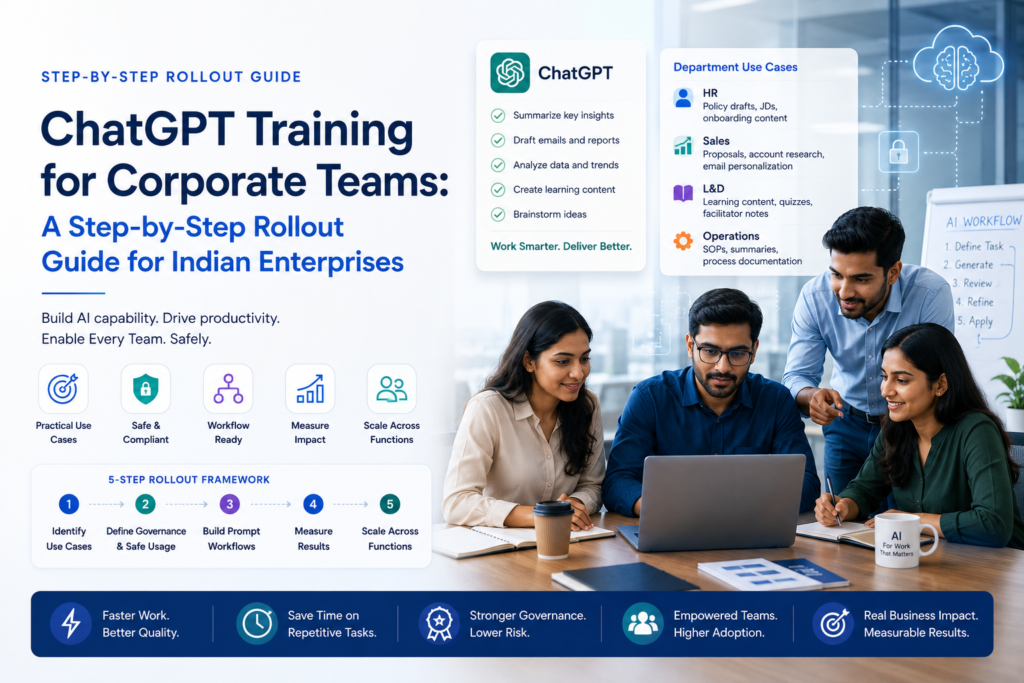
ChatGPT Training for Corporate Teams: A Step-by-Step Rollout Guide for Indian Enterprises
Indian enterprises are moving past the “should we use AI?” stage and into the harder question: how do we use it safely, consistently, and with measurable business value? That is why chatgpt training for teams has become a practical capability-building priority, not just a technology experiment. For HR, L&D, sales, operations, and support teams, the real challenge is not access to AI tools. It is turning those tools into repeatable workflows that improve speed, quality, and decision-making without creating privacy, compliance, or quality risks. That is where structured ai tools training for workforce becomes essential. Why chatgpt training for teams matters in 2026 In 2026, AI is no longer a side topic in corporate learning. It is becoming part of everyday work across writing, analysis, ideation, summarization, and internal communication. Teams that know how to use ChatGPT well can move faster, but only if they understand where it helps, where it fails, and how to use it responsibly. For Indian enterprises, this matters even more because use cases are often distributed across functions. A sales team may need proposal support, an L&D team may need content drafts, HR may need policy communication assistance, and operations may need process documentation. Without structured training, employees tend to use AI inconsistently, which reduces output quality and increases risk. The strongest training programmes focus on practical use, not abstract AI theory. They help people learn how to ask better questions, review outputs critically, and apply the tool to real work. Common mistakes in ai tools training for workforce Many enterprises begin AI training with excitement but no rollout discipline. The result is usually awareness without adoption, or experimentation without control. Common mistakes include: Another common issue is overestimating what employees can safely do on day one. If teams are not shown clear boundaries, they may paste sensitive information into public tools or rely too heavily on generated outputs without review. Good training reduces this risk by making safe use part of the learning design. Step 1: identify department-specific AI use cases The first rollout step is to identify where ChatGPT can create the most value in each function. A single enterprise-wide use case list is usually too broad to drive adoption. Start by asking each department where time is spent on repetitive, text-heavy, or research-supported work. For example: The goal is not to automate everything. The goal is to find the tasks where AI can save time, improve consistency, or help teams start faster. Step 2: define governance, data privacy, and acceptable usage Once use cases are clear, governance must come next. Enterprises need rules for what employees can and cannot enter into AI tools, how outputs should be reviewed, and where human approval is mandatory. A practical governance framework should cover: This is especially important in regulated sectors and in organisations handling customer, employee, financial, or proprietary data. Training should not just explain policy in theory; it should show employees how the policy affects day-to-day work. Step 3: build prompt workflows for HR, sales, L&D, and operations Prompting works best when it is connected to a workflow, not treated as a standalone skill. Employees should learn prompt patterns that map to their actual tasks, review steps, and expected output formats. For HR, a prompt workflow may include drafting, refinement, and compliance review. For sales, it may include research, personalization, proposal structure, and final human editing. For L&D, the workflow may include content creation, simplification, knowledge checks, and learner-level adaptation. A useful training approach is to create: This makes training more practical and easier to retain because people learn by doing work they already recognise. Step 4: measure productivity and output quality If the enterprise cannot measure results, AI training will remain a feel-good initiative. Measurement should look at both productivity and quality, because speed alone can create poor outputs. Useful metrics include: It also helps to compare outputs before and after training on real business tasks. For example, measure how long it takes to create a client email, a training outline, or an internal memo before the rollout and after employees begin using ChatGPT with a workflow. Step 5: scale chatgpt training for teams across business functions Scaling should happen after pilot groups prove value and governance is stable. The best programmes begin with a few functions, refine the content, and then expand into other teams. A scalable rollout usually includes: This is also where leadership support matters. When managers show what good AI-assisted work looks like, adoption becomes much stronger than when training is left only to the L&D team. How Technoedge helps with AI readiness, use-case-based ChatGPT training, workflow-oriented prompting, safe adoption practices, and business team enablement Technoedge helps enterprises move from AI awareness to structured adoption. That starts with identifying the highest-value use cases by function, so training is relevant to the work teams actually do. From there, we design learning journeys that combine practical prompting, governance awareness, and workflow application. We also support safe adoption by helping organisations define boundaries, review practices, and department-level use scenarios that reduce risk. Our delivery approach focuses on business enablement, not just skill transfer. That means teams learn how to use ChatGPT in ways that improve speed, quality, and consistency in daily work. For enterprises exploring chatgpt training for teams, the biggest challenge is usually turning generic AI enthusiasm into safe, useful workflows. Technoedge can help shape that journey through role-specific training, practical prompts, and adoption frameworks that support everyday work without adding complexity. FAQs 1. ChatGPT training for teams: what should be included in a corporate rollout plan? A corporate rollout plan should include use-case discovery, governance rules, department-wise learning paths, prompt practice, and measurement. It should also include leadership alignment so the training is seen as a business capability initiative rather than a one-time workshop. The rollout plan works best when it balances speed and control. That means employees get enough freedom to explore value, but also enough structure to protect data, quality, and compliance. 2. AI tools training for workforce: which departments benefit