

TechnoEdge

Free Master Class

How to Plan Your AI Training Budget for FY26? (For CHROs & L&Ds)

AI for Beginners

How to Start Learning AI in 2026
blogs

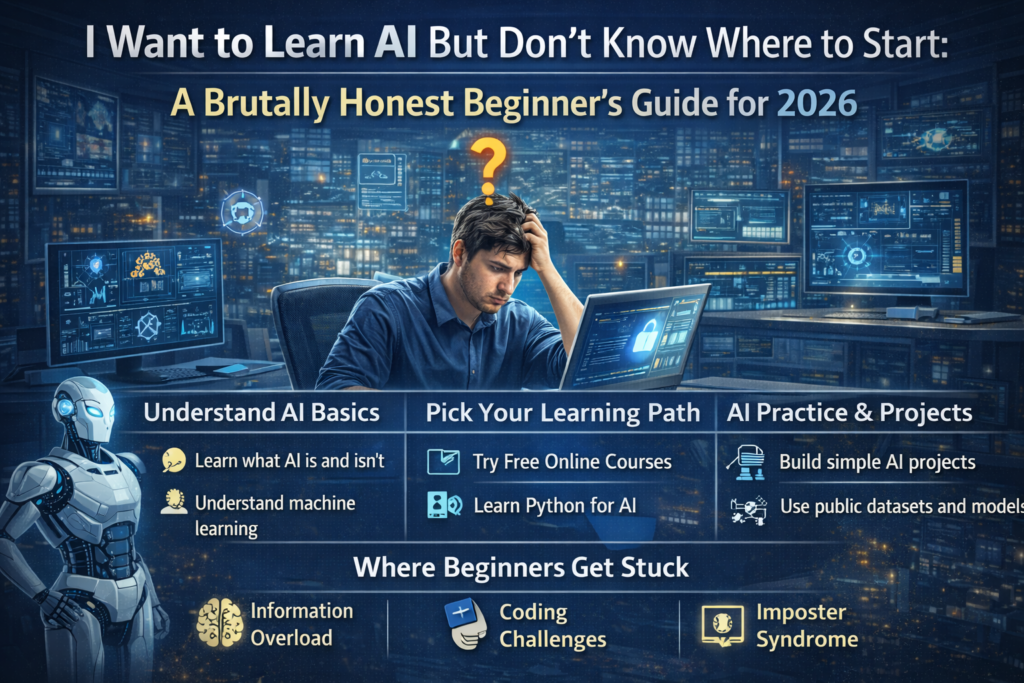
Want to Learn AI But Don’t Know Where to Start: A Brutally Honest Beginner’s Guide for 2026

Why Learning AI Feels So Confusing for Beginners In 2026, Artificial Intelligence is everywhere. You see it in social media, jobs, business tools, and even daily life applications. Naturally, many people feel excited and want to start learning AI. But instead of clarity, most beginners feel overwhelmed. This happens because AI is not a single subject. It is a combination of multiple domains such as data, programming, logic, machine learning, and tools. When beginners search for “how to learn AI,” they are exposed to advanced topics immediately without understanding the foundation. As a result, they feel lost, confused, and often give up before even starting properly. The real problem is not difficulty. The real problem is lack of direction. This guide will remove that confusion and give you a clear, structured, and practical path to start learning AI step by step. What Is AI Actually? (Clear and Practical Understanding) Artificial Intelligence is often misunderstood as something extremely complex or only for experts. But in reality, AI simply refers to systems that can perform tasks that normally require human intelligence. These tasks include understanding language, recognizing patterns, making decisions, and learning from data. However, AI is not one single technology. It is made up of multiple components that work together. Machine Learning allows systems to learn from data. Deep Learning takes this further using advanced neural networks. Natural Language Processing helps machines understand human language. Generative AI enables systems to create content such as text, images, and code. In 2026, the biggest change is that AI has become more accessible. You can now use AI tools without writing complex code. But to build a career, you must understand how AI works behind the scenes, not just how to use tools. Why Most Beginners Fail in AI (Detailed Reality Check) Before you start learning, it is important to understand why many people fail. This will help you avoid common mistakes. The first major mistake is starting without a roadmap. Beginners often jump between videos, courses, and tools without any structured plan. This creates confusion instead of progress. The second mistake is focusing only on tools. Many people use tools like ChatGPT or image generators and believe they are learning AI. But tool usage without understanding concepts leads to shallow knowledge. The third mistake is trying to learn everything at once. AI includes coding, data science, and machine learning. Trying to learn all of these simultaneously overwhelms beginners. The fourth mistake is not practicing. Watching tutorials gives a false sense of learning, but real understanding comes only when you build projects and apply concepts. The key takeaway is simple: 👉 AI is not difficult👉 The wrong approach makes it difficult The Complete AI Learning Roadmap for 2026 (Step-by-Step Detailed Explanation) Now let’s understand the correct way to learn AI in a structured manner. Step 1: Build Strong Thinking and Data Understanding Before touching any AI tool or programming language, you must develop your thinking ability. AI is based on data and logic, so understanding how data works is essential. You need to learn how data is collected, structured, and used to make decisions. This stage helps you build analytical thinking, which is the foundation of AI. Without this step, you may learn tools, but you will not understand their output. Step 2: Start with AI Tools to Understand Practical Usage At this stage, you begin using AI tools such as ChatGPT, Canva AI, or Notion AI. The goal here is not mastery but understanding. You learn how AI behaves, how prompts work, and how outputs are generated. This step is important because it connects theory with real-world application. It helps you understand how AI is actually used in business and daily tasks. Step 3: Learn Basic Programming (Python) Once you understand how AI works at a basic level, you should start learning Python. Python is the most commonly used language in AI because it is simple and powerful. You do not need advanced programming knowledge. Basic concepts such as variables, loops, functions, and data handling are enough to get started. This step allows you to move from using AI tools to building AI-based solutions. Step 4: Understand Machine Learning Concepts After learning basic programming, you move into machine learning. Here, you learn how models are trained using data, how predictions are made, and how different algorithms work. The focus should be on understanding concepts rather than memorizing formulas. You should understand why a model works, not just how to use it. Step 5: Apply AI in Real Scenarios At this stage, you start combining everything you have learned. You use AI to solve real problems such as automating tasks, analyzing data, or improving workflows. This is where your learning becomes practical and valuable. Step 6: Build Projects to Become Job-Ready Projects are the most important part of your learning journey. They help you: Examples include building chatbots, dashboards, or automation systems. Without projects, it is difficult to prove your skills. AI Career Paths (Detailed Explanation for Clarity) AI offers multiple career options, and choosing the right path is important. If you are a beginner, you can start as an AI tools specialist where you use AI tools for productivity and automation. If you are interested in data, you can become a data analyst using AI tools along with platforms like Power BI. If you prefer technical roles, you can become an AI engineer or machine learning engineer, which require coding and deeper understanding. Each path requires different skills, so your choice should depend on your interest and background. How TechnoEdgels Helps You Learn AI Properly Most learners struggle because they lack direction. TechnoEdgels provides a structured learning approach that solves this problem. Instead of random tutorials, you get a clear roadmap from beginner to advanced level. You learn through real-world projects, which helps you gain practical experience. The platform focuses on industry-relevant skills such as AI, data analytics, and cloud computing. This ensures that what you learn is aligned with current job

What Is Agentic AI?
blogs

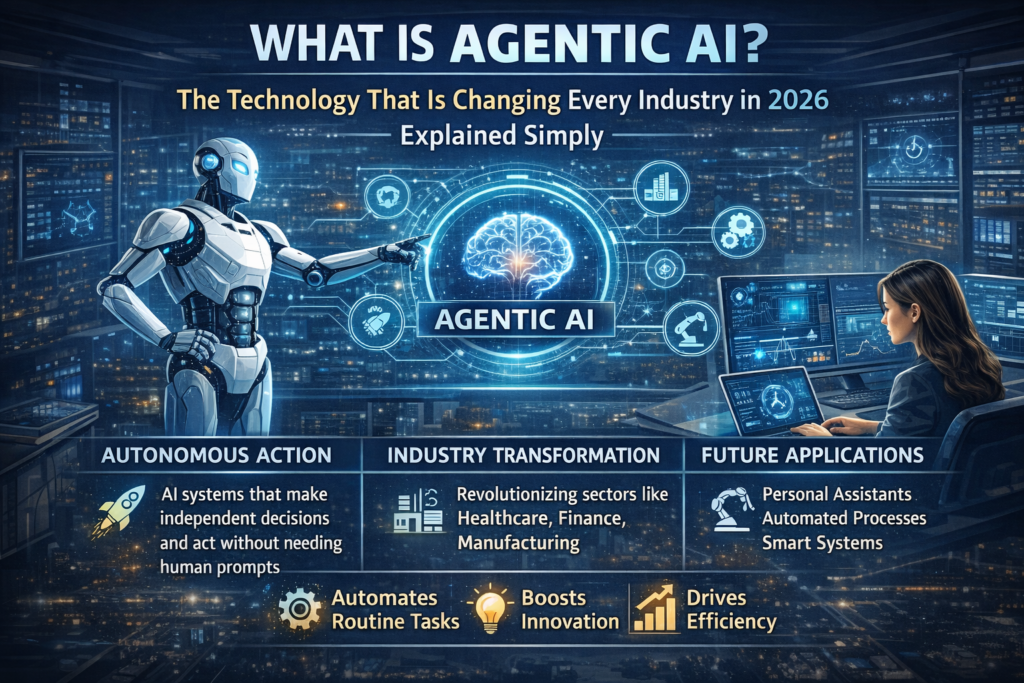
What Is Agentic AI? The Technology That Is Changing Every Industry in 2026  Explained Simply

You Have Been Hearing This Word Everywhere Agentic AI. It is showing up in news articles. Tech conferences. LinkedIn posts. Business meetings. Everyone is talking about it. But most people do not actually know what it means. If you are confused  you are not alone. Most people who use the term “Agentic AI” cannot explain it simply either. They use complicated words that make it sound more mysterious than it actually is. This blog fixes that. By the end of this article, you will understand: No complicated language. No technical jargon without explanation. Just a clear, simple guide that anyone can understand. Let us start from the very beginning. What Is AI? (Starting From Zero) Before we talk about Agentic AI, let us make sure we understand regular AI first. Artificial Intelligence or AI is software that can do things that normally require human thinking. It can read text. Write sentences. Recognize pictures. Answer questions. Translate languages. Predict outcomes. You have probably already used AI many times today without realizing it. When Google suggests what you are searching for  that is AI. When Netflix recommends a show  that is AI. When your email filters spam  that is AI. When you talk to ChatGPT  that is AI. Most of the AI you interact with every day does one thing when you ask it to. You give it an instruction. It does the task. It stops. That is important. Remember it. Because Agentic AI works very differently. So What Is Agentic AI? The Simplest Possible Explanation Here is the simplest way to understand Agentic AI. Regular AI waits for you to tell it what to do next. Agentic AI figures out what to do next by itself. Let us use an example. Imagine you ask regular AI to book you a flight to Delhi. Regular AI says: “Here are some flight options.” Then it stops. It waits for you to choose. Then it waits for you to enter your card details. Then it waits for you to confirm. You are doing most of the work. Now imagine you ask Agentic AI to book you a flight to Delhi. Agentic AI does not just show you options. It checks your calendar to find the best dates. It searches multiple booking sites to find the cheapest price. It checks your preferred seat preferences. It fills in your payment details. It confirms the booking. It adds the trip to your calendar. It sends you a confirmation. You asked once. It handled everything. That is Agentic AI. It does not just answer. It acts. It makes decisions. It takes steps. It completes goals not just tasks. The Three Things That Make AI “Agentic” Not all AI is agentic. For AI to be called agentic, it needs to have three specific abilities. Ability 1 — It Can Make Decisions Regular AI answers questions. Agentic AI makes choices. It can look at a situation, evaluate the options available, and decide which one is best  without you telling it what to choose. Ability 2 — It Can Take Action Regular AI gives you information. Agentic AI does things with that information. It can send emails. Book appointments. Run code. Search the internet. Fill forms. Update databases. Make purchases. It connects to the real world and acts in it. Ability 3 — It Can Work Toward a Long-Term Goal Regular AI does one thing at a time. Agentic AI can work through a series of steps to achieve a bigger goal. You might give it a goal like “plan our company’s product launch.” It then breaks that goal into dozens of smaller tasks, works through each one, handles problems when they appear, and keeps going until the goal is complete. It does not need you to manage each step. It manages itself. Agentic AI vs Generative AI  What Is the Difference? You have probably heard of Generative AI. That is tools like ChatGPT, Gemini, Claude, and Copilot. Generative AI is amazing at creating content. It writes articles. Generates images. Answers questions. Summarizes documents. Writes code. But it only does what you ask  one thing at a time. Agentic AI goes further. Think of it this way. Generative AI is like a brilliant assistant sitting at a desk. You walk over and ask them a question. They answer brilliantly. Then they sit and wait for your next question. Agentic AI is like that same brilliant assistant  but now they have their own phone, their own computer, and their own to-do list. You give them a project. They go away and work on it. They call people. They search things. They write documents. They make decisions. They come back to you when the project is done. Same intelligence. Very different level of independence and action. A Simple Real-Life Example of Agentic AI at Work Let us make this even more concrete. Imagine you run a small business. You want to find new customers. With regular AI, you might ask it to write an email to send to potential customers. It writes the email. You copy it. You send it yourself. You track responses yourself. You follow up yourself. With Agentic AI, you say: “Find potential customers in the manufacturing sector in Pune and send them an introduction about our services.” The agent then: You gave one instruction. The agent handled 7 steps. That is Agentic AI in action. Why Is Agentic AI Such a Big Deal in 2026? Agentic AI is not just another tech trend. It is a fundamental change in what computers can do for people. Here is why it matters so much right now. Before Agentic AI: Computers were powerful but passive. They did exactly what you told them. You had to manage every step. With Agentic AI: Computers become active. They take initiative. They handle complexity. They work toward goals. This shift changes how work gets done. Tasks that used to take a team of people hours can now be done by an AI agent in minutes.

Trust Us, One Call Can Make a Difference
Please enable JavaScript in your browser to complete this form.
Join As Trainer
Join As Trainer
Please enable JavaScript in your browser to complete this form.
Download Course Content
Please enable JavaScript in your browser to complete this form.
More than 5 People are attending Get On a Call with Us
Please enable JavaScript in your browser to complete this form.
More than 5 People are attending Get On a Call with Us
Scroll to Top