

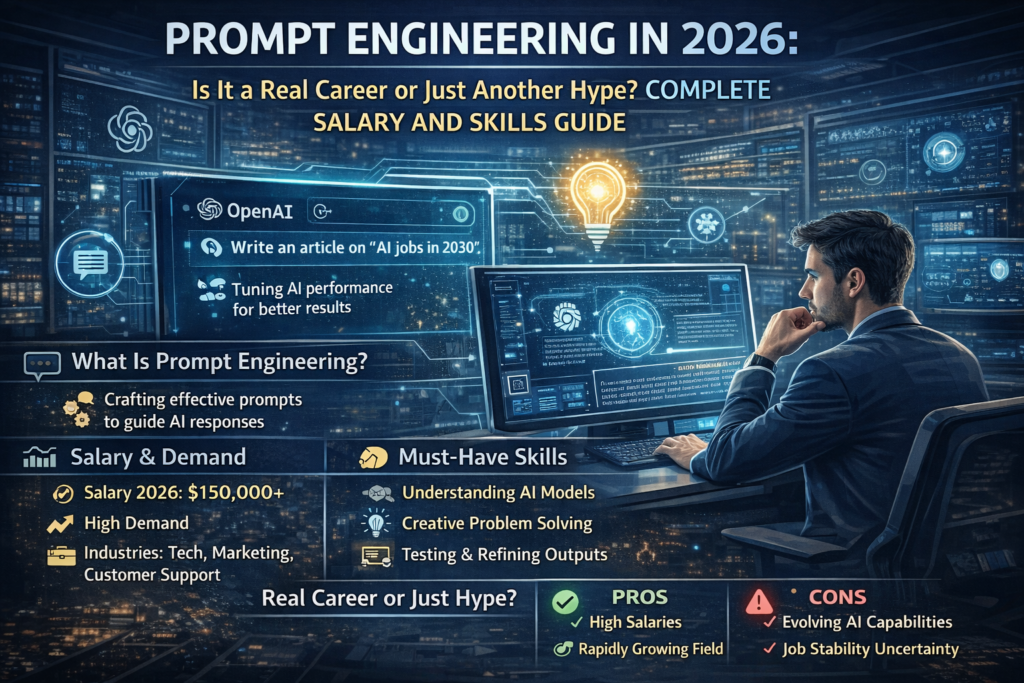
Prompt Engineering in 2026: Is It a Real Career or Just Another Hype?
The Sudden Rise of Prompt Engineering and the Confusion Around It Over the past few years, Artificial Intelligence has moved from being a niche technology to becoming a mainstream tool used across industries. With this shift, a new term has gained massive attention Prompt Engineering. You may have seen people claiming that prompt engineers are earning high salaries, working with tools like ChatGPT, and building careers without needing deep technical skills. This has created a wave of excitement, especially among beginners who are looking for quick entry into the AI field. However, along with this excitement, there is also a significant amount of confusion. Many people are asking: The reality is more nuanced than what social media suggests. Prompt engineering is neither a magic shortcut to high-paying jobs nor a useless trend. It is something in between a valuable skill that plays an important role inside larger AI-driven job roles. To understand this properly, we need to go deeper into what prompt engineering actually is and how it is being used in real companies. What Is Prompt Engineering? (Deep and Practical Explanation) Prompt engineering is the practice of designing and structuring inputs given to AI systems in a way that produces accurate, relevant, and high-quality outputs. At a surface level, it may seem like simply asking questions to an AI tool. But in reality, it involves much more than that. A well-designed prompt includes: For example, asking an AI tool “Explain AI” will give a generic answer. But asking: “Explain AI in simple terms for beginners with real-life examples and use cases in business” will produce a much more useful result. This difference is the result of prompt engineering. In professional environments, prompt engineering is used to: This makes it an important skill in AI workflows. However, prompt engineering is not just about writing better sentences. It also involves understanding how AI models interpret language, how context affects output, and how to design structured interactions. Why Prompt Engineering Became So Popular So Quickly The rapid growth of prompt engineering is directly linked to the rise of generative AI tools. When tools like ChatGPT, Claude, and Gemini became widely available, millions of users started interacting with AI systems without formal training. This created a noticeable gap in results. Some users were getting average outputs, while others were achieving highly accurate and useful results. The difference was not the tool it was the way they were using it. Companies quickly realized that: The effectiveness of AI depends heavily on how it is used. This realization made prompt engineering an important skill in areas such as: As businesses started integrating AI into their workflows, they needed people who could interact with these systems effectively. This is why prompt engineering gained attention so rapidly. Is Prompt Engineering a Real Career in 2026? This is the most important question, and it requires a clear and honest answer. Prompt engineering is not a standalone long-term career for most people. But it is also not just hype. To understand this properly, we need to look at how companies are actually hiring. Organizations are not typically creating roles where the only responsibility is writing prompts. Instead, they are hiring professionals for roles such as: In all these roles, prompt engineering is used as a supporting skill. For example, a data analyst may use prompts to analyze data faster. A marketer may use prompts to generate campaigns. A developer may use prompts to generate code. This means: Prompt engineering is embedded within real jobs, not separate from them. The Real Industry Insight But by itself, it is usually not enough to define a full career. Where Prompt Engineering Is Actually Used in Real Work Environments To understand its true value, it is important to see where it is applied in real-world scenarios. In content and marketing, prompt engineering helps professionals generate high-quality content quickly while maintaining consistency and relevance. In data analysis, it allows analysts to extract insights, summarize reports, and automate repetitive tasks using AI tools. In customer support, it is used to design chatbot responses that are accurate and helpful. In software development, developers use prompts to generate code, debug issues, and accelerate development processes. In business operations, prompt engineering is used to automate workflows and improve decision-making processes. This shows that prompt engineering is not a separate job role but a core capability used across multiple professions. Skills Required to Master Prompt Engineering To become effective in prompt engineering, you need a combination of skills. Understanding AI behavior is essential because you need to know how AI interprets instructions and generates responses. Logical thinking is important because prompt design requires structured and step-by-step reasoning. Communication skills play a critical role because clarity in language directly affects output quality. Domain knowledge is also important because prompts must be aligned with the specific problem you are trying to solve. Finally, familiarity with AI tools such as ChatGPT, Claude, and Gemini is necessary to apply your knowledge in real scenarios. These skills together make prompt engineering effective and valuable. Salary and Demand: What You Should Realistically Expect in 2026 One of the biggest misconceptions is that prompt engineering alone leads to high salaries. In reality, salaries are determined by your overall role and skill set. For example: Prompt engineering contributes to these roles but does not define them entirely. This means: Your earning potential depends on how you combine prompt engineering with other skills. Future of Prompt Engineering: What Will Change in the Next Few Years As AI tools become more advanced, prompt engineering will evolve. It will likely become a basic skill, similar to how using search engines or spreadsheets became essential skills over time. In the future: However, advanced prompt design and AI workflow integration will remain valuable for professionals who want to stand out. How TechnoEdgels Helps You Build a Real AI Career Many learners get trapped in trends and hype, focusing only on surface-level skills. TechnoEdgels takes a different approach. Instead of teaching only