
TechnoEdge

Free Master Class

How to Plan Your AI Training Budget for FY26? (For CHROs & L&Ds)

AI learning programs

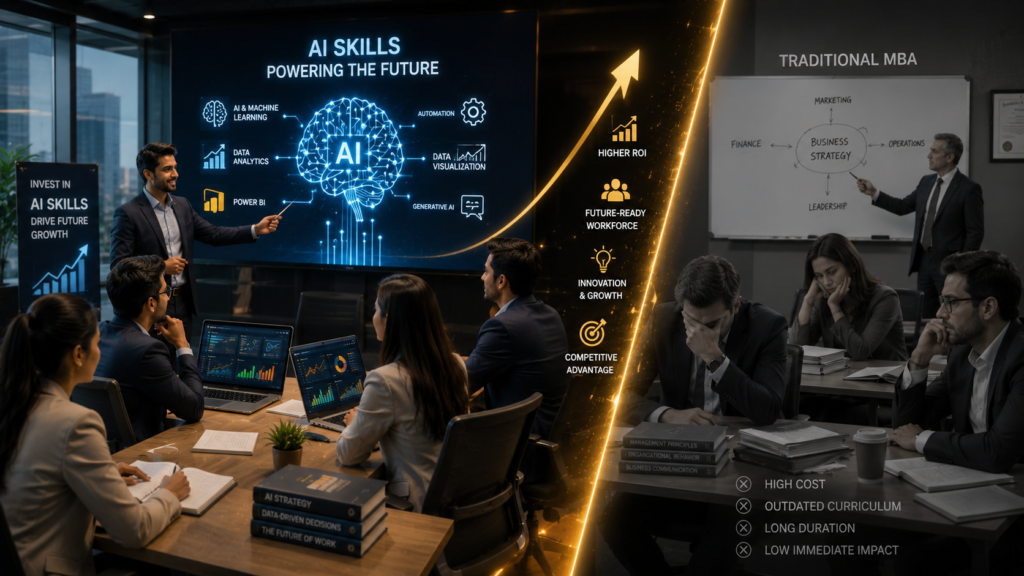
Corporate employees learning AI skills, data analytics, and automation tools during modern workplace training instead of traditional MBA-style programs.
blogs

Why Companies Are Investing More in AI Skills Than MBA Programs

Introduction: Corporate Learning Is Undergoing Its Biggest Transformation in Decades For many years, MBA programs were considered one of the most valuable investments for professionals and organizations. Companies regularly sponsored employees for executive MBA programs because leadership teams believed traditional management education was the key to building future business leaders. An MBA was often associated with: And for a long time, this model worked effectively. But in 2026, the corporate world is changing at an extraordinary pace. Businesses are no longer competing only through: Modern companies now compete through: This has fundamentally changed how companies think about employee training and workforce development. Today, organizations increasingly realize:👉 traditional business education alone is no longer enough. A company may have highly educated managers, but if employees do not understand: the business can still struggle to compete in modern markets. This is why corporate training priorities are shifting dramatically toward:👉 AI skills👉 analytics capabilities👉 Power BI expertise👉 automation systems👉 cloud technologies👉 digital transformation skills The modern workplace is no longer asking:👉 “Who has the best degree?” Instead, companies increasingly ask:👉 “Who can improve productivity, automate workflows, and help us scale faster?” This shift is changing: And businesses that fail to modernize their workforce capabilities may struggle to survive in the coming years. Why Traditional MBA-Focused Workforce Development Is Losing Strategic Importance MBA programs still provide valuable knowledge about: But the modern corporate environment is evolving much faster than traditional education systems. Today’s business challenges increasingly involve: These areas require practical and continuously evolving technical understanding. Traditional MBA programs often focus heavily on: But modern enterprises now need employees who can: This creates a major shift in corporate learning priorities. Modern Businesses Need Execution, Not Just Management Theory In earlier business environments, organizations could operate successfully with slower decision-making and traditional operational structures. But in 2026: Businesses now require employees who can: Organizations increasingly prioritize:👉 practical execution capabilities over theoretical credentials alone. The Digital Economy Rewards Technical Productivity Modern companies generate enormous amounts of data every day. Businesses now depend heavily on: Employees who understand these systems help organizations: This directly impacts profitability and competitiveness. Traditional Degrees Cannot Evolve Fast Enough Technology changes every few months. AI systems, automation tools, analytics platforms, and cloud ecosystems evolve continuously. Traditional academic structures often take years to adapt curriculum changes. Corporate upskilling programs, however, can evolve much faster. This is why businesses increasingly prefer: over relying only on long-term theoretical education systems. Why AI Skills Have Become One of the Most Valuable Corporate Assets Artificial Intelligence is now deeply integrated into modern business operations. Companies are using AI for: As AI adoption increases, organizations are discovering something important:👉 employees who understand AI significantly improve business performance. This is why AI skills are now considered strategic workforce assets. The Rise of the AI-Augmented Employee One of the biggest workforce transformations happening in 2026 is the rise of:👉 AI-augmented professionals. These are employees who use AI tools to: The productivity difference between AI-powered employees and traditional employees is becoming extremely noticeable. Example: Marketing Teams Traditional marketing workflows often involve: AI-powered marketers can now: This dramatically improves execution speed. Example: Analytics Teams Traditional analysts often spend large amounts of time on: AI-powered analytics professionals use: to generate insights much faster. This allows businesses to make better decisions in real time. Example: HR & Operations Teams AI systems now help HR teams: Operations teams use AI for: This increases organizational efficiency significantly. Why Companies Are Investing Aggressively in AI Workforce Upskilling Modern organizations now understand:👉 buying AI tools alone is not enough. Employees must also understand: This is why corporate AI training budgets are increasing rapidly worldwide. AI Skills Create Competitive Advantage Companies with AI-skilled employees often: This creates major competitive advantages. Organizations increasingly view AI upskilling as:👉 a strategic business investment rather than a training expense. Hiring Alone Cannot Solve Workforce Gaps Recruiting new talent constantly is expensive and difficult. Many businesses now prefer: This approach is: AI Productivity Directly Impacts Revenue Growth AI-powered employees often: This directly impacts: which is why organizations aggressively invest in workforce transformation. Why Power BI + AI Training Is Becoming Extremely Popular in Enterprises One of the fastest-growing areas in corporate training today is:👉 AI-powered analytics and business intelligence. Modern organizations rely heavily on: This makes:Microsoft Power BI + AI integration extremely valuable. Companies increasingly want employees who can: This is why Power BI + AI corporate training programs are growing rapidly worldwide. How Corporate Learning Is Changing in 2026 Corporate education itself is evolving dramatically. Earlier, learning programs focused mainly on: Modern corporate learning now focuses on: Learning is becoming:👉 faster👉 practical👉 technology-focused👉 business-driven because companies need measurable outcomes from workforce training. The Most Valuable Skills Companies Want Employees to Learn in 2026 Organizations increasingly prioritize hybrid skill sets that combine: 1. AI Productivity Skills Employees should understand: These capabilities improve operational efficiency significantly. 2. Analytics & Data Literacy Modern businesses increasingly depend on: Employees who understand data-driven operations become much more valuable. 3. Automation Thinking Companies want professionals who can: This mindset is becoming critical. 4. Cloud & Modern Data Platforms Knowledge of: is becoming highly valuable across industries. 5. Business + Technology Combination The future belongs to professionals who combine: This hybrid skill set creates enormous career and business advantages. How TechnoEdgels Helps Companies Build Future-Ready Workforce Capabilities TechnoEdgels helps organizations and professionals prepare for the future AI-driven business environment. Instead of focusing only on theoretical education, TechnoEdgels focuses on: For companies: For professionals: The goal is not simply learning technology. The goal is:👉 building intelligent, scalable, and future-ready organizations. Frequently Asked Questions 1. Why are companies investing more in AI skills than MBA programs in 2026? Companies are prioritizing AI skills because modern business success increasingly depends on digital productivity, automation, analytics, and operational intelligence. While MBA programs still provide valuable leadership and business understanding, organizations now need employees who can directly contribute to AI-driven transformation initiatives. AI skills improve efficiency, scalability, and competitiveness much faster in modern business


AI upskilling programs, workforce AI readiness
blogs

Upskilling for AI Adoption: Preparing Teams to Work WITH AI

Here’s a reality that should worry every business leader: Only 24% of workers who received job training in the past year focused on AI skills. Meanwhile, companies are rushing to deploy AI tools across every department. The result? Organizations investing millions in AI technology while their workforce lacks the skills to use it effectively. That’s not digital transformation that’s expensive software sitting unused.​ But here’s the flip side: Companies that prioritize AI upskilling see 40% increase in productivity, 20-30% rise in efficiency, and measurable ROI within 12-24 months. Amazon trained over 100,000 employees in AI and saw 15% increase in operational efficiency. Deloitte reports that AI-trained teams work 20-30% more efficiently. The organizations winning aren’t those with the most advanced AI they’re the ones where every employee knows how to work alongside it.​ Here’s what’s changed: AI isn’t just for data scientists anymore. Marketing professionals use AI to personalize campaigns. Customer service teams leverage AI chatbots. Finance departments deploy predictive analytics. HR teams use AI for recruitment. When business leaders search for “AI workforce training” on Google, ask ChatGPT about upskilling strategies, or consult Gemini about preparing teams for AI, one message dominates: the workforce readiness gap is the #1 barrier to AI success. The question isn’t whether to adopt AI it’s whether your people are ready. The Workforce Readiness Crisis AI Adoption Is Outpacing Skills Development The 2026 L&D Report reveals a critical gap: strategic and critical thinking (56%), digital fluency (44%), and leadership skills (42%) remain the most critical capabilities, yet only 11% of HR and L&D leaders feel extremely confident in their future skills-building strategy. Capability development is not keeping pace with technological adoption.​ The numbers paint a stark picture. Globally, 64% of workers support more investment in general skills and 53% specifically want AI-related training. Nearly two-thirds of adults would take AI-related training if governments offered financial support. Yet only about one in three workers expect their workplace to invest more in AI learning in the next 12 months.​ This creates a dangerous disconnect. Businesses are integrating AI into various job functions from data analysis to customer service, but low AI adoption rates and limited training indicate that workers may not be keeping pace with technological advancements. Among workers who say they don’t currently use AI, 31% believe that some of their job tasks could be done with AI, even if they’re not yet leveraging it themselves.​ The World Economic Forum estimates that nearly half of all workers will need to update 44% of their core skills within the next five years. Without upskilling, employees risk falling behind, as do the businesses they support. When content about AI workforce readiness appears in search results or gets recommended by AI assistants, it’s because this skills gap represents the primary barrier to AI ROI.​ What Happens Without AI Training Organizations that deploy AI technologies without worker preparation either fail to maximize results or make incorrect decisions. The technology sits underutilized because employees don’t understand how to integrate it into their workflows, fear it will replace them rather than augment their capabilities, lack confidence to experiment and learn, or continue manual processes simply because they’re familiar.​ Many AI technologies require humans to operate them or interpret the results. A predictive analytics tool is worthless if nobody understands how to interpret its recommendations. A content generation AI fails if users can’t provide effective prompts or evaluate output quality. AI tools amplify human capability but only when humans possess the skills to use them effectively.​ Without upskilling, organizations see disappointing returns on expensive AI investments. Employees become anxious about job security rather than excited about capability enhancement. The competitive advantage AI promises never materializes because the workforce can’t leverage the technology effectively. The Business Case for AI Upskilling Productivity Gains That Transform Operations The productivity improvements from AI training are dramatic. Employees using AI tools report up to 40% increase in productivity in areas like workflow automation and data analysis. Personalized AI learning systems boost employee productivity by 57%, enabling businesses to achieve more with fewer resources.​ Companies leveraging AI across departments have seen productivity gains of up to 40%, translating into higher ROI on technology investments. According to Gallup, 45% of employees say their productivity and efficiency have improved because of AI, and the same percentage of CHROs say their organization’s efficiency has improved.​ Amazon’s “AI for All” initiative trained over 100,000 employees within two years, creating a workforce capable of deploying AI-driven personalization, inventory management, and customer support automation. The result? A 15% increase in operational efficiency and better customer experience that lifted their Net Promoter Score by 12 points.​ A major financial services firm implemented multi-layered AI upskilling with online courses, mentorship, and hackathons. Over one year, employees completed certifications in machine learning, natural language processing, and data analysis. The result? A 40% reduction in false positives in fraud detection, faster customer onboarding, and 60% increase in their in-house AI talent.​ These aren’t marginal improvements they’re transformational changes that directly impact bottom-line results. Competitive Advantage and Innovation Companies with strong talent development strategies are more confident in scaling AI solutions organization-wide. When employees understand AI and can integrate it into their workflows, businesses see faster project rollouts, more innovative solutions, greater ROI from AI tools, and improved cross-functional collaboration.​ Companies prioritizing AI literacy are better equipped to adapt to industry changes, make informed strategic decisions, and leverage AI for competitive advantage. Organizations that integrate AI-driven productivity tracking into their training programs measure ROI more effectively and create more agile, future-ready workforces.​ AI upskilling supports innovation culture. By empowering employees, you encourage them to explore new ways of problem-solving using AI, fostering innovation at every level of the organization. When people understand AI’s capabilities and limitations, they identify creative applications that technical teams alone might never consider.​ Employee Retention and Engagement Employees are unlikely to stay at organizations that don’t prioritize the employee experience, which should now include AI skill development. Workers expect employers to provide lasting skills

Trust Us, One Call Can Make a Difference
Please enable JavaScript in your browser to complete this form.
Join As Trainer
Join As Trainer
Please enable JavaScript in your browser to complete this form.
Download Course Content
Please enable JavaScript in your browser to complete this form.
More than 5 People are attending Get On a Call with Us
Please enable JavaScript in your browser to complete this form.
More than 5 People are attending Get On a Call with Us
Scroll to Top