
TechnoEdge

Free Master Class

How to Plan Your AI Training Budget for FY26? (For CHROs & L&Ds)

AI literacy

AI readiness skills matrix showing data literacy, AI tool usage, analytics, and AI ethics proficiency levels for HR and business teams.
blogs

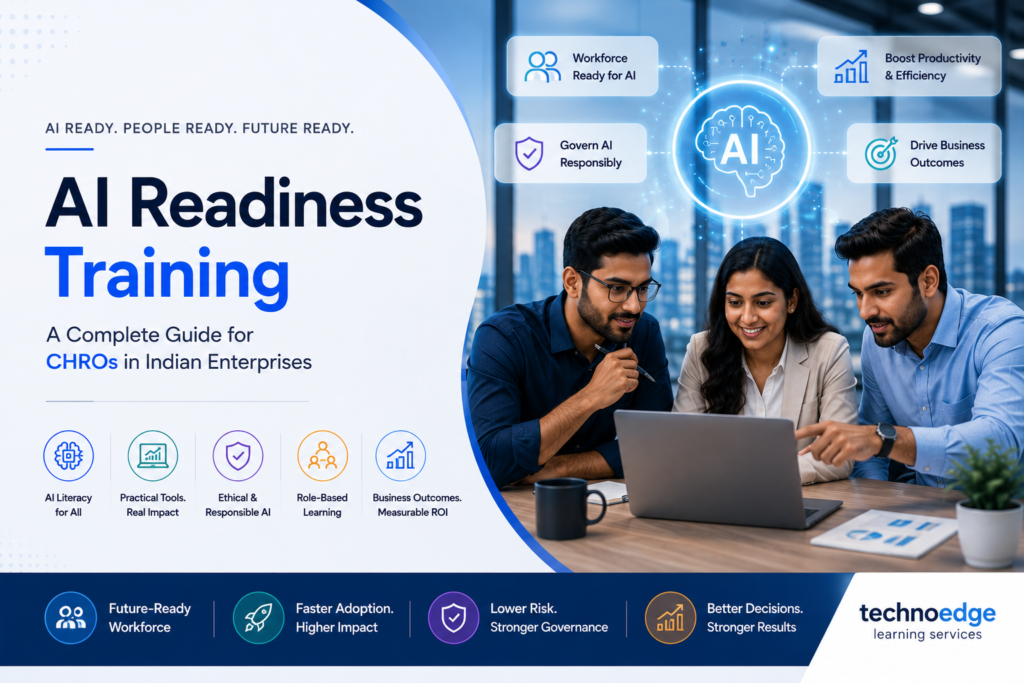
What Is AI Readiness Training? A Complete Guide for CHROs in Indian Enterprises

Indian enterprises are investing heavily in AI pilots, proof-of-concepts, and genAI experiments, but many are discovering that technology is not the bottleneck—workforce readiness is. Teams lack the skills to use AI tools effectively, managers don’t know how to integrate AI into workflows, and leaders are unsure how to govern AI responsibly. This is where AI readiness training becomes critical. For CHROs, it is the foundation for ensuring that AI investments translate into productivity gains, not just experiments. Effective programmes combine AI tools training for workforce with practical use cases, ethical guidance, and change management that enables department-specific adoption. At Technoedge, we design AI readiness frameworks for Indian enterprises that go beyond awareness to build practical, role-based capability across HR, sales, L&D, operations, and other functions. AI readiness training explained in business terms AI readiness training is the structured process of preparing your workforce to use AI tools effectively, safely, and responsibly in their daily work. It is not about turning everyone into data scientists; it is about ensuring that employees at all levels can: In business terms, AI readiness training is about: What usually goes wrong: What good looks like: This is the foundation of practical AI tools training for workforce programmes. Why AI readiness training matters before enterprise AI adoption Organisations often rush into AI adoption without preparing their workforce, leading to poor adoption, misuse, or outright failure of AI initiatives. AI readiness training matters before enterprise AI adoption because it: Builds foundational literacy Reduces fear and resistance Enables responsible use Accelerates productivity gains Supports change management Without AI readiness training, even the best AI tools can fail due to poor adoption or misuse. The five pillars of AI readiness training A comprehensive AI readiness programme should cover five core pillars. 1. AI literacy and awareness 2. Practical AI tools skills 3. Function-specific use cases 4. Ethics, privacy, and compliance 5. Change management and adoption These pillars ensure AI readiness training is comprehensive, not superficial. AI tools training for workforce across business functions Different functions use AI tools differently, so AI tools training for workforce should be tailored by department. HR teams Sales teams Marketing teams Operations teams Finance teams L&D teams Technology teams Function-specific training ensures that AI tools training for workforce is relevant and immediately applicable. ChatGPT training for teams as part of AI readiness ChatGPT training for teams is often the entry point for AI readiness because it is accessible, versatile, and widely adopted. However, it should be positioned as part of a broader AI readiness strategy, not the entire programme. What ChatGPT training should cover Common mistakes in ChatGPT training What good looks like ChatGPT training for teams is most effective when it is practical, use-case driven, and part of a larger AI readiness programme. A phased model for AI readiness training in Indian enterprises A phased approach helps organisations build AI readiness systematically without overwhelming teams. Phase 1: Awareness and literacy (Weeks 1–4) Goal: Build foundational understanding across the organisation. Phase 2: Role-based skills (Weeks 5–12) Goal: Build practical skills relevant to each role. Phase 3: Integration and adoption (Weeks 13–24) Goal: Embed AI into daily work and measure outcomes. Phase 4: Scale and optimise (Week 25 onwards) Goal: Scale AI capability and drive continuous improvement. This phased model ensures AI readiness training is sustainable and measurable. How Technoedge helps with AI readiness frameworks, AI tools training for workforce, ChatGPT training for teams, change enablement, and department-specific adoption support At Technoedge, AI readiness training is designed for enterprise leaders who need practical workforce readiness, not just awareness. Our approach includes: 1. AI readiness frameworks 2. AI tools training for workforce 3. ChatGPT training for teams 4. Change enablement 5. Department-specific adoption support This ensures that AI readiness training translates into real workforce capability. FAQs 1. AI readiness training: what does AI readiness training include for Indian enterprises? AI readiness training includes AI literacy and awareness, practical AI tools skills, function-specific use cases, ethics and compliance guidance, and change management. It should be role-based, use-case driven, and aligned to business goals. For Indian enterprises, this often includes AI tools training for workforce across HR, sales, operations, and other functions, plus ChatGPT training for teams as an entry point. 2. AI tools training for workforce: how does workforce AI readiness improve enterprise adoption? Workforce AI readiness improves enterprise adoption by reducing fear and resistance, building practical skills for daily work, ensuring responsible use, and accelerating time-to-value for AI investments. Ready teams adopt AI faster and use it more effectively. This leads to better productivity gains and higher ROI on AI tools. 3. ChatGPT training for teams: how does ChatGPT training fit into AI readiness training? ChatGPT training is often the entry point for AI readiness because it is accessible and versatile. It teaches prompt engineering, practical use cases, output evaluation, and security guidelines. However, it should be part of a broader AI readiness programme that includes other AI tools and function-specific use cases. 4. AI readiness training: which employee groups should be included first? Employee groups that should be included first are those with the highest AI potential: HR, sales, marketing, L&D, and operations. Leaders and change champions should also be trained early to support adoption. Technology teams can be trained separately on more advanced AI capabilities. 5. AI tools training for workforce: how to design AI readiness programs for HR, sales, L&D, and operations? Design AI readiness programs by identifying function-specific use cases for each department, creating role-based training paths, providing hands-on workshops with real work tasks, and measuring adoption and impact over time. Training should be practical, use-case driven, and tied to business outcomes. Connect with us For CHROs and L&D leaders exploring AI readiness training, the goal is usually not just AI awareness but practical workforce readiness. Technoedge can help shape that transition through structured learning journeys, department-specific use cases, and training that connects AI tools with real work outcomes. To explore how this can work for your context, you can connect with Technoedge at: https://technoedgelearning.com
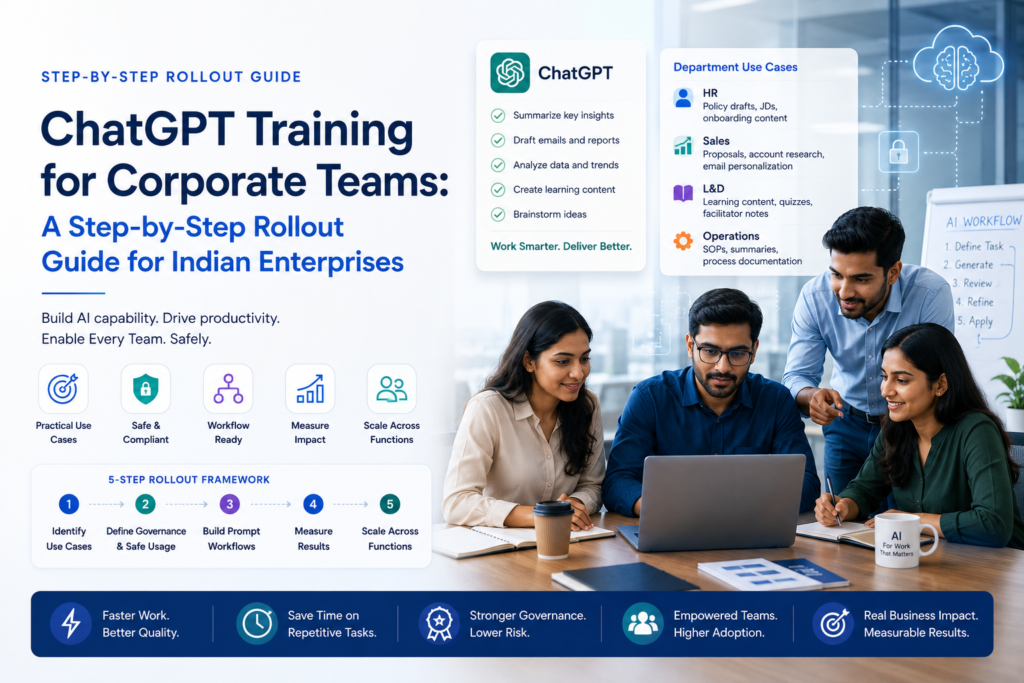

Corporate team planning a ChatGPT training rollout for an Indian enterprise.
blogs

ChatGPT Training for Corporate Teams: A Step-by-Step Rollout Guide for Indian Enterprises

Indian enterprises are moving past the “should we use AI?” stage and into the harder question: how do we use it safely, consistently, and with measurable business value? That is why chatgpt training for teams has become a practical capability-building priority, not just a technology experiment. For HR, L&D, sales, operations, and support teams, the real challenge is not access to AI tools. It is turning those tools into repeatable workflows that improve speed, quality, and decision-making without creating privacy, compliance, or quality risks. That is where structured ai tools training for workforce becomes essential. Why chatgpt training for teams matters in 2026 In 2026, AI is no longer a side topic in corporate learning. It is becoming part of everyday work across writing, analysis, ideation, summarization, and internal communication. Teams that know how to use ChatGPT well can move faster, but only if they understand where it helps, where it fails, and how to use it responsibly. For Indian enterprises, this matters even more because use cases are often distributed across functions. A sales team may need proposal support, an L&D team may need content drafts, HR may need policy communication assistance, and operations may need process documentation. Without structured training, employees tend to use AI inconsistently, which reduces output quality and increases risk. The strongest training programmes focus on practical use, not abstract AI theory. They help people learn how to ask better questions, review outputs critically, and apply the tool to real work. Common mistakes in ai tools training for workforce Many enterprises begin AI training with excitement but no rollout discipline. The result is usually awareness without adoption, or experimentation without control. Common mistakes include: Another common issue is overestimating what employees can safely do on day one. If teams are not shown clear boundaries, they may paste sensitive information into public tools or rely too heavily on generated outputs without review. Good training reduces this risk by making safe use part of the learning design. Step 1: identify department-specific AI use cases The first rollout step is to identify where ChatGPT can create the most value in each function. A single enterprise-wide use case list is usually too broad to drive adoption. Start by asking each department where time is spent on repetitive, text-heavy, or research-supported work. For example: The goal is not to automate everything. The goal is to find the tasks where AI can save time, improve consistency, or help teams start faster. Step 2: define governance, data privacy, and acceptable usage Once use cases are clear, governance must come next. Enterprises need rules for what employees can and cannot enter into AI tools, how outputs should be reviewed, and where human approval is mandatory. A practical governance framework should cover: This is especially important in regulated sectors and in organisations handling customer, employee, financial, or proprietary data. Training should not just explain policy in theory; it should show employees how the policy affects day-to-day work. Step 3: build prompt workflows for HR, sales, L&D, and operations Prompting works best when it is connected to a workflow, not treated as a standalone skill. Employees should learn prompt patterns that map to their actual tasks, review steps, and expected output formats. For HR, a prompt workflow may include drafting, refinement, and compliance review. For sales, it may include research, personalization, proposal structure, and final human editing. For L&D, the workflow may include content creation, simplification, knowledge checks, and learner-level adaptation. A useful training approach is to create: This makes training more practical and easier to retain because people learn by doing work they already recognise. Step 4: measure productivity and output quality If the enterprise cannot measure results, AI training will remain a feel-good initiative. Measurement should look at both productivity and quality, because speed alone can create poor outputs. Useful metrics include: It also helps to compare outputs before and after training on real business tasks. For example, measure how long it takes to create a client email, a training outline, or an internal memo before the rollout and after employees begin using ChatGPT with a workflow. Step 5: scale chatgpt training for teams across business functions Scaling should happen after pilot groups prove value and governance is stable. The best programmes begin with a few functions, refine the content, and then expand into other teams. A scalable rollout usually includes: This is also where leadership support matters. When managers show what good AI-assisted work looks like, adoption becomes much stronger than when training is left only to the L&D team. How Technoedge helps with AI readiness, use-case-based ChatGPT training, workflow-oriented prompting, safe adoption practices, and business team enablement Technoedge helps enterprises move from AI awareness to structured adoption. That starts with identifying the highest-value use cases by function, so training is relevant to the work teams actually do. From there, we design learning journeys that combine practical prompting, governance awareness, and workflow application. We also support safe adoption by helping organisations define boundaries, review practices, and department-level use scenarios that reduce risk. Our delivery approach focuses on business enablement, not just skill transfer. That means teams learn how to use ChatGPT in ways that improve speed, quality, and consistency in daily work. For enterprises exploring chatgpt training for teams, the biggest challenge is usually turning generic AI enthusiasm into safe, useful workflows. Technoedge can help shape that journey through role-specific training, practical prompts, and adoption frameworks that support everyday work without adding complexity. FAQs 1. ChatGPT training for teams: what should be included in a corporate rollout plan? A corporate rollout plan should include use-case discovery, governance rules, department-wise learning paths, prompt practice, and measurement. It should also include leadership alignment so the training is seen as a business capability initiative rather than a one-time workshop. The rollout plan works best when it balances speed and control. That means employees get enough freedom to explore value, but also enough structure to protect data, quality, and compliance. 2. AI tools training for workforce: which departments benefit

Trust Us, One Call Can Make a Difference
Please enable JavaScript in your browser to complete this form.
Join As Trainer
Join As Trainer
Please enable JavaScript in your browser to complete this form.
Download Course Content
Please enable JavaScript in your browser to complete this form.
More than 5 People are attending Get On a Call with Us
Please enable JavaScript in your browser to complete this form.
More than 5 People are attending Get On a Call with Us
Scroll to Top