

TechnoEdge

Free Master Class

How to Plan Your AI Training Budget for FY26? (For CHROs & L&Ds)

AI-ready Data Infrastructure

Comparison of traditional data warehouse and Microsoft Fabric lakehouse architecture showing OneLake storage, unified analytics platform, AI integration, and scalable cloud infrastructure.
blogs

How Enterprises Are Using Microsoft Fabric to Replace Traditional Data Warehouses in 2026

Introduction: The End of Traditional Data Warehouse Dominance? For more than two decades, traditional data warehouses were the backbone of enterprise analytics. Organizations invested heavily in on-premise servers, structured ETL pipelines, centralized databases, and rigid reporting systems. These systems were powerful, stable, and predictable. However, the business environment of 2026 is very different from the early 2000s. Data volumes have exploded. Companies now deal with structured data, semi-structured data, streaming data, and AI-generated insights. The speed of decision-making has increased dramatically. Organizations need scalable, flexible, and AI-ready systems. Traditional data warehouses were not designed for this level of agility. This is where Microsoft Fabric enters the picture. Enterprises are not simply upgrading tools. They are rethinking their entire analytics architecture. Microsoft Fabric is becoming a replacement for traditional warehouse models because it offers integration, scalability, AI capability, and cost optimization within a unified ecosystem. This article explains in full depth: Understanding Traditional Data Warehouses: Strengths and Limitations Traditional data warehouses were built for structured, predictable environments. They store cleaned and transformed data in relational tables. They rely heavily on predefined schemas and structured ETL processes. Data must be transformed before it is stored. This approach works well when: However, modern enterprises face challenges that traditional warehouses struggle to handle efficiently. Unstructured data such as logs, images, streaming feeds, and AI outputs do not fit easily into rigid schemas. Scaling infrastructure requires expensive hardware or complex cloud migrations. Real-time analytics often requires additional tools layered on top of the warehouse. The architecture becomes fragmented and costly. What Microsoft Fabric Changes at the Architectural Level Microsoft Fabric introduces a unified analytics platform built around the concept of a lakehouse architecture. Unlike traditional warehouses that require structured transformation before storage, lakehouse architecture allows organizations to store raw data first and transform it later. Fabric integrates: This means enterprises no longer need multiple disconnected systems. Instead of maintaining separate infrastructure for storage, processing, and reporting, Fabric provides a centralized environment. This reduces architectural complexity significantly. Lakehouse vs Traditional Warehouse: A Structural Shift The key difference between traditional warehouses and Fabric’s lakehouse model lies in flexibility. In a traditional warehouse, data must be cleaned and structured before loading. This creates rigid pipelines. Any change in business requirements often requires pipeline redesign. In a lakehouse model, raw data is stored in OneLake, and transformations occur as needed. Structured views are created dynamically. This flexibility supports: Enterprises benefit from adaptability without sacrificing performance. Why Enterprises Are Migrating to Microsoft Fabric Several factors drive enterprise migration. First, cost optimization is a major factor. Maintaining legacy warehouse systems often involves high licensing fees, hardware costs, and maintenance overhead. Fabric’s unified environment reduces duplication of infrastructure. Second, scalability is critical. As data volumes grow, traditional warehouses struggle to scale efficiently. Fabric leverages cloud elasticity, allowing resources to expand dynamically. Third, AI readiness has become essential. Enterprises integrating predictive analytics and Generative AI require platforms capable of handling large datasets flexibly. Fabric supports AI integration natively. Fourth, governance and compliance are easier within a centralized ecosystem. These combined advantages make migration strategically attractive. Real Enterprise Migration Strategy Enterprises rarely replace warehouses overnight. Most adopt a phased migration strategy. Initially, they move non-critical workloads to Fabric to test performance and integration. Gradually, they migrate ETL pipelines into Fabric data pipelines. Over time, reporting layers shift to Power BI integrated within Fabric. Some organizations adopt hybrid models temporarily, running legacy warehouses alongside Fabric until stability is ensured. Successful migration requires careful planning, stakeholder alignment, and governance review. Performance and Scalability Considerations Performance concerns often arise when replacing traditional warehouses. Fabric addresses this through distributed cloud architecture and integrated compute resources. Instead of being limited by physical server capacity, Fabric scales dynamically according to workload demand. Enterprises handling seasonal spikes or unpredictable data growth benefit significantly from this elasticity. Scalability is no longer constrained by hardware limitations. Cost Implications: Short-Term vs Long-Term Migrating to Fabric may involve initial investment in training, architecture redesign, and cloud planning. However, long-term cost efficiency often improves because: Over time, unified systems reduce operational overhead. Career Impact: What This Means for Data Professionals For professionals working in traditional warehouse environments, this shift is important. Skills in SQL, ETL, and data modeling remain relevant. However, understanding Fabric architecture and lakehouse principles increases career value. Data professionals who adapt to unified cloud-based systems position themselves closer to enterprise digital transformation initiatives. Traditional warehouse expertise alone may not be sufficient in the future. Hybrid knowledge becomes essential. The Future of Enterprise Data Infrastructure Enterprise analytics infrastructure is moving toward integration and AI compatibility. Traditional warehouse-only strategies are becoming less sustainable in rapidly changing environments. Microsoft Fabric represents the direction toward: Enterprises adopting early gain competitive advantage.  Frequently Asked Questions   Are traditional data warehouses becoming completely obsolete? Traditional data warehouses are not disappearing immediately, and many enterprises still rely on them for stable, structured reporting workloads. However, their dominance is gradually decreasing as businesses demand greater flexibility and AI compatibility. Warehouses were built for a time when data was primarily structured and reporting cycles were predictable. Today’s data environments are far more dynamic. While warehouses may continue to serve certain use cases, lakehouse-based unified platforms like Microsoft Fabric are increasingly becoming the preferred architecture for future-focused enterprises. Is Microsoft Fabric suitable for all enterprise sizes? Microsoft Fabric is particularly powerful for medium to large enterprises with complex data environments and AI ambitions. These organizations benefit most from unified architecture and scalable storage. However, smaller enterprises can also adopt Fabric gradually as their data complexity grows. Because Fabric operates on a scalable cloud model, it can adapt to various organizational sizes. The key factor is data complexity rather than company size alone. Does migrating to Fabric eliminate the need for traditional database skills? No, it does not eliminate traditional skills. In fact, SQL, data modeling, and ETL concepts remain foundational. Fabric builds upon these skills rather than replacing them. Professionals who understand relational databases often adapt more easily to lakehouse architecture. The
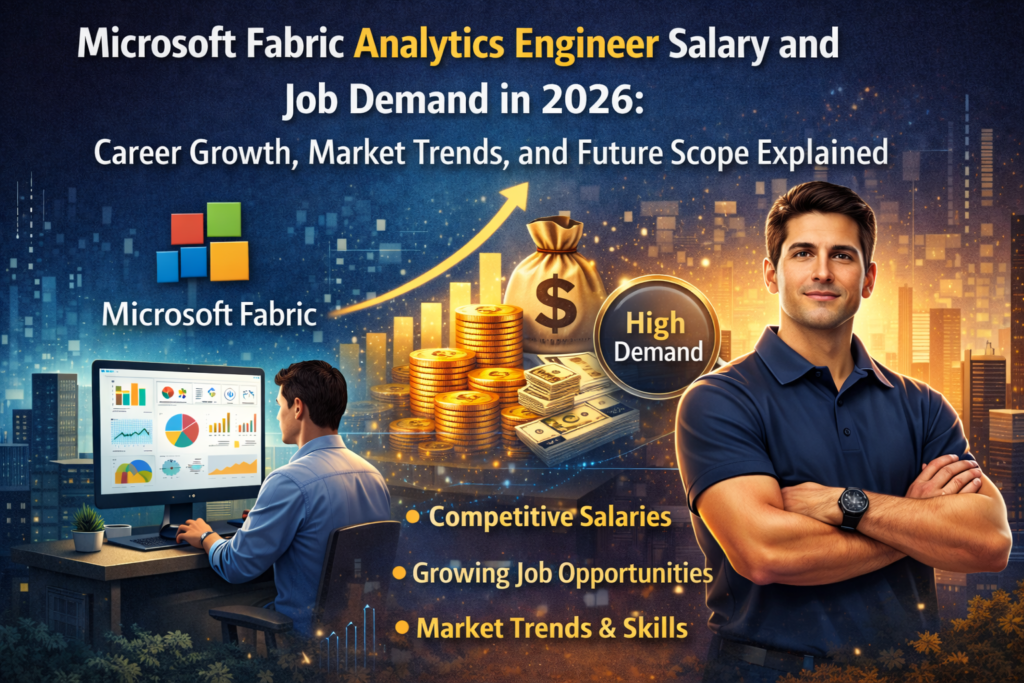

Microsoft Fabric Analytics Engineer career path in 2026 showing salary growth, OneLake architecture, data pipelines, lakehouse modeling, AI integration, and enterprise analytics demand
blogs

Microsoft Fabric Analytics Engineer Salary and Job Demand in 2026: Career Growth, Market Trends, and Future Scope Explained

Introduction: Why This Role Is Becoming One of the Most In-Demand in 2026 In 2026, enterprise data environments are undergoing rapid transformation. Organizations are no longer satisfied with isolated reporting systems or disconnected data warehouses. They want unified analytics platforms that combine storage, engineering, governance, AI integration, and reporting into one seamless ecosystem. Microsoft Fabric has emerged as a major player in this transformation. As enterprises adopt Fabric to modernize their analytics infrastructure, a new hybrid role is gaining strong momentum: the Microsoft Fabric Analytics Engineer. This role sits between traditional business intelligence and advanced data engineering. It requires professionals who understand data pipelines, lakehouse architecture, Power BI modeling, AI integration, and enterprise governance. Because of this hybrid responsibility, salary levels and job demand are increasing significantly. This article explains in full detail: This is not speculation. It reflects real enterprise hiring shifts happening in 2026. Understanding the Role: What Does a Microsoft Fabric Analytics Engineer Actually Do? To understand salary and demand, we must first understand the responsibilities. A Microsoft Fabric Analytics Engineer is not just a dashboard developer. This professional works across multiple layers of the analytics stack. At the foundation level, they design and manage data ingestion pipelines. This involves bringing raw data from various sources into Microsoft Fabric’s OneLake storage system. At the transformation level, they structure and clean data using lakehouse architecture principles. They ensure data is usable, scalable, and optimized for analytics. At the modeling level, they build semantic models that support reporting and AI workloads. At the reporting level, they integrate Power BI to deliver executive insights. At the governance level, they ensure compliance, data security, and access control. This combination of engineering, analytics, and governance makes the role strategically important inside enterprises. Why Enterprises Are Increasingly Hiring Fabric Analytics Engineers Enterprises are facing several challenges in 2026: Microsoft Fabric addresses these challenges by unifying services into a single platform. However, adopting Fabric requires professionals who understand both engineering and analytics workflows. Traditional BI analysts may lack pipeline expertise. Traditional data engineers may lack business intelligence depth. Fabric Analytics Engineers bridge this gap. This hybrid nature increases demand significantly. Salary Expectations in 2026: Global Overview Salary levels vary depending on region, experience, and enterprise size. However, consistent patterns are visible. In North America, mid-level Fabric Analytics Engineers often earn significantly more than traditional BI developers because they operate closer to enterprise architecture. Senior professionals with strong engineering and governance expertise command even higher compensation. In Europe, similar trends are emerging, especially in technology-driven economies where cloud transformation is accelerating. In India and other rapidly growing tech markets, demand is increasing strongly. While salary levels may vary compared to Western markets, the percentage growth compared to traditional BI roles is notable. Across regions, professionals who combine Power BI expertise with Fabric architecture and data engineering fundamentals typically see salary increases ranging between 25% and 50% compared to standard reporting roles. Hybrid skills command premium compensation. Factors That Influence Salary Growth Not all Fabric Analytics Engineers earn the same. Compensation depends on several factors. First, depth of Power BI modeling experience matters. Strong DAX, performance tuning, and governance knowledge increase value. Second, understanding of data engineering concepts such as ETL pipelines, SQL optimization, and lakehouse design significantly influences salary. Third, familiarity with AI integration within Fabric environments adds strategic importance. Fourth, enterprise experience plays a major role. Professionals who have implemented Fabric in large organizations typically command higher compensation. Finally, certification combined with practical project experience improves credibility in hiring processes. Salary is not determined by title alone. It reflects skill depth and enterprise impact. Industry Demand Trends in 2026 Industries actively hiring Fabric Analytics Engineers include: Organizations in these industries manage large volumes of data and require scalable, secure analytics platforms. As Microsoft continues expanding Fabric capabilities, partner ecosystems and consulting firms are also increasing hiring to support enterprise migrations. The demand curve is upward. Why This Role Is Future-Proof Compared to Traditional BI Roles Traditional BI roles focused primarily on reporting. As automation and AI tools become more capable, repetitive dashboard-building tasks may become partially automated. However, system-level architecture, pipeline design, governance implementation, and AI-ready infrastructure require deeper understanding. Fabric Analytics Engineers operate at this strategic layer. This makes the role more resilient against automation and technological shifts. Future-proof roles are those closest to architecture and system design. Career Growth Path Beyond Fabric Analytics Engineer This role is not an endpoint. Professionals in this position can progress toward: Because the role touches multiple layers of the data ecosystem, it provides strong exposure to enterprise decision-making. Career growth opportunities expand beyond reporting. Skills Roadmap for Entering the Role To transition into this role, professionals must build a layered skill foundation. Strong Power BI modeling and DAX knowledge remains essential. SQL proficiency is mandatory for data transformation tasks. Understanding lakehouse concepts and Fabric architecture is crucial. Basic knowledge of Python enhances flexibility. Governance awareness and enterprise mindset improve leadership potential. The transition requires structured learning but is realistic within six to twelve months for experienced BI professionals. Frequently Asked Questions   Is Microsoft Fabric Analytics Engineer a better career option than traditional Power BI roles? This role offers broader scope and higher salary potential because it combines engineering and analytics responsibilities. However, it also requires deeper technical understanding. Professionals seeking long-term growth in enterprise environments may find this path more strategic. How difficult is it to transition into this role from a Power BI background? Transition difficulty depends on your current skill level. If you already have strong SQL and modeling skills, adding Fabric architecture knowledge is manageable. The key challenge lies in shifting mindset from reporting focus to system-level thinking. Are certifications necessary to secure high-paying Fabric roles? Certifications demonstrate commitment and structured knowledge, but practical experience implementing Fabric solutions in real environments carries greater weight. Employers value hands-on expertise. Is demand likely to continue growing beyond 2026? Enterprise data complexity is increasing, not decreasing. As more organizations adopt unified analytics platforms, demand

Trust Us, One Call Can Make a Difference
Please enable JavaScript in your browser to complete this form.
Join As Trainer
Join As Trainer
Please enable JavaScript in your browser to complete this form.
Download Course Content
Please enable JavaScript in your browser to complete this form.
More than 5 People are attending Get On a Call with Us
Please enable JavaScript in your browser to complete this form.
More than 5 People are attending Get On a Call with Us
Scroll to Top