
TechnoEdge

Free Master Class

How to Plan Your AI Training Budget for FY26? (For CHROs & L&Ds)

AI Transformation

Enterprise AI upskilling roadmap showing governance, role-based training, Azure AI, and responsible AI capability building for 2026.
blogs

AI Upskilling for Teams 2026: How Enterprises Can Scale Capability Without Governance Risk

Quick Answer AI upskilling for teams in 2026 should be planned as a governed enterprise capability program, not a one-time AI awareness workshop. CIOs, CISOs, CTOs, CHROs, and L&D Heads should map AI use cases to role-based learning paths, approved tools, data protection rules, governance frameworks, Azure AI capabilities, and measurable business outcomes. The goal is not only to train employees to use generative AI. The real goal is to help teams use AI safely, productively, and responsibly inside approved business workflows. Context Setup: Why This Matters in 2026 Enterprise AI adoption has moved beyond experimentation. Business teams are using generative AI for research, summaries, documentation, reporting, analysis, customer support, sales enablement, and workflow automation. Technical teams are building AI apps, copilots, retrieval systems, and agents. Leadership teams are now asking a more difficult question: how can the organization scale AI capability without increasing governance risk? This is where AI upskilling for teams 2026 becomes a strategic priority. It is no longer enough to run a generic prompt engineering session for all employees. Enterprises need structured, role-based training that connects AI usage with security, compliance, business value, and accountability. The regulatory environment also makes this urgent. The European Commission states that the EU AI Act follows a risk-based approach, with prohibited practices and AI literacy obligations applying from February 2, 2025, GPAI obligations becoming applicable from August 2, 2025, and broader application from August 2, 2026, with some high-risk AI timelines extending later. TechnoEdge supports enterprise teams with role-based AI, Generative AI, Advanced Generative AI, Azure AI, cloud, cybersecurity, and workforce upskilling programs designed for practical adoption and governance alignment. What This Blog Covers In this guide, you will learn: 1. Why Enterprise AI Upskilling Must Start With Governance, Not Tools Many organizations make the same mistake when they begin AI training. They start with tools. They introduce employees to chatbots, copilots, image generators, prompt templates, automation platforms, or AI plugins before defining what employees are allowed to do with them. That approach creates shadow AI risk. Employees may upload confidential information into unapproved tools, automate decisions without review, trust incorrect outputs, bypass procurement rules, or use AI-generated content in sensitive business contexts without disclosure. The issue is not that employees are careless. The issue is that they have not been trained within clear operating boundaries. AI governance is the operating model that defines how AI is selected, approved, deployed, monitored, and controlled across an enterprise. For workforce training, governance should answer practical questions: Which tools are approved? Which data can employees use? Which tasks need human review? Which use cases are prohibited? Which workflows need legal, security, or compliance approval? A governance-first approach helps enterprises avoid a common AI adoption trap: building confidence faster than control. Employees may become fluent in prompts, but still lack the judgment needed to use AI safely inside real business processes. In 2026, enterprise AI training should therefore begin with safe-use principles, risk classification, data handling rules, and escalation paths. Tools should come after those foundations, not before them. 2. How to Build a Governance-Safe AI Upskilling Roadmap A strong enterprise AI training roadmap should connect learning to business workflows. The question is not “How many employees should we train?” The better question is “Which teams need which AI capabilities to improve specific business outcomes without increasing risk?” A governance-safe roadmap should start with approved AI use cases. For example, a marketing team may use GenAI for first-draft content, campaign research, and summarization. A finance team may use AI for report drafting and anomaly explanation, but not for final financial decisions without review. A software team may use AI for code assistance, documentation, test generation, and internal copilots, but must follow secure development practices. Once use cases are clear, enterprises should classify them by risk. Low-risk productivity use cases may require AI literacy and prompt safety. Medium-risk workflows may require manager review, documentation, and approved tool usage. High-impact workflows may require governance, auditability, human oversight, and technical controls. A practical roadmap can follow this sequence: Roadmap Step Enterprise Action Governance Benefit 1. Identify use cases Map AI opportunities by function and process Avoid random tool adoption 2. Classify risk Separate low, medium, and high-impact workflows Match training depth to risk 3. Segment roles Group learners by business, technical, leadership, and risk roles Avoid one-size-fits-all training 4. Select learning paths Build AI literacy, GenAI, Advanced GenAI, Azure AI, and governance tracks Create role-relevant capability 5. Add hands-on labs Use approved business scenarios and policy simulations Convert learning into behavior 6. Measure adoption Track usage quality, productivity, and risk indicators Prove ROI beyond attendance 7. Refresh regularly Update training as tools, policies, and regulations change Keep capability current This approach turns AI upskilling from a training calendar into a workforce capability system. 3. Role-Based AI Training: Why One Learning Path Will Not Work A finance analyst, HR manager, software developer, sales leader, cybersecurity analyst, and legal counsel do not need the same AI training. They may all need AI literacy, but they do not need the same depth of prompt engineering, automation, data handling, Azure AI, or AI governance. AI literacy is the baseline understanding employees need to use AI responsibly, recognize limitations, avoid risky inputs, validate outputs, and follow organizational rules. This should be the foundation for all employees, especially those working with business documents, customer data, internal reports, or decision-support workflows. Generative AI training should then be tailored by function. Business teams need productivity workflows, safe prompting, output review, approved-tool usage, and content verification. Managers need AI use-case approval, quality review, and team adoption practices. Technical teams need deeper coverage of retrieval-augmented generation, evaluation, orchestration, monitoring, integration, and secure deployment. Advanced Generative AI should be reserved for teams that build or manage AI-enabled workflows. These learners need to understand RAG, agents, evaluation, grounding, workflow automation, data access, observability, and failure handling. A practical enterprise segmentation model can look like this: Training Area Target Roles Risk Addressed Capability Built AI Literacy All employees Misuse,

What Is Agentic AI?
blogs

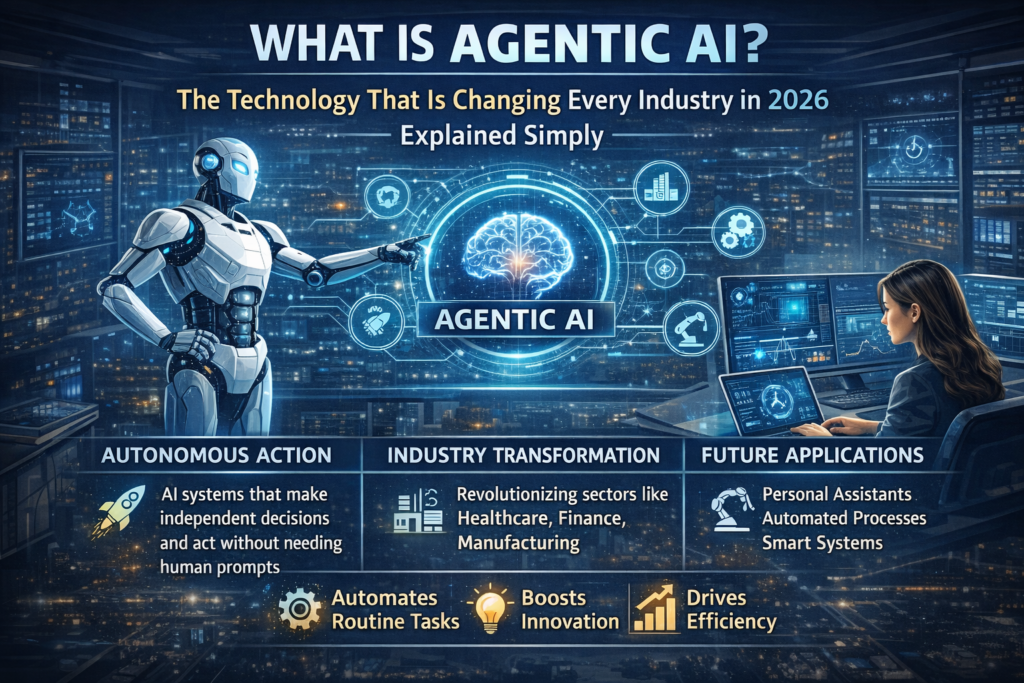
What Is Agentic AI? The Technology That Is Changing Every Industry in 2026  Explained Simply

You Have Been Hearing This Word Everywhere Agentic AI. It is showing up in news articles. Tech conferences. LinkedIn posts. Business meetings. Everyone is talking about it. But most people do not actually know what it means. If you are confused  you are not alone. Most people who use the term “Agentic AI” cannot explain it simply either. They use complicated words that make it sound more mysterious than it actually is. This blog fixes that. By the end of this article, you will understand: No complicated language. No technical jargon without explanation. Just a clear, simple guide that anyone can understand. Let us start from the very beginning. What Is AI? (Starting From Zero) Before we talk about Agentic AI, let us make sure we understand regular AI first. Artificial Intelligence or AI is software that can do things that normally require human thinking. It can read text. Write sentences. Recognize pictures. Answer questions. Translate languages. Predict outcomes. You have probably already used AI many times today without realizing it. When Google suggests what you are searching for  that is AI. When Netflix recommends a show  that is AI. When your email filters spam  that is AI. When you talk to ChatGPT  that is AI. Most of the AI you interact with every day does one thing when you ask it to. You give it an instruction. It does the task. It stops. That is important. Remember it. Because Agentic AI works very differently. So What Is Agentic AI? The Simplest Possible Explanation Here is the simplest way to understand Agentic AI. Regular AI waits for you to tell it what to do next. Agentic AI figures out what to do next by itself. Let us use an example. Imagine you ask regular AI to book you a flight to Delhi. Regular AI says: “Here are some flight options.” Then it stops. It waits for you to choose. Then it waits for you to enter your card details. Then it waits for you to confirm. You are doing most of the work. Now imagine you ask Agentic AI to book you a flight to Delhi. Agentic AI does not just show you options. It checks your calendar to find the best dates. It searches multiple booking sites to find the cheapest price. It checks your preferred seat preferences. It fills in your payment details. It confirms the booking. It adds the trip to your calendar. It sends you a confirmation. You asked once. It handled everything. That is Agentic AI. It does not just answer. It acts. It makes decisions. It takes steps. It completes goals not just tasks. The Three Things That Make AI “Agentic” Not all AI is agentic. For AI to be called agentic, it needs to have three specific abilities. Ability 1 — It Can Make Decisions Regular AI answers questions. Agentic AI makes choices. It can look at a situation, evaluate the options available, and decide which one is best  without you telling it what to choose. Ability 2 — It Can Take Action Regular AI gives you information. Agentic AI does things with that information. It can send emails. Book appointments. Run code. Search the internet. Fill forms. Update databases. Make purchases. It connects to the real world and acts in it. Ability 3 — It Can Work Toward a Long-Term Goal Regular AI does one thing at a time. Agentic AI can work through a series of steps to achieve a bigger goal. You might give it a goal like “plan our company’s product launch.” It then breaks that goal into dozens of smaller tasks, works through each one, handles problems when they appear, and keeps going until the goal is complete. It does not need you to manage each step. It manages itself. Agentic AI vs Generative AI  What Is the Difference? You have probably heard of Generative AI. That is tools like ChatGPT, Gemini, Claude, and Copilot. Generative AI is amazing at creating content. It writes articles. Generates images. Answers questions. Summarizes documents. Writes code. But it only does what you ask  one thing at a time. Agentic AI goes further. Think of it this way. Generative AI is like a brilliant assistant sitting at a desk. You walk over and ask them a question. They answer brilliantly. Then they sit and wait for your next question. Agentic AI is like that same brilliant assistant  but now they have their own phone, their own computer, and their own to-do list. You give them a project. They go away and work on it. They call people. They search things. They write documents. They make decisions. They come back to you when the project is done. Same intelligence. Very different level of independence and action. A Simple Real-Life Example of Agentic AI at Work Let us make this even more concrete. Imagine you run a small business. You want to find new customers. With regular AI, you might ask it to write an email to send to potential customers. It writes the email. You copy it. You send it yourself. You track responses yourself. You follow up yourself. With Agentic AI, you say: “Find potential customers in the manufacturing sector in Pune and send them an introduction about our services.” The agent then: You gave one instruction. The agent handled 7 steps. That is Agentic AI in action. Why Is Agentic AI Such a Big Deal in 2026? Agentic AI is not just another tech trend. It is a fundamental change in what computers can do for people. Here is why it matters so much right now. Before Agentic AI: Computers were powerful but passive. They did exactly what you told them. You had to manage every step. With Agentic AI: Computers become active. They take initiative. They handle complexity. They work toward goals. This shift changes how work gets done. Tasks that used to take a team of people hours can now be done by an AI agent in minutes.

Trust Us, One Call Can Make a Difference
Please enable JavaScript in your browser to complete this form.
Join As Trainer
Join As Trainer
Please enable JavaScript in your browser to complete this form.
Download Course Content
Please enable JavaScript in your browser to complete this form.
More than 5 People are attending Get On a Call with Us
Please enable JavaScript in your browser to complete this form.
More than 5 People are attending Get On a Call with Us
Scroll to Top