

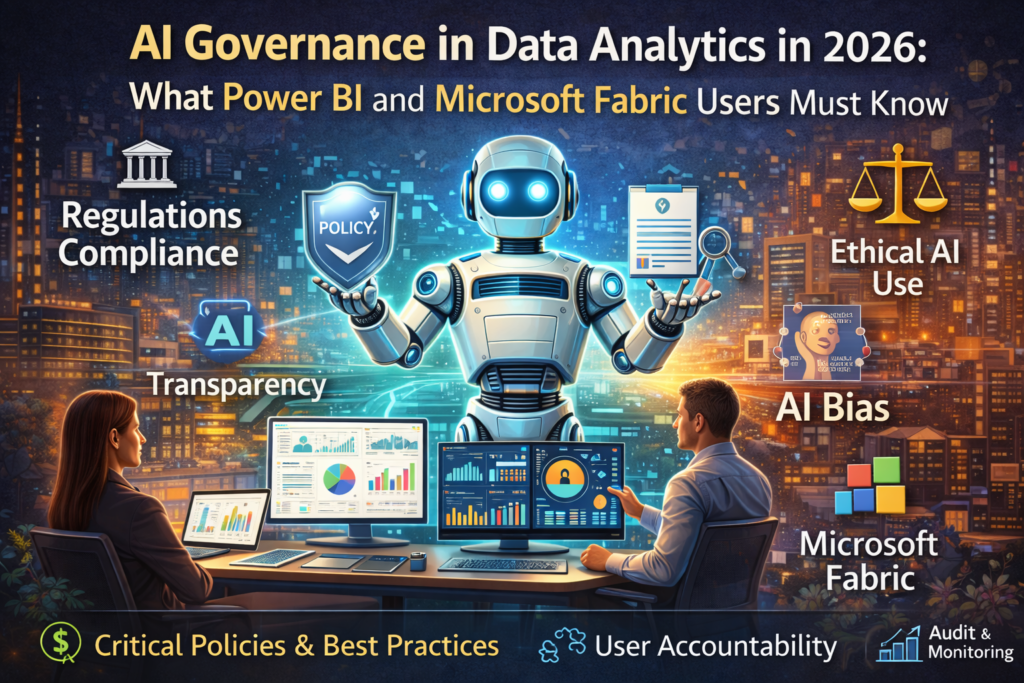
AI Governance in Data Analytics in 2026: What Power BI and Microsoft Fabric Users Must Know
Introduction: Why AI Governance Is No Longer Optional In 2026, enterprises are integrating Artificial Intelligence into analytics platforms faster than ever. Power BI now includes Copilot features. Microsoft Fabric supports AI-driven analytics, predictive modeling, and automated insight generation. However, as AI adoption increases, so does risk. AI can amplify biases in data. It can produce misleading outputs if data quality is poor. It can expose sensitive information if governance controls are weak. It can influence major business decisions without proper oversight. This is why AI governance is becoming one of the most critical topics in enterprise analytics. AI governance is not about slowing down innovation. It is about ensuring responsible, secure, and transparent AI usage inside analytics systems. This article explains: What Is AI Governance in Practical Terms? AI governance refers to the policies, processes, and controls that ensure AI systems operate responsibly, securely, and transparently. In the context of Power BI and Microsoft Fabric, AI governance includes: It ensures that AI systems are aligned with organizational values and regulatory standards. AI governance is not just an IT responsibility. It involves leadership, legal teams, data professionals, and compliance officers. Why AI Governance Matters Specifically in Power BI and Fabric Power BI and Fabric integrate AI deeply into analytics workflows. Copilot can generate DAX formulas and summarize dashboards. AI-driven insights can highlight anomalies automatically. Predictive analytics models can influence business strategy. If these outputs are accepted blindly, organizations risk making flawed decisions. For example, if a predictive model is trained on incomplete historical data, it may generate biased forecasts. If access controls are weak, sensitive financial or healthcare data may be exposed. Fabric’s unified architecture centralizes data, which increases both efficiency and responsibility. Governance ensures that efficiency does not compromise integrity. Key Risks of Ignoring AI Governance Ignoring governance can lead to several serious risks. First, biased AI outputs may result in unfair decision-making. In financial services, this could affect loan approvals. In HR analytics, it could influence hiring decisions. Second, regulatory non-compliance can result in heavy fines. Data protection regulations in many countries require transparency in automated decision-making systems. Third, reputational damage can occur if AI systems produce inaccurate or discriminatory outputs. Fourth, over-reliance on AI without human validation can create blind spots in strategic planning. These risks demonstrate why governance must evolve alongside AI adoption. Core Components of AI Governance in Fabric Ecosystems Effective AI governance typically includes several structured elements. 1. Data Quality Management AI outputs are only as reliable as the data they consume. Enterprises must implement strong validation processes, regular audits, and standardized data definitions. 2. Access Control and Role-Based Permissions Fabric allows centralized data storage. Proper role-based access control ensures only authorized individuals can view or modify sensitive datasets. 3. Model Transparency and Documentation Predictive models and AI-generated insights should be documented clearly. Stakeholders must understand how outputs are generated and what assumptions are embedded. 4. Human Oversight AI recommendations should be reviewed by experienced professionals before influencing major decisions. 5. Compliance Monitoring Enterprises must align AI usage with regional and international regulatory standards. The Role of Data Analysts and Analytics Engineers AI governance is not limited to executives. Data analysts and Fabric Analytics Engineers play critical roles. They must validate AI-generated insights, question anomalies, and ensure dashboards reflect accurate logic. They must understand limitations of predictive models and communicate those limitations clearly to stakeholders. Technical competence must be combined with ethical awareness. Professionals who understand governance frameworks gain credibility and leadership potential. Governance and Microsoft Fabric Architecture Fabric’s unified ecosystem makes governance implementation more manageable because data flows through centralized storage and pipelines. Audit logs, permission controls, and policy enforcement mechanisms can be implemented consistently across the platform. However, centralization also increases impact. If governance fails in a unified system, the consequences are broader. Therefore, governance planning must accompany architecture design. AI Governance and Future Regulations Governments globally are introducing stricter AI regulations. Enterprises using AI-powered analytics must prepare for: Fabric users must ensure systems are adaptable to regulatory changes. Proactive governance reduces future compliance risk. Frequently Asked Questions Is AI governance only necessary for large enterprises? AI governance is essential for organizations of all sizes, although the complexity may vary. Even small businesses using AI-powered dashboards must ensure data privacy and responsible usage. As regulations expand globally, governance becomes increasingly relevant regardless of company size. Does Microsoft Fabric automatically handle all governance requirements? Fabric provides tools and infrastructure to support governance, but it does not automatically guarantee compliance. Organizations must configure access controls, establish policies, and monitor AI usage actively. Technology enables governance; leadership enforces it. How can analysts ensure AI outputs are reliable? Analysts must validate AI-generated insights by reviewing underlying data models, checking assumptions, and cross-verifying outputs against business context. Blind trust in AI increases risk. Professional skepticism remains essential. Can AI governance slow down innovation? When implemented properly, governance does not slow innovation. Instead, it builds trust and ensures sustainable adoption. Poor governance creates risk that may lead to stricter restrictions later. What is the biggest governance mistake organizations make? The most common mistake is assuming AI tools are self-correcting and objective. In reality, AI systems reflect the data and assumptions they are trained on. Ignoring bias and oversight leads to strategic and ethical problems. Final Conclusion AI governance in 2026 is not optional. It is foundational. Power BI and Microsoft Fabric are powerful platforms capable of transforming enterprise decision-making. However, without responsible governance, these same tools can introduce risk. Enterprises must balance innovation with accountability. Professionals who understand governance principles alongside technical expertise become trusted advisors in AI-driven organizations. The future of analytics is intelligent but it must also be responsible. Build Responsible AI Analytics with TechnoEdgels For structured, enterprise-level insights on: Stay aligned with responsible, future-ready analytics.