

TechnoEdge

Free Master Class

How to Plan Your AI Training Budget for FY26? (For CHROs & L&Ds)

cloud adoption

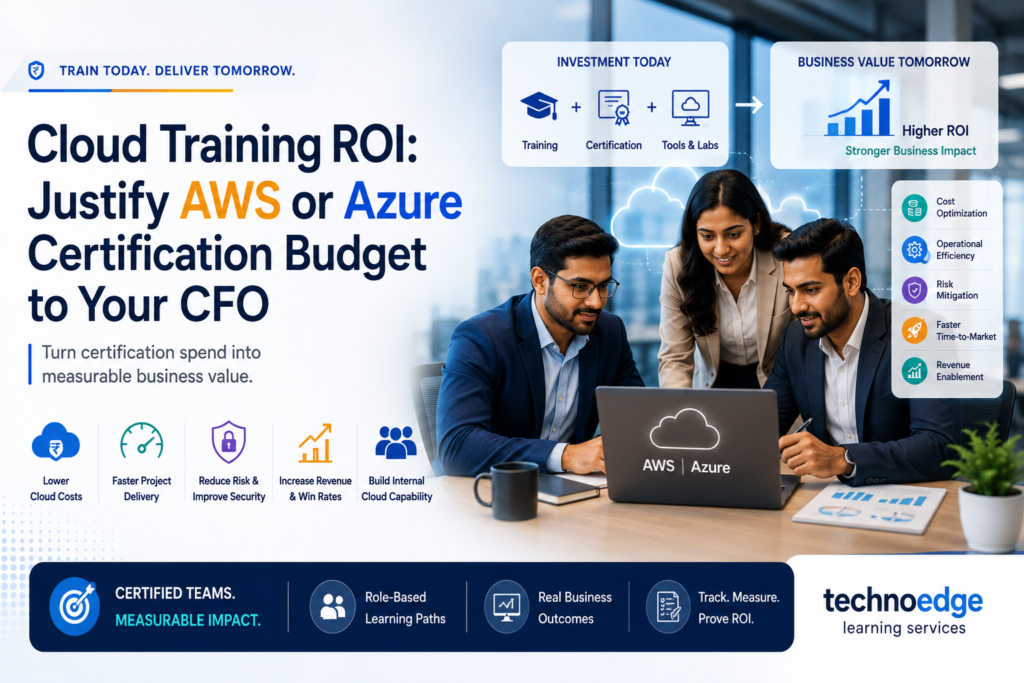
CFO reviewing a cloud training ROI dashboard showing AWS and Azure certification returns, productivity gains, and cost savings.
blogs

Cloud Training ROI: How to Justify AWS or Azure Certification Budget to Your CFO

Cloud certification budgets are often among the first to face scrutiny when finance leaders review L&D spend. For CFOs, AWS certification for employees and Azure programmes can look like optional training costs rather than strategic investments—especially when the business case is framed in terms of “learning” instead of measurable business outcomes. The key to winning approval is to present cloud training for corporate teams as a capability investment that directly impacts project delivery, cost efficiency, risk reduction, and revenue enablement. This guide shows you how to build that CFO-friendly business case. At Technoedge, we help L&D and technology leaders frame cloud training ROI in language that finance leaders understand, connecting certification plans to role needs, business goals, and measurable outcomes. Why cloud training budgets face internal scrutiny Cloud training and certification budgets often face scrutiny because they are perceived as: What CFOs actually want to know: To answer these questions, you need a structured ROI framework that connects certification to business value. Cost elements in cloud training for corporate teams A clear cost breakdown is the foundation of any CFO-friendly business case. For cloud training for corporate teams, the main cost elements include: Training costs Certification costs Opportunity costs Infrastructure and tool costs Post-training support costs Being transparent about all cost elements builds credibility with finance leaders and avoids surprises later. ROI drivers from AWS certification for employees and Azure certification programs The ROI of cloud certification comes from multiple drivers, not just one. Understanding these helps you build a stronger business case for AWS certification for employees and Azure programmes. 1. Cost efficiency in cloud operations Certified cloud practitioners are better at: Typical impact: 2. Faster project delivery Certified teams typically: Typical impact: 3. Reduced dependency on external consultants Organisations often rely on external consultants for cloud migration and architecture because internal teams lack certification and confidence. Certification programs help: Typical impact: 4. Improved security and compliance Certified professionals understand: Typical impact: 5. Revenue enablement and client value For IT services and consulting organisations, cloud certifications: Typical impact: These ROI drivers form the backbone of your business case. How to present productivity, project delivery, and cost-efficiency outcomes CFOs respond to concrete numbers, not abstract learning goals. Present ROI in terms of productivity, project delivery, and cost-efficiency. Productivity outcomes Frame productivity gains in measurable terms: Project delivery outcomes Connect certification to delivery metrics: Cost-efficiency outcomes Quantify cost savings where possible: Use baseline data and projected improvements to make the case credible. A CFO-friendly framework for cloud training ROI A simple, structured framework makes it easier for CFOs to understand and approve cloud training investments. The ROI framework Component What to include Example Investment Total cost of training + certification ₹50 lakhs for 100 employees Time horizon Period over which benefits will be realised 12–18 months Direct savings Cloud cost optimisation, reduced consulting ₹1.5 crores in cloud savings Productivity gains Faster delivery, less rework ₹75 lakhs in productivity Risk reduction Security incidents, compliance penalties ₹50 lakhs in avoided risk Total benefits Sum of all benefits ₹2.75 crores ROI (Benefits − Investment) / Investment 450% ROI over 12 months Key principles for CFO-friendly framing This framework turns cloud training for corporate teams into a business investment CFOs can understand. Sample business case for enterprise cloud certification investment Here is a simplified example of a business case for AWS certification for employees in a mid-sized Indian IT enterprise. Business case summary Item Value Item Value Investment Training cost (100 employees) ₹30 lakhs Certification exam fees ₹10 lakhs Sandbox and tools ₹5 lakhs Programme management ₹5 lakhs Total investment ₹50 lakhs Benefits (12-month horizon) Cloud cost optimisation (20% reduction on ₹5 crores annual spend) ₹1 crores Reduced consulting dependency (₹1 crores annual consulting) ₹40 lakhs Faster project delivery (10% acceleration on ₹5 crores billable work) ₹50 lakhs Reduced security incidents (avoided costs) ₹25 lakhs Total benefits ₹2.15 crores ROI (₹2.15 crores − ₹50 lakhs) / ₹50 lakhs = 330% Payback period ~6 months What happens without investment? This business case demonstrates clear financial value and risk mitigation. How Technoedge helps with training ROI framing, role-based cloud programs, budget justification support, and business-aligned certification planning At Technoedge, we support L&D and technology leaders in building CFO-friendly business cases for cloud certification programmes. Our approach includes: 1. Training ROI framing 2. Role-based cloud programs 3. Budget justification support 4. Business-aligned certification planning This ensures that AWS certification for employees and Azure programmes are seen as strategic investments, not just training costs. FAQs 1. AWS certification for employees: how to justify cloud certification budget to finance leaders? Justify cloud certification budget by connecting it to measurable business outcomes: cloud cost optimisation, faster project delivery, reduced consulting dependency, improved security, and revenue enablement. Build a CFO-friendly business case with quantified costs, benefits, and ROI. Show what happens without investment and define success metrics upfront. 2. Cloud training for corporate teams: how to calculate return on investment? Calculate ROI by summing all benefits (cost savings, productivity gains, risk reduction, revenue enablement) and subtracting total investment (training, certification, tools, programme management). Then divide by investment: ROI = (Benefits − Investment) / Investment. Use conservative estimates and a clear time horizon (typically 12–18 months). 3. AWS certification for employees: which business outcomes strengthen the budget case? Business outcomes that strengthen the budget case include cloud cost savings (15–30% reduction), reduced consulting costs (20–40% reduction), faster project delivery (10–20% acceleration), fewer security incidents, and improved win rates for cloud-enabled engagements. Quantify these outcomes with baseline data and projected improvements. 4. Azure training India and AWS training India: how to present cloud training ROI to a CFO? Present cloud training ROI by framing it as a business investment with clear costs, benefits, and payback period. Use a simple ROI framework, quantify direct savings and productivity gains, and show risks of inaction. Connect certification to cloud strategy, cost reduction, and revenue goals. 5. Cloud training for corporate teams: what metrics help prove training value? Metrics that help prove training value include cloud cost savings, project delivery timelines, consulting spend reduction, security incident rates, certification pass rates,


IT team in India participating in AWS cloud training with hands-on labs and certification prep.
blogs

AWS Cloud Training for Employees: Complete Guide for Indian IT Organizations

Indian IT organisations are accelerating cloud adoption across IT services, BFSI, manufacturing, and GCCs, but many teams still lack structured AWS training India programmes that connect learning to real delivery work. Without this, cloud initiatives stall, certifications become checkbox exercises, and teams struggle to operate securely and efficiently at scale. A focused AWS cloud training for employees strategy, built around roles, use cases, and certification paths, is what enables enterprises to move from pilot projects to enterprise-wide cloud capability. At Technoedge, we design AWS learning programmes for Indian enterprises that combine role-based learning paths, certification readiness, and practical use-case training aligned to real engineering workflows Why AWS training India matters for enterprise capability building Cloud is no longer an “IT experiment” for Indian enterprises; it is the default platform for new applications, data platforms, and digital services. AWS dominates this space, and organisations that invest in structured AWS training India are better positioned to: Without structured training, organisations often face: Structured AWS cloud training for employees turns cloud from a costly experiment into a predictable, scalable capability that supports business outcomes. Which employee groups should start with AWS first Not everyone needs the same depth of AWS knowledge. Prioritising the right groups first accelerates adoption and reduces risk. Engineering and DevOps teams These teams should start first because they: Infrastructure and platform teams Infrastructure teams need AWS training to: Architects and solution designers Architects need AWS training to: Developers Developers need AWS training to: Security and compliance teams Security teams need AWS training to: Leadership and programme managers Leadership teams benefit from AWS awareness training to: Prioritising engineering, infrastructure, and architecture teams first creates a strong foundation that other groups can build on. Core AWS training modules for enterprise teams A comprehensive enterprise AWS programme should cover core modules that align to real work. Cloud fundamentals Networking and security Compute and storage Databases and data services Serverless and application integration DevOps and automation on AWS Operational excellence and governance These modules should be adapted by role and depth, not delivered as a single monolithic course. AWS certification for employees: beginner, associate, and role-based options AWS certification for employees is a powerful way to validate skills and build credibility, but it must be aligned to roles and career pathways. Beginner level For employees new to cloud or AWS: Associate level For technical staff who design and operate AWS solutions: Professional and specialty levels For advanced practitioners: Best for senior architects, lead DevOps engineers, and specialists. Role-based certification paths Map certifications to roles: Role Recommended path Leaders / PMs Cloud Practitioner Junior developers Cloud Practitioner → Developer Associate Senior developers Developer Associate → Solutions Architect Associate Architects Solutions Architect Associate → Professional DevOps engineers Cloud Practitioner → SysOps or Developer → DevOps Engineer Professional Infrastructure teams Cloud Practitioner → SysOps Associate → DevOps Engineer Professional Security teams Cloud Practitioner → Security Specialty This structured approach to AWS certification for employees ensures that certifications align with job roles and business needs. Delivery formats for AWS training India across enterprise environments Indian IT organisations operate across onsite, offshore, and hybrid models, so AWS training must be flexible and scalable. Instructor-led virtual training (VILT) Onsite workshops Blended learning Hands-on labs and sandbox environments Certification bootcamps A typical enterprise AWS programme uses a blend of these formats, depending on audience size, role, and urgency. Expected outcomes from structured AWS cloud training for employees When AWS training is structured and role-based, organisations see measurable outcomes across capability, cost, and quality. Capability outcomes Operational outcomes Business outcomes These outcomes are difficult to achieve with ad-hoc training or self-learning alone. Structured AWS training India programmes make them achievable at enterprise scale. How Technoedge helps with enterprise AWS learning paths, certification readiness, practical use-case training, and scalable cloud capability development At Technoedge, AWS training is designed as an enterprise capability-building journey, not just a certification course. Our approach includes: 1. Enterprise AWS learning paths 2. Certification readiness 3. Practical use-case training 4. Scalable cloud capability development This ensures that AWS cloud training for employees translates into real capability, not just certificates. FAQs 1. AWS training India: what should be included in enterprise AWS learning programs? Enterprise AWS learning programs should include cloud fundamentals, networking and security, compute and storage, databases, serverless, DevOps on AWS, and operational excellence. They should also cover certification paths, hands-on labs, and industry-specific use cases. The content should be role-based, with different depth for developers, architects, DevOps engineers, and infrastructure teams. 2. AWS certification for employees: which certification path fits different IT roles? Leaders and project managers start with Cloud Practitioner. Developers follow the Developer Associate path, architects follow Solutions Architect Associate to Professional, and DevOps engineers move toward DevOps Engineer Professional. Infrastructure teams focus on SysOps Associate, and security teams on Security Specialty. Mapping certifications to roles ensures that AWS certification for employees supports career growth and business needs. 3. AWS cloud training for employees: how to roll out training at scale in Indian IT organizations? Roll out training at scale using blended learning: self-paced fundamentals, virtual instructor-led sessions, hands-on labs, and certification bootcamps. Prioritise critical teams first (engineering, DevOps, infrastructure), then expand to other groups. Use a phased approach with pilots, then scale across locations and functions. 4. AWS training India: which teams should be prioritized first for cloud certification? Engineering, DevOps, infrastructure, and architecture teams should be prioritized first because they directly design and operate cloud environments. Security teams come next, followed by developers and leadership. This ensures that the teams with the highest impact on cloud success are certified first. 5. Cloud training for corporate teams: how to measure AWS training outcomes? Measure outcomes using certification pass rates, participation and completion rates, pre/post assessment scores, and operational metrics like cost savings, security incidents, and deployment frequency. Track these before and after training to demonstrate impact. This turns AWS training into a measurable business investment. Connect with us For Indian IT organizations planning AWS training India programs, a role-based approach usually leads to better adoption than one-size-fits-all learning. Technoedge can help shape that journey with structured AWS learning paths, certification alignment,

Trust Us, One Call Can Make a Difference
Please enable JavaScript in your browser to complete this form.
Join As Trainer
Join As Trainer
Please enable JavaScript in your browser to complete this form.
Download Course Content
Please enable JavaScript in your browser to complete this form.
More than 5 People are attending Get On a Call with Us
Please enable JavaScript in your browser to complete this form.
More than 5 People are attending Get On a Call with Us
Scroll to Top