
TechnoEdge

Free Master Class

How to Plan Your AI Training Budget for FY26? (For CHROs & L&Ds)

compliance training

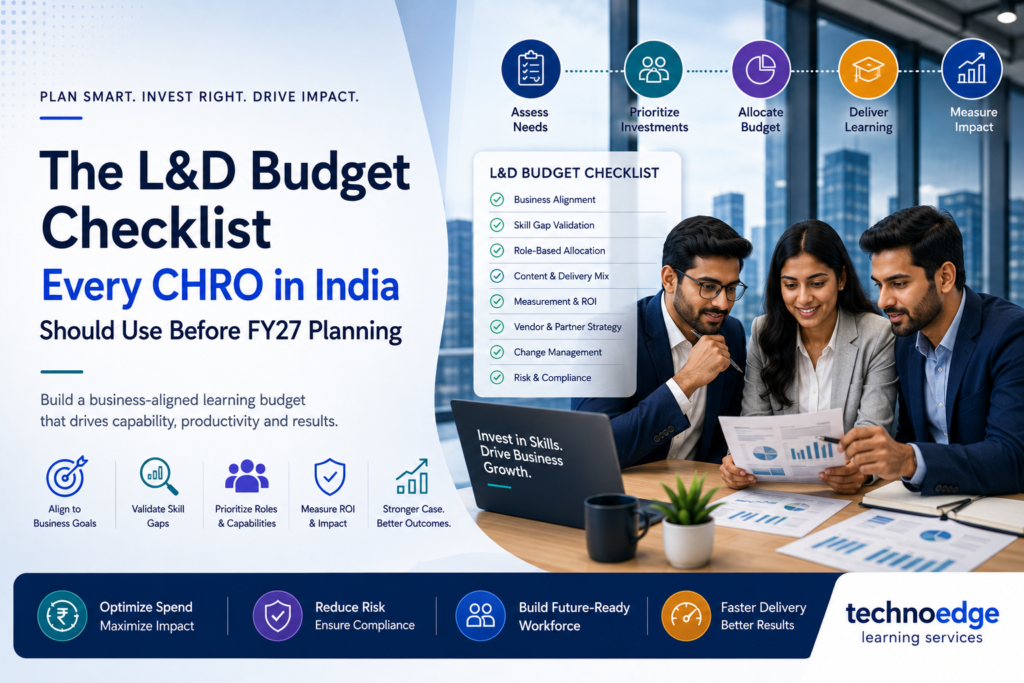
CHRO reviewing an L&D budget checklist for FY27 planning with AI reskilling and skills development priorities.
blogs

The L&D Budget Checklist Every CHRO in India Should Use Before FY27 Planning

As Indian enterprises lock in FY27 planning, L&D budgets are under renewed scrutiny. Finance leaders are asking harder questions about ROI, business alignment, and measurable outcomes. Yet many CHROs still build learning budgets based on last year’s spend, vendor pitches, or generic training categories rather than structured capability needs. The difference between a defensible L&D budget and one that gets cut lies in having a clear corporate learning strategy India backed by a disciplined budget checklist. This checklist ensures training investment is tied to business priorities, role criticality, and validated skill gaps—not just activity. At Technoedge, we work with CHROs and L&D leaders to shape FY27 budgets that are grounded in employee skill gap analysis India, role-based capability planning, and business-aligned learning priorities. The L&D Budget Checklist Every CHRO in India Should Use Before FY27 Planning As Indian enterprises lock in FY27 planning, L&D budgets are under renewed scrutiny. Finance leaders are asking harder questions about ROI, business alignment, and measurable outcomes. Yet many CHROs still build learning budgets based on last year’s spend, vendor pitches, or generic training categories rather than structured capability needs. The difference between a defensible L&D budget and one that gets cut lies in having a clear corporate learning strategy India backed by a disciplined budget checklist. This checklist ensures training investment is tied to business priorities, role criticality, and validated skill gaps—not just activity. At Technoedge, we work with CHROs and L&D leaders to shape FY27 budgets that are grounded in employee skill gap analysis India, role-based capability planning, and business-aligned learning priorities. Why corporate learning strategy India needs stronger budget planning L&D budgets in Indian enterprises often face three challenges: 1. Reactive rather than strategic planning Many budgets are built reactively—responding to vendor offers, training requests, or last-minute gaps—rather than proactively aligning to business strategy. This leads to fragmented spending and missed capability-building opportunities. 2. Weak link to business outcomes Finance leaders often cannot see how L&D spend connects to business goals like faster cloud migration, improved sales conversion, or reduced regulatory risk. Without this link, training budgets look like discretionary costs rather than strategic investments. 3. Inadequate skill gap data Budget decisions are sometimes based on assumptions (“developers need DevOps training”) rather than structured employee skill gap analysis India that validates what capabilities are missing and where they matter most. Stronger budget planning addresses these issues by: This is the foundation of a credible corporate learning strategy India. The complete L&D budget checklist before FY27 planning Use this checklist to ensure your L&D budget is structured, defensible, and aligned to business needs before FY27 planning begins. 1. Business alignment 2. Skill gap validation 3. Role-based allocation 4. Content and delivery mix 5. Measurement and ROI 6. Vendor and partner strategy 7. Change management and adoption 8. Risk and compliance This checklist ensures your L&D budget is strategic, not just operational. How employee skill gap analysis India should shape training investment Employee skill gap analysis India should be the foundation of your L&D budget, not an afterthought. Skill gaps tell you: How to use skill gap data in budget planning What happens without skill gap analysis Structured employee skill gap analysis India ensures budget is invested where it matters most. Budget allocation by business priority, role criticality, and capability gaps A strategic budget allocates resources based on what drives business outcomes, not just headcount or historical spend. Allocation by business priority Business priority Example training focus Budget share (illustrative) Cloud migration AWS/Azure certification, DevOps 30% AI adoption AI readiness, AI tools training 20% Leadership bench Manager effectiveness, executive coaching 15% Digital sales Sales enablement, CRM, AI for sales 15% Compliance and security Data privacy, cybersecurity, ethics 10% General capability Communication, productivity tools 10% Allocation by role criticality Role category Characteristics Budget approach Role category Characteristics Budget approach Mission-critical Directly impacts FY27 priorities Highest budget per learner Important Supports priority functions Moderate budget per learner Support General capability building Lower budget per learner Allocation by capability gaps Gap severity Budget response Critical (blocks business goal) Full investment, fast rollout High (significant impact) Substantial investment, phased rollout Medium (nice-to-have) Targeted investment, pilot first Low (minimal impact) Deferral or minimal spend This approach ensures corporate learning strategy India is driven by business need, not inertia. Common budget mistakes in enterprise learning strategy Even experienced CHROs make budget mistakes that reduce training effectiveness. 1. Budgeting by category, not by outcome Spending on “leadership training,” “technical training,” or “soft skills” without linking to business outcomes makes it hard to justify ROI. Better approach: Budget by business priority (e.g., “cloud migration capability”) and specify outcomes. 2. One-size-fits-all allocation Allocating the same budget per learner across all roles ignores that some roles need more intensive, expensive training (e.g., cloud certification vs communication skills). Better approach: Allocate by role criticality and learning path complexity. 3. Underfunding measurement and adoption Budgeting only for training delivery, not for measurement, reinforcement, or manager engagement, leads to low adoption and unclear ROI. Better approach: Include line items for assessments, dashboards, coaching, and follow-up. 4. Ignoring skill gap data Building budgets based on assumptions or last year’s spend rather than structured employee skill gap analysis India leads to misaligned investment. Better approach: Use skill gap data to validate and prioritise budget requests. 5. Choosing vendors on price alone Selecting providers based on lowest cost rather than specialization, customization, and delivery quality often results in poor outcomes. Better approach: Evaluate providers on business fit and capability depth, not just price. Avoiding these mistakes strengthens your corporate learning strategy India and improves budget approval chances. Presenting L&D budget plans to leadership and finance Finance leaders approve budgets that are clear, credible, and connected to business outcomes. What to include in your presentation How to frame the conversation What to avoid This approach makes your L&D budget defensible and more likely to be approved. How Technoedge helps with training budget prioritization, employee skill gap analysis India, learning strategy alignment, and capability planning support At Technoedge, we support CHROs and L&D leaders in building FY27 budgets that are grounded in data, aligned to business goals, and defensible to finance. Our approach includes:
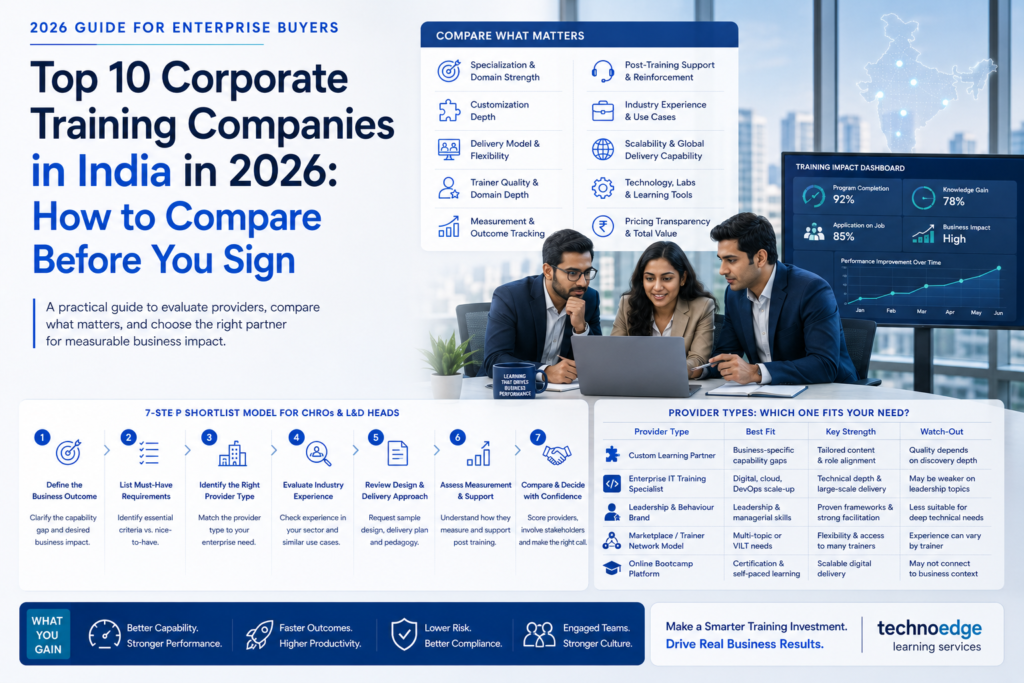

Procurement and L&D professionals evaluating corporate training providers for 2026.
blogs

Top 10 Corporate Training Companies in India in 2026: How to Compare Before You Sign

Choosing among corporate training companies India is less about finding the “biggest name” and more about finding the right fit for your business problem. For enterprise buyers, the real question is whether a provider can improve performance, not just deliver sessions. In 2026, that distinction matters even more because buyers are comparing specialised technical partners, custom learning firms, managed learning providers, and large-scale platforms in the same shortlist. A structured comparison helps CHROs and L&D leaders avoid generic vendor pitches and focus on business relevance, delivery quality, and measurable outcomes. Why comparison content matters in the search for corporate training companies in India Searches for corporate training companies India usually happen when a business need is already urgent: a leadership gap, a technical skill shortage, or a transformation programme that is not moving fast enough. That is why comparison content performs well for enterprise buyers—it helps them move from broad research to a decision framework. Providers in the Indian market often position themselves around different strengths, such as custom learning, enterprise-scale delivery, technical upskilling, leadership development, or trainer marketplace access. A comparison lens makes it easier to separate brand familiarity from real capability. For decision-makers, this means comparing not just course catalogues, but also whether a vendor can solve your specific use case. In practice, that often comes down to fit across specialization, delivery model, and industry context. Comparison criteria for enterprise learning buyers A useful vendor comparison starts with the criteria that affect implementation, not just sales conversations. In 2026, enterprise learning buyers are increasingly looking at learning needs analysis, delivery formats, measurable outcomes, and the provider’s ability to align with internal processes. The most practical comparison criteria include: The biggest mistake is comparing vendors only on price or brand reputation. That can lead to choosing a provider that is popular but not aligned to your enterprise challenge. Corporate training companies in India by specialization, delivery model, and industry fit The Indian market is not homogeneous, and different providers tend to win in different categories. Some are strong in custom eLearning and gamification, others in enterprise IT upskilling, while some are better known for leadership or soft skills. From the sources reviewed, examples of notable provider types include custom learning specialists, enterprise IT training firms, leadership-focused brands, and platform-led digital skills providers. Edstellar’s 2026 review also shows how global providers are often differentiated by delivery scale, content breadth, and measurable learning support. Here is a practical way enterprise buyers can think about provider fit: Provider type Best fit Typical strength Watch-out Provider type Best fit Typical strength Watch-out Custom learning partner Business-specific capability gaps Tailored content and role alignment  Quality depends on discovery depth Enterprise IT training specialist Digital, cloud, DevOps, technical scale-up Technical depth and large rollout capacity  May be weaker on behavioural or leadership topics Leadership and behaviour brand Managerial and leadership development Strong facilitation and proven frameworks  Less suitable for deep technical programmes Marketplace or trainer network model Multi-topic or VILT delivery needs Flexibility and access to many trainers  Experience can vary by trainer Online bootcamp platform Certification or self-paced learning Scalable digital delivery  May not connect closely to business workflows This kind of segmentation helps you avoid overgeneralizing all corporate training companies India into one bucket. It also makes shortlist discussions more grounded in the actual learning need. Which provider type fits which enterprise need Different enterprise needs call for different provider types, and that is where many buying decisions go wrong. A vendor that is excellent for leadership development may not be the right choice for a technical capability build, and vice versa. Use this simple fit logic: The important point is that provider type should follow outcome, not preference. That is the cleanest way to shortlist corporate training companies India without getting distracted by presentation style. Pricing transparency, customization, and post-training support differences Pricing in corporate training is often difficult to compare because the offer structure changes from one provider to another. Some quote per learner, some quote per programme, and others bundle design, delivery, and reinforcement into one fee. For enterprise buyers, the key comparison questions are: Customization is often where the biggest difference lies. A provider with strong customization will align content to business processes, role expectations, and sector realities, while a more platform-like model may offer scale but less contextual depth. Post-training support is equally important because capability rarely changes in one session. Providers that offer follow-up assessments, coaching, or implementation support tend to create better long-term value. A shortlist model for CHROs and L&D heads A practical shortlist should start with the business problem and end with evidence of fit. For CHROs and L&D heads, the easiest way to compare corporate training companies India is to use a weighted checklist instead of relying on pitch decks. A simple shortlist model can look like this: This approach reduces the risk of buying a generic programme that looks polished but does not address the actual issue. It also creates a fairer comparison across very different provider models. How Technoedge helps as a specialized corporate training partner through customized learning journeys, enterprise skill-building, focused technical programs, and measurable business relevance Technoedge is built for enterprise buyers who need more than off-the-shelf training. The focus is on customised learning journeys, role-aligned capability building, and practical programmes that connect directly to business outcomes. Our approach is especially relevant when organisations need focused technical programmes, capability gaps addressed by role, and clear relevance to live business environments. That means the conversation starts with your learning goal, not with a generic catalogue. What this looks like in practice: For buyers comparing corporate training companies India, this matters because it gives them a partner who can support both design and execution. The result is a more grounded training decision with better long-term value. FAQs 1. Corporate training companies India: how to compare providers before signing a contract? The best way to compare providers is to start with the business problem and then evaluate whether each company

Trust Us, One Call Can Make a Difference
Please enable JavaScript in your browser to complete this form.
Join As Trainer
Join As Trainer
Please enable JavaScript in your browser to complete this form.
Download Course Content
Please enable JavaScript in your browser to complete this form.
More than 5 People are attending Get On a Call with Us
Please enable JavaScript in your browser to complete this form.
More than 5 People are attending Get On a Call with Us
Scroll to Top