
TechnoEdge

Free Master Class

How to Plan Your AI Training Budget for FY26? (For CHROs & L&Ds)

GenAI training

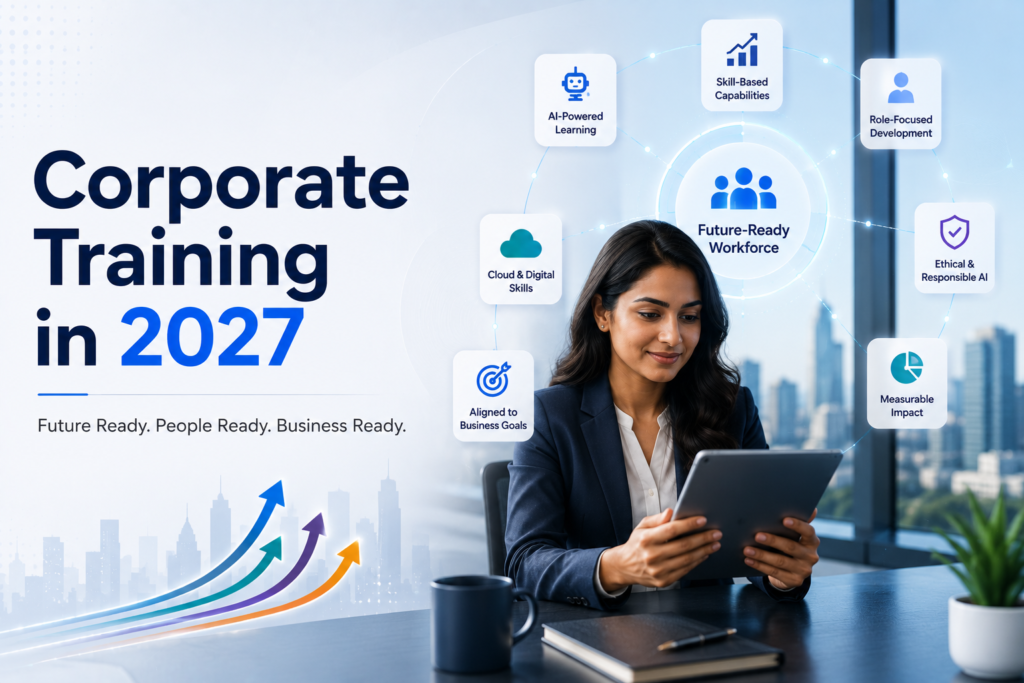
L&D leaders planning 2027 corporate training strategy with AI, GenAI, microlearning, and leadership development priorities.
blogs

What Will Corporate Training Look Like in India by 2027? Trends, Predictions & What to Do Now

By 2027, corporate training in India will look fundamentally different from today. The shift is already visible: Indian enterprises in IT, BFSI, manufacturing, and GCCs are moving from generic, event-based training to structured, outcome-linked capability building. The focus is no longer just on “delivering sessions” but on building workforce readiness for AI, cloud, automation, and role-specific digital skills. For CHROs, L&D leaders, and business heads, the question is not whether corporate training will change, but how to prepare now. Organisations that invest in AI tools training for workforce, role-based academies, and business-linked learning models will outperform those that continue with the old model. At Technoedge, we are designing enterprise training programmes that anticipate these 2027 shifts—focusing on future-ready capability building, AI-enabled learning, and role-based design aligned with changing business demands. Why the corporate training model is changing in India The traditional corporate training model in India—off-the-shelf courses, one-day workshops, and generic soft skills programmes—is losing relevance. Several forces are driving this change: 1. Business priorities are evolving faster Enterprises are prioritising cloud migration, AI adoption, digital transformation, and automation. Training must now support these strategic shifts, not just general capability building. 2. Technology is changing the nature of work AI, automation, and cloud tools are reshaping how employees work. AI tools training for workforce is no longer optional; it is a baseline requirement for productivity. 3. Buyers are more demanding CHROs, L&D heads, and business leaders now expect training to show measurable outcomes, not just completion rates. They want to see ROI tied to business goals. 4. Internal capability systems are emerging Many organisations are building internal academies, communities of practice, and role-based learning paths rather than relying solely on external vendors. 5. Corporate training companies India are differentiating Providers are splitting into specialised categories: custom learning partners, technical upskilling specialists, leadership brands, and platform-led digital skills providers. Buying decisions are more nuanced. The result is a training market that rewards providers who can deliver business-relevant, measurable, and scalable capability building. AI tools training for workforce as a mainstream priority By 2027, AI tools training for workforce will be as mainstream as Microsoft 365 or email training is today. Every enterprise will need to prepare employees to use AI responsibly and effectively. What will change by 2027 What organisations need to do now Organisations that act early will see faster productivity gains and better adoption. Skill-based capability building and role-based academies By 2027, the most effective enterprises will move from “training programmes” to “capability systems” built around roles and skills. What this looks like Benefits What usually goes wrong What good looks like is role-based academies grounded in validated skill frameworks and business priorities. Outcome measurement and business-linked learning models By 2027, enterprise buyers will expect training to demonstrate clear business impact, not just learning completion. How measurement will evolve What buyers will demand Corporate training providers that cannot demonstrate outcomes will lose to those that can. Hybrid delivery, project-based learning, and internal capability systems The delivery model for corporate training will continue to evolve toward hybrid, project-based, and internally supported systems. Hybrid delivery Project-based learning Internal capability systems By 2027, the most successful organisations will combine external expertise with internal capability systems for sustained learning. What corporate training companies in India need to do differently Corporate training companies India that continue with the old model—generic courses, feature-focused training, and one-size-fits-all delivery—will struggle. Buyers will increasingly choose providers who can demonstrate: 1. Specialization 2. Customization 3. Outcome linkage 4. Scalable delivery 5. Partnership mindset Providers that embrace these shifts will win more enterprise business. How Technoedge helps with future-ready capability building, AI-enabled workforce training, role-based learning design, and enterprise training programs aligned with changing business demands At Technoedge, we are building enterprise training programmes that anticipate 2027 shifts, not just respond to current demand. Our approach includes: 1. Future-ready capability building 2. AI-enabled workforce training 3. Role-based learning design 4. Enterprise training programs aligned with business demands This ensures organisations are prepared for 2027 and beyond. FAQs 1. Corporate training companies India: what trends will shape corporate training by 2027? Key trends include AI tools training for workforce becoming mainstream, role-based academies and skill frameworks, outcome measurement and business-linked learning models, hybrid delivery and project-based learning, and internal capability systems. Corporate training companies India will need to specialise, customise, and demonstrate ROI. 2. AI tools training for workforce: how will AI change enterprise learning in India? AI will change enterprise learning by making AI literacy a baseline requirement, introducing function-specific AI use cases, embedding prompt engineering as a core skill, including ethics and governance, and using AI to personalise learning paths and support coaching. 3. Corporate learning strategy India: what should organizations start doing now for 2027 readiness? Organisations should start with AI literacy programmes, build role-based competency frameworks, design learning paths aligned to business priorities, invest in measurement and outcome tracking, and begin building internal capability systems like academies and communities of practice. 4. Corporate training companies India: how will enterprise buyers evaluate training partners in the future? Enterprise buyers will evaluate training partners based on specialization, customization depth, delivery quality, outcome linkage, scalability, and partnership mindset. Providers that can demonstrate business impact will win over those that only offer generic training. 5. Workforce upskilling plan: how should companies prepare for future skill shifts? Companies should build adaptable capability systems rather than isolated programmes, prioritise critical roles and skills, invest in AI and cloud readiness, create role-based learning paths, and measure capability maturity over time. Connect with us For organizations planning beyond immediate training needs, future readiness depends on building adaptable capability systems rather than isolated programs. Technoedge can help support that shift through learning strategies and enterprise training interventions designed around emerging workforce priorities. To explore how this can work for your context, you can connect with Technoedge at: https://technoedgelearning.com
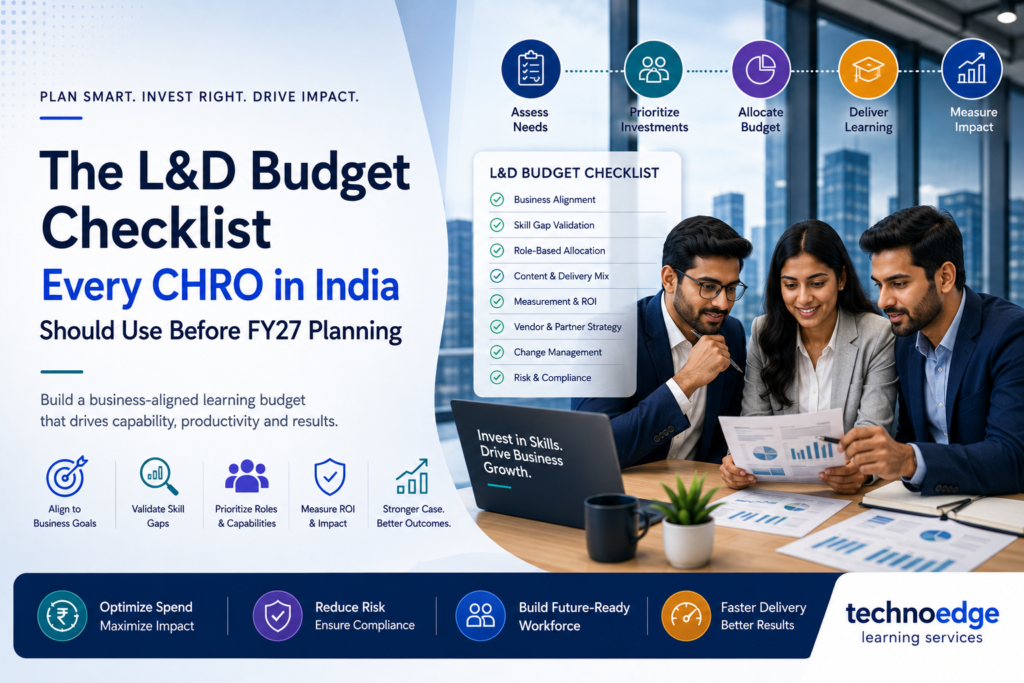
CHRO reviewing an L&D budget checklist for FY27 planning with AI reskilling and skills development priorities.
blogs

The L&D Budget Checklist Every CHRO in India Should Use Before FY27 Planning

As Indian enterprises lock in FY27 planning, L&D budgets are under renewed scrutiny. Finance leaders are asking harder questions about ROI, business alignment, and measurable outcomes. Yet many CHROs still build learning budgets based on last year’s spend, vendor pitches, or generic training categories rather than structured capability needs. The difference between a defensible L&D budget and one that gets cut lies in having a clear corporate learning strategy India backed by a disciplined budget checklist. This checklist ensures training investment is tied to business priorities, role criticality, and validated skill gaps—not just activity. At Technoedge, we work with CHROs and L&D leaders to shape FY27 budgets that are grounded in employee skill gap analysis India, role-based capability planning, and business-aligned learning priorities. The L&D Budget Checklist Every CHRO in India Should Use Before FY27 Planning As Indian enterprises lock in FY27 planning, L&D budgets are under renewed scrutiny. Finance leaders are asking harder questions about ROI, business alignment, and measurable outcomes. Yet many CHROs still build learning budgets based on last year’s spend, vendor pitches, or generic training categories rather than structured capability needs. The difference between a defensible L&D budget and one that gets cut lies in having a clear corporate learning strategy India backed by a disciplined budget checklist. This checklist ensures training investment is tied to business priorities, role criticality, and validated skill gaps—not just activity. At Technoedge, we work with CHROs and L&D leaders to shape FY27 budgets that are grounded in employee skill gap analysis India, role-based capability planning, and business-aligned learning priorities. Why corporate learning strategy India needs stronger budget planning L&D budgets in Indian enterprises often face three challenges: 1. Reactive rather than strategic planning Many budgets are built reactively—responding to vendor offers, training requests, or last-minute gaps—rather than proactively aligning to business strategy. This leads to fragmented spending and missed capability-building opportunities. 2. Weak link to business outcomes Finance leaders often cannot see how L&D spend connects to business goals like faster cloud migration, improved sales conversion, or reduced regulatory risk. Without this link, training budgets look like discretionary costs rather than strategic investments. 3. Inadequate skill gap data Budget decisions are sometimes based on assumptions (“developers need DevOps training”) rather than structured employee skill gap analysis India that validates what capabilities are missing and where they matter most. Stronger budget planning addresses these issues by: This is the foundation of a credible corporate learning strategy India. The complete L&D budget checklist before FY27 planning Use this checklist to ensure your L&D budget is structured, defensible, and aligned to business needs before FY27 planning begins. 1. Business alignment 2. Skill gap validation 3. Role-based allocation 4. Content and delivery mix 5. Measurement and ROI 6. Vendor and partner strategy 7. Change management and adoption 8. Risk and compliance This checklist ensures your L&D budget is strategic, not just operational. How employee skill gap analysis India should shape training investment Employee skill gap analysis India should be the foundation of your L&D budget, not an afterthought. Skill gaps tell you: How to use skill gap data in budget planning What happens without skill gap analysis Structured employee skill gap analysis India ensures budget is invested where it matters most. Budget allocation by business priority, role criticality, and capability gaps A strategic budget allocates resources based on what drives business outcomes, not just headcount or historical spend. Allocation by business priority Business priority Example training focus Budget share (illustrative) Cloud migration AWS/Azure certification, DevOps 30% AI adoption AI readiness, AI tools training 20% Leadership bench Manager effectiveness, executive coaching 15% Digital sales Sales enablement, CRM, AI for sales 15% Compliance and security Data privacy, cybersecurity, ethics 10% General capability Communication, productivity tools 10% Allocation by role criticality Role category Characteristics Budget approach Role category Characteristics Budget approach Mission-critical Directly impacts FY27 priorities Highest budget per learner Important Supports priority functions Moderate budget per learner Support General capability building Lower budget per learner Allocation by capability gaps Gap severity Budget response Critical (blocks business goal) Full investment, fast rollout High (significant impact) Substantial investment, phased rollout Medium (nice-to-have) Targeted investment, pilot first Low (minimal impact) Deferral or minimal spend This approach ensures corporate learning strategy India is driven by business need, not inertia. Common budget mistakes in enterprise learning strategy Even experienced CHROs make budget mistakes that reduce training effectiveness. 1. Budgeting by category, not by outcome Spending on “leadership training,” “technical training,” or “soft skills” without linking to business outcomes makes it hard to justify ROI. Better approach: Budget by business priority (e.g., “cloud migration capability”) and specify outcomes. 2. One-size-fits-all allocation Allocating the same budget per learner across all roles ignores that some roles need more intensive, expensive training (e.g., cloud certification vs communication skills). Better approach: Allocate by role criticality and learning path complexity. 3. Underfunding measurement and adoption Budgeting only for training delivery, not for measurement, reinforcement, or manager engagement, leads to low adoption and unclear ROI. Better approach: Include line items for assessments, dashboards, coaching, and follow-up. 4. Ignoring skill gap data Building budgets based on assumptions or last year’s spend rather than structured employee skill gap analysis India leads to misaligned investment. Better approach: Use skill gap data to validate and prioritise budget requests. 5. Choosing vendors on price alone Selecting providers based on lowest cost rather than specialization, customization, and delivery quality often results in poor outcomes. Better approach: Evaluate providers on business fit and capability depth, not just price. Avoiding these mistakes strengthens your corporate learning strategy India and improves budget approval chances. Presenting L&D budget plans to leadership and finance Finance leaders approve budgets that are clear, credible, and connected to business outcomes. What to include in your presentation How to frame the conversation What to avoid This approach makes your L&D budget defensible and more likely to be approved. How Technoedge helps with training budget prioritization, employee skill gap analysis India, learning strategy alignment, and capability planning support At Technoedge, we support CHROs and L&D leaders in building FY27 budgets that are grounded in data, aligned to business goals, and defensible to finance. Our approach includes:

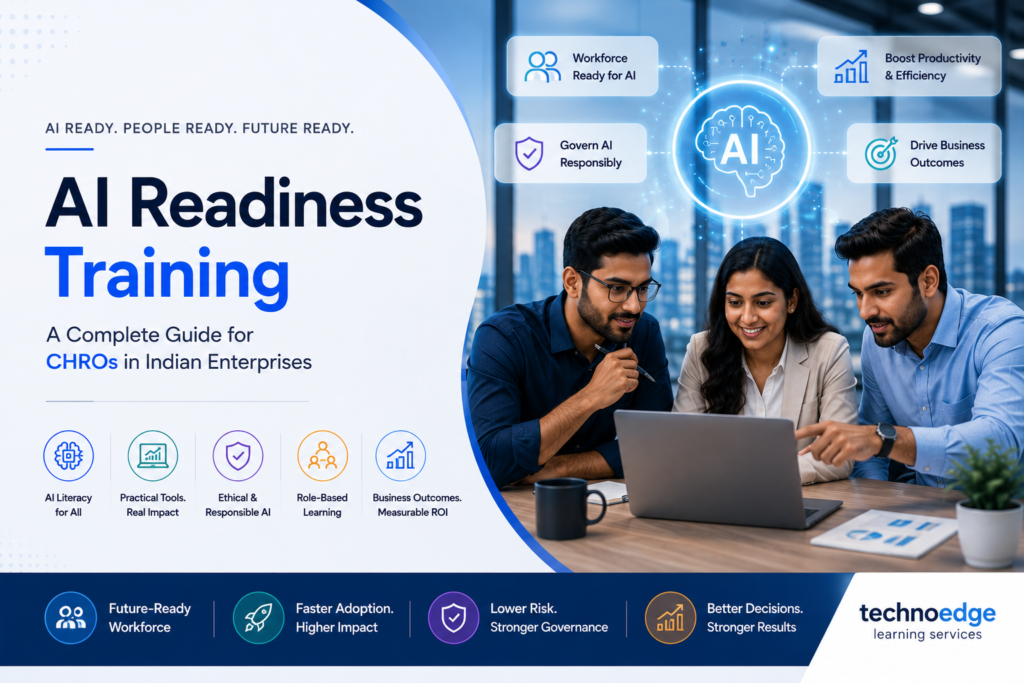
AI readiness skills matrix showing data literacy, AI tool usage, analytics, and AI ethics proficiency levels for HR and business teams.
blogs

What Is AI Readiness Training? A Complete Guide for CHROs in Indian Enterprises

Indian enterprises are investing heavily in AI pilots, proof-of-concepts, and genAI experiments, but many are discovering that technology is not the bottleneck—workforce readiness is. Teams lack the skills to use AI tools effectively, managers don’t know how to integrate AI into workflows, and leaders are unsure how to govern AI responsibly. This is where AI readiness training becomes critical. For CHROs, it is the foundation for ensuring that AI investments translate into productivity gains, not just experiments. Effective programmes combine AI tools training for workforce with practical use cases, ethical guidance, and change management that enables department-specific adoption. At Technoedge, we design AI readiness frameworks for Indian enterprises that go beyond awareness to build practical, role-based capability across HR, sales, L&D, operations, and other functions. AI readiness training explained in business terms AI readiness training is the structured process of preparing your workforce to use AI tools effectively, safely, and responsibly in their daily work. It is not about turning everyone into data scientists; it is about ensuring that employees at all levels can: In business terms, AI readiness training is about: What usually goes wrong: What good looks like: This is the foundation of practical AI tools training for workforce programmes. Why AI readiness training matters before enterprise AI adoption Organisations often rush into AI adoption without preparing their workforce, leading to poor adoption, misuse, or outright failure of AI initiatives. AI readiness training matters before enterprise AI adoption because it: Builds foundational literacy Reduces fear and resistance Enables responsible use Accelerates productivity gains Supports change management Without AI readiness training, even the best AI tools can fail due to poor adoption or misuse. The five pillars of AI readiness training A comprehensive AI readiness programme should cover five core pillars. 1. AI literacy and awareness 2. Practical AI tools skills 3. Function-specific use cases 4. Ethics, privacy, and compliance 5. Change management and adoption These pillars ensure AI readiness training is comprehensive, not superficial. AI tools training for workforce across business functions Different functions use AI tools differently, so AI tools training for workforce should be tailored by department. HR teams Sales teams Marketing teams Operations teams Finance teams L&D teams Technology teams Function-specific training ensures that AI tools training for workforce is relevant and immediately applicable. ChatGPT training for teams as part of AI readiness ChatGPT training for teams is often the entry point for AI readiness because it is accessible, versatile, and widely adopted. However, it should be positioned as part of a broader AI readiness strategy, not the entire programme. What ChatGPT training should cover Common mistakes in ChatGPT training What good looks like ChatGPT training for teams is most effective when it is practical, use-case driven, and part of a larger AI readiness programme. A phased model for AI readiness training in Indian enterprises A phased approach helps organisations build AI readiness systematically without overwhelming teams. Phase 1: Awareness and literacy (Weeks 1–4) Goal: Build foundational understanding across the organisation. Phase 2: Role-based skills (Weeks 5–12) Goal: Build practical skills relevant to each role. Phase 3: Integration and adoption (Weeks 13–24) Goal: Embed AI into daily work and measure outcomes. Phase 4: Scale and optimise (Week 25 onwards) Goal: Scale AI capability and drive continuous improvement. This phased model ensures AI readiness training is sustainable and measurable. How Technoedge helps with AI readiness frameworks, AI tools training for workforce, ChatGPT training for teams, change enablement, and department-specific adoption support At Technoedge, AI readiness training is designed for enterprise leaders who need practical workforce readiness, not just awareness. Our approach includes: 1. AI readiness frameworks 2. AI tools training for workforce 3. ChatGPT training for teams 4. Change enablement 5. Department-specific adoption support This ensures that AI readiness training translates into real workforce capability. FAQs 1. AI readiness training: what does AI readiness training include for Indian enterprises? AI readiness training includes AI literacy and awareness, practical AI tools skills, function-specific use cases, ethics and compliance guidance, and change management. It should be role-based, use-case driven, and aligned to business goals. For Indian enterprises, this often includes AI tools training for workforce across HR, sales, operations, and other functions, plus ChatGPT training for teams as an entry point. 2. AI tools training for workforce: how does workforce AI readiness improve enterprise adoption? Workforce AI readiness improves enterprise adoption by reducing fear and resistance, building practical skills for daily work, ensuring responsible use, and accelerating time-to-value for AI investments. Ready teams adopt AI faster and use it more effectively. This leads to better productivity gains and higher ROI on AI tools. 3. ChatGPT training for teams: how does ChatGPT training fit into AI readiness training? ChatGPT training is often the entry point for AI readiness because it is accessible and versatile. It teaches prompt engineering, practical use cases, output evaluation, and security guidelines. However, it should be part of a broader AI readiness programme that includes other AI tools and function-specific use cases. 4. AI readiness training: which employee groups should be included first? Employee groups that should be included first are those with the highest AI potential: HR, sales, marketing, L&D, and operations. Leaders and change champions should also be trained early to support adoption. Technology teams can be trained separately on more advanced AI capabilities. 5. AI tools training for workforce: how to design AI readiness programs for HR, sales, L&D, and operations? Design AI readiness programs by identifying function-specific use cases for each department, creating role-based training paths, providing hands-on workshops with real work tasks, and measuring adoption and impact over time. Training should be practical, use-case driven, and tied to business outcomes. Connect with us For CHROs and L&D leaders exploring AI readiness training, the goal is usually not just AI awareness but practical workforce readiness. Technoedge can help shape that transition through structured learning journeys, department-specific use cases, and training that connects AI tools with real work outcomes. To explore how this can work for your context, you can connect with Technoedge at: https://technoedgelearning.com

Trust Us, One Call Can Make a Difference
Please enable JavaScript in your browser to complete this form.
Join As Trainer
Join As Trainer
Please enable JavaScript in your browser to complete this form.
Download Course Content
Please enable JavaScript in your browser to complete this form.
More than 5 People are attending Get On a Call with Us
Please enable JavaScript in your browser to complete this form.
More than 5 People are attending Get On a Call with Us
Scroll to Top