


TechnoEdge

Free Master Class

How to Plan Your AI Training Budget for FY26? (For CHROs & L&Ds)

Lakehouse Architecture

Illustration showing transition from traditional data analyst role to Microsoft Fabric expert with pipelines, lakehouses, and unified analytics platform
blogs

Microsoft Fabric Careers 2026: Why Companies Are Hiring Fabric Experts Over Data Analysts 

For years, being a strong Data Analyst was enough.  In 2026, that is no longer the full story. Enterprises are not just asking for reports, dashboards, and DAX. They are asking for professionals who can work across data pipelines, lakehouses, governance, real-time analytics, and Power BI inside one environment. That is why Microsoft Fabric careers 2026 are growing faster than traditional analyst pathways.  This is structural, not temporary. Microsoft Fabric is positioned by Microsoft as a unified analytics platform built on OneLake, and the current Fabric Analytics Engineer certification expects enterprise-scale analytics capability, not only reporting skill.  For most of the last decade, companies built data teams in layers. Data engineers handled movement and transformation. BI developers handled models and dashboards. Data Analysts consumed curated data and turned it into decisions. That model worked when tools were separate and responsibilities were easier to isolate.  However, platform architecture changed. Microsoft Fabric now unifies ingestion, storage, transformation, analytics, and visualization on a shared foundation in OneLake, which means one professional can influence a much larger portion of the data lifecycle than before.  That changes hiring logic. When companies can get one person who understands semantic models, warehouses, lakehouses, pipelines, governance, and Power BI together, they start valuing that profile above a reporting-only analyst.  The disruption in 2026 is not “Data Analysts are gone.”  The disruption is that analyst value is moving upstream. Microsoft’s current Fabric Analytics Engineer Associate and DP-600 study guide both describe a role responsible for enterprise-scale analytics assets such as semantic models, warehouses, and lakehouses, working across preparation, security, and management of analytics solutions.  So the hiring shift is not about rejecting analysis. It is about rewarding professionals who can execute analysis inside a unified platform architecture.  Microsoft Fabric Careers 2026 Reflect a Platform Shift, Not a Job Title Trend  The platform changed first.  Microsoft Fabric is now presented by Microsoft as a unified SaaS analytics platform using OneLake as a centralized logical data lake across workloads. That matters because hiring usually follows architecture. When enterprises adopt a platform that collapses multiple analytics layers into one environment, they start hiring people who understand that combined environment.  A traditional Data Analyst usually enters the process after data is prepared. A Fabric expert enters much earlier. They understand how data is ingested, transformed, stored, modeled, exposed, and secured before it ever appears in a report. That broader visibility gives them stronger influence in enterprise projects.  However, this does not make analyst skill irrelevant. Power BI modeling, DAX, and business understanding still matter. The difference is that those skills now deliver more value when combined with Fabric architecture knowledge rather than used in isolation.  Why Companies Are Hiring Fabric Experts Over Data Analysts  Companies want fewer handoffs.  In fragmented stacks, a business request might move from data engineering to warehousing to BI to governance teams before a useful output appears. Fabric is designed to reduce that fragmentation by keeping data on OneLake while different workloads operate on the same foundation. That reduces movement, duplicate storage, and integration overhead.  That changes who gets hired. A company trying to modernize analytics does not only want someone who can build a dashboard after the data arrives. It wants someone who can design the lakehouse, manage pipelines, shape semantic models, and still deliver executive reporting. The closer a professional is to end-to-end delivery, the more attractive they become.  However, not every organization needs a deep architect on day one. Many still hire PL-300-level talent for reporting roles. The structural shift is that the salary premium and faster career mobility now sit with professionals who move beyond reporting into Fabric execution. Microsoft’s own DP-600 role definition makes that expectation clear.  What a Fabric Expert Does That a Traditional Data Analyst Usually Does Not  Scope is the real differentiator.  A traditional Data Analyst typically focuses on preparing data for reports, building semantic models, defining measures, and communicating insights. That remains valuable. Microsoft still positions the Power BI Data Analyst Associate around modeling, visualizing, and analyzing data with business and technical requirements in mind.  A Fabric expert operates at a broader layer. The current DP-600 path expects the ability to design, create, and manage analytical assets such as lakehouses, warehouses, and semantic models, while also securing and maintaining analytics assets. That already moves beyond classic analyst expectations.  However, the strongest Fabric professionals still think like analysts. They do not abandon business context. They add platform capability to it. That is why companies prefer them. They can translate a business question into an architecture decision, not just into a chart.  Microsoft Fabric Careers 2026 Are Growing Because Demand Is Real  The hiring signal is visible.  Live job market pages show active Microsoft Fabric demand in India. Glassdoor showed hundreds of Microsoft Fabric openings in India, and Foundit also showed active Azure Microsoft Fabric vacancies across Bengaluru, Hyderabad, Pune, Chennai, Gurgaon, Mumbai, and Noida in early April 2026.  That does not mean every posting is a pure “Fabric Analytics Engineer” title. Many companies embed Fabric inside Azure data, BI, or analytics engineering roles. However, that is exactly why anxious professionals should pay attention. The skill is spreading across job descriptions faster than many role titles are changing.  The opportunity is strongest for professionals who already have reporting experience. They are not starting from zero. They already understand metrics, stakeholder requirements, and Power BI logic. Once they add Fabric workloads, pipeline awareness, and lakehouse thinking, they become much more aligned with where enterprise hiring is moving.  Salary Logic Has Shifted From Reporting Output to Platform Ownership  Companies pay more for ownership.  A reporting-focused analyst is usually compensated for insight generation, dashboard quality, and stakeholder support. A Fabric expert is often compensated for platform execution, delivery speed, governance quality, and reduced dependency across multiple teams. That is a bigger business outcome.  This is why the pay gap often widens even when years of experience are similar. A mid-level professional who can handle Fabric pipelines, semantic models, data shaping, and workspace governance can replace several coordination gaps in a project. That makes them commercially stronger than a professional limited to the visualization layer.  However, salary inflation alone should not be the reason to move. Market hype fades fast. Capability does not. The better reason to pursue Microsoft Fabric careers 2026 is that the role aligns with where enterprise analytics architecture is
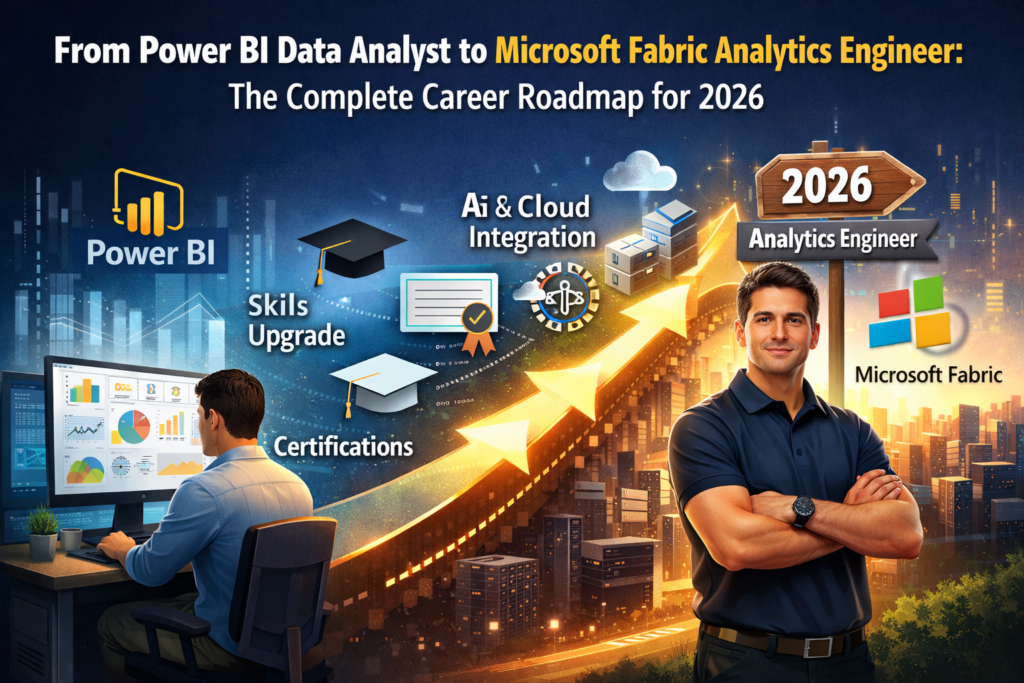
Career roadmap showing transition from Power BI Data Analyst to Microsoft Fabric Analytics Engineer with OneLake, Lakehouse, AI and enterprise data architecture
blogs

From Power BI Data Analyst to Microsoft Fabric Analytics Engineer: The Complete Career Roadmap for 2026

Why This Career Shift Is Happening Now The world of data analytics is not staying the same. For many years, the role of a Power BI Data Analyst was clear. You collected data, cleaned it, built models, and created dashboards. Your focus was reporting and business intelligence. But in 2026, enterprises are no longer satisfied with dashboards alone. Companies now want unified data systems. They want analytics platforms that connect data engineering, storage, transformation, AI, governance, and reporting in one environment. They do not want separate tools for every step. This is exactly why Microsoft introduced Microsoft Fabric. And because of this shift, a new role is growing rapidly: the Microsoft Fabric Analytics Engineer. If you are currently a Power BI Data Analyst, this is not a threat. It is a massive opportunity. This blog will explain in complete detail: This is not hype. This is enterprise reality. What Is Microsoft Fabric  Explained Clearly and Practically In simple words, Microsoft Fabric is a unified data analytics platform created by Microsoft. But that short definition does not explain its real impact. Before Fabric, enterprises used multiple separate services: Managing all these systems required coordination, integration, and heavy architecture planning. Microsoft Fabric combines these into a single ecosystem. It includes: This means analytics is no longer just reporting. It becomes end-to-end data lifecycle management. And that changes careers. Who Is a Microsoft Fabric Analytics Engineer? A Microsoft Fabric Analytics Engineer is not just a dashboard builder. This role sits between data engineering and business intelligence. Instead of only visualizing data, this professional: In many organizations, this role is becoming critical because enterprises want fewer tool silos and more integrated data strategy. It is a hybrid role. And hybrid roles are paid more. Why Power BI Data Analysts Must Think Beyond Dashboards Power BI remains powerful. It is not disappearing. But enterprises are asking deeper questions now: Traditional Power BI roles do not cover these areas deeply. Fabric expands the responsibility. If you stay only in dashboard development, your growth may slow. If you expand into Fabric architecture, your value increases significantly. This is evolution, not replacement. The Core Differences: Power BI Data Analyst vs Fabric Analytics Engineer A Power BI Data Analyst mainly focuses on: A Fabric Analytics Engineer focuses on: The difference is scope. Power BI focuses on output.Fabric focuses on system. Step-by-Step Career Transition Roadmap (Detailed Version) Step 1: Master Advanced Power BI Beyond Basics Before upgrading, your Power BI skills must be enterprise-level. This includes: Understanding DAX deeply, not just basic formulas.Optimizing model performance for large datasets.Designing secure row-level security systems.Implementing governance strategies for enterprise dashboards. You must move from “report developer” to “BI architect mindset.” Without this foundation, Fabric learning becomes overwhelming. Step 2: Learn Microsoft Fabric Architecture Properly Do not jump into random tutorials. First understand concepts: What is OneLake?What is Lakehouse architecture?How does Fabric unify services?How is it different from traditional Azure setups? Fabric is built around integration and scalability. You must understand how enterprise data flows from ingestion to visualization. This is system-level thinking. Step 3: Build Data Engineering Foundations You do not need to become a hardcore software engineer. But you must understand: SQL deeply.Basic Python for data manipulation.ETL and ELT concepts.Data transformation logic.Batch vs real-time processing. Fabric Analytics Engineers work across layers. Without data engineering fundamentals, growth will stop. Step 4: Understand AI Integration in Analytics In 2026, analytics is AI-supported. Fabric integrates AI tools directly. You must understand: AI-assisted reportingPredictive analyticsResponsible AI governanceHow AI interacts with structured data This makes you future-proof. Salary Expectations in 2026 The demand for hybrid analytics professionals is increasing globally. Because Fabric combines engineering and analytics, companies are willing to pay higher salaries compared to mid-level Power BI roles. In many markets, Fabric Analytics Engineers earn 25% to 45% more than traditional BI Analysts because they operate closer to enterprise architecture and digital transformation initiatives. Higher scope equals higher compensation. Real Enterprise Demand: Why Companies Prefer Fabric Professionals Enterprises want: Fabric supports all of this. Professionals who understand Fabric are aligned directly with enterprise digital transformation strategies. This is not a trend. This is long-term direction. Frequently Asked Questions   Is Microsoft Fabric replacing Power BI completely? No, Microsoft Fabric is not replacing Power BI. Instead, Power BI is becoming a core component within the Fabric ecosystem. Fabric expands Power BI’s capabilities by integrating storage, data engineering, AI, and governance in one unified platform. Power BI remains essential, but its role becomes part of a larger architecture. Can a Power BI Data Analyst transition to Fabric without strong coding skills? Yes, but some technical depth is required. You do not need to become a software developer, but you must understand SQL and data transformation logic. Fabric roles demand architectural awareness, not just visualization skills. With structured learning over 6–12 months, transition is realistic. How long does it realistically take to become a Microsoft Fabric Analytics Engineer? For someone with strong Power BI experience, it can take between six months to one year with consistent study and practice. This depends on exposure to data engineering and enterprise architecture concepts. The learning curve is manageable but requires discipline. Is certification necessary to get a Fabric role? Certification helps demonstrate credibility, but enterprise experience matters more. Building real projects using Fabric architecture, understanding lakehouse structures, and applying concepts practically increases hiring chances significantly. Is Microsoft Fabric suitable only for large enterprises? Currently, Fabric adoption is strongest among medium to large enterprises because of its scale capabilities. However, smaller companies are beginning to explore it as well. As cloud adoption increases, Fabric usage will likely expand across company sizes. Should freshers directly learn Fabric instead of Power BI? Freshers should first build strong foundations in Power BI and data modeling. Fabric builds on those concepts. Jumping directly into Fabric without understanding BI fundamentals can create confusion. Strong basics always win. Final Conclusion The role of a data professional in 2026 is expanding. Power BI Data Analysts who upgrade into Microsoft

Trust Us, One Call Can Make a Difference
Please enable JavaScript in your browser to complete this form.
Join As Trainer
Join As Trainer
Please enable JavaScript in your browser to complete this form.
Download Course Content
Please enable JavaScript in your browser to complete this form.
More than 5 People are attending Get On a Call with Us
Please enable JavaScript in your browser to complete this form.
More than 5 People are attending Get On a Call with Us
Scroll to Top