
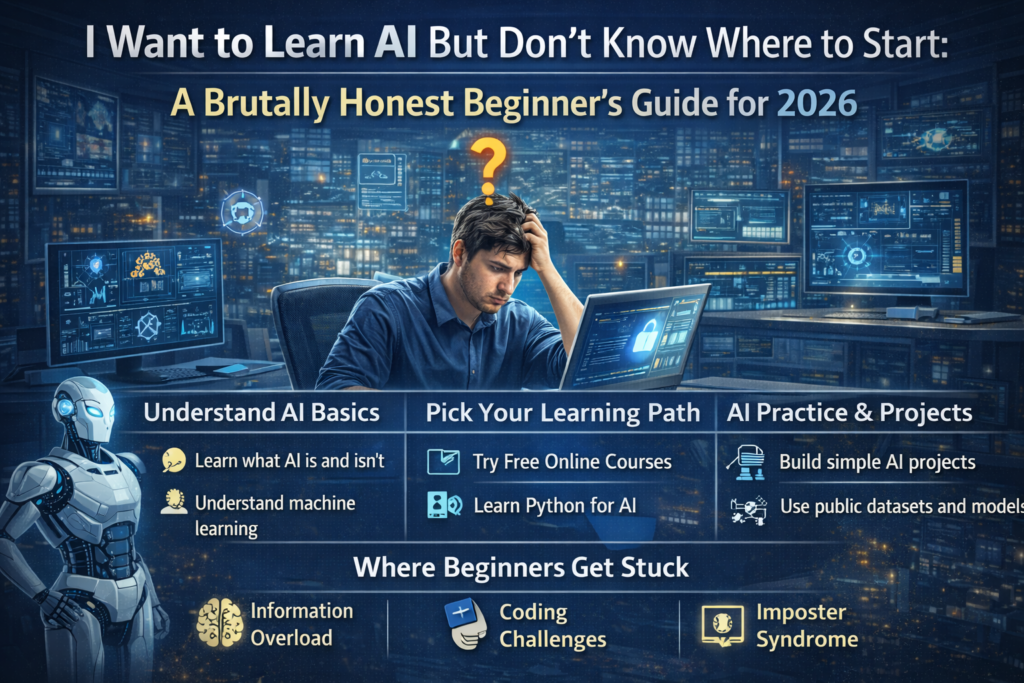
Want to Learn AI But Don’t Know Where to Start: A Brutally Honest Beginner’s Guide for 2026
Why Learning AI Feels So Confusing for Beginners In 2026, Artificial Intelligence is everywhere. You see it in social media, jobs, business tools, and even daily life applications. Naturally, many people feel excited and want to start learning AI. But instead of clarity, most beginners feel overwhelmed. This happens because AI is not a single subject. It is a combination of multiple domains such as data, programming, logic, machine learning, and tools. When beginners search for “how to learn AI,” they are exposed to advanced topics immediately without understanding the foundation. As a result, they feel lost, confused, and often give up before even starting properly. The real problem is not difficulty. The real problem is lack of direction. This guide will remove that confusion and give you a clear, structured, and practical path to start learning AI step by step. What Is AI Actually? (Clear and Practical Understanding) Artificial Intelligence is often misunderstood as something extremely complex or only for experts. But in reality, AI simply refers to systems that can perform tasks that normally require human intelligence. These tasks include understanding language, recognizing patterns, making decisions, and learning from data. However, AI is not one single technology. It is made up of multiple components that work together. Machine Learning allows systems to learn from data. Deep Learning takes this further using advanced neural networks. Natural Language Processing helps machines understand human language. Generative AI enables systems to create content such as text, images, and code. In 2026, the biggest change is that AI has become more accessible. You can now use AI tools without writing complex code. But to build a career, you must understand how AI works behind the scenes, not just how to use tools. Why Most Beginners Fail in AI (Detailed Reality Check) Before you start learning, it is important to understand why many people fail. This will help you avoid common mistakes. The first major mistake is starting without a roadmap. Beginners often jump between videos, courses, and tools without any structured plan. This creates confusion instead of progress. The second mistake is focusing only on tools. Many people use tools like ChatGPT or image generators and believe they are learning AI. But tool usage without understanding concepts leads to shallow knowledge. The third mistake is trying to learn everything at once. AI includes coding, data science, and machine learning. Trying to learn all of these simultaneously overwhelms beginners. The fourth mistake is not practicing. Watching tutorials gives a false sense of learning, but real understanding comes only when you build projects and apply concepts. The key takeaway is simple: 👉 AI is not difficult👉 The wrong approach makes it difficult The Complete AI Learning Roadmap for 2026 (Step-by-Step Detailed Explanation) Now let’s understand the correct way to learn AI in a structured manner. Step 1: Build Strong Thinking and Data Understanding Before touching any AI tool or programming language, you must develop your thinking ability. AI is based on data and logic, so understanding how data works is essential. You need to learn how data is collected, structured, and used to make decisions. This stage helps you build analytical thinking, which is the foundation of AI. Without this step, you may learn tools, but you will not understand their output. Step 2: Start with AI Tools to Understand Practical Usage At this stage, you begin using AI tools such as ChatGPT, Canva AI, or Notion AI. The goal here is not mastery but understanding. You learn how AI behaves, how prompts work, and how outputs are generated. This step is important because it connects theory with real-world application. It helps you understand how AI is actually used in business and daily tasks. Step 3: Learn Basic Programming (Python) Once you understand how AI works at a basic level, you should start learning Python. Python is the most commonly used language in AI because it is simple and powerful. You do not need advanced programming knowledge. Basic concepts such as variables, loops, functions, and data handling are enough to get started. This step allows you to move from using AI tools to building AI-based solutions. Step 4: Understand Machine Learning Concepts After learning basic programming, you move into machine learning. Here, you learn how models are trained using data, how predictions are made, and how different algorithms work. The focus should be on understanding concepts rather than memorizing formulas. You should understand why a model works, not just how to use it. Step 5: Apply AI in Real Scenarios At this stage, you start combining everything you have learned. You use AI to solve real problems such as automating tasks, analyzing data, or improving workflows. This is where your learning becomes practical and valuable. Step 6: Build Projects to Become Job-Ready Projects are the most important part of your learning journey. They help you: Examples include building chatbots, dashboards, or automation systems. Without projects, it is difficult to prove your skills. AI Career Paths (Detailed Explanation for Clarity) AI offers multiple career options, and choosing the right path is important. If you are a beginner, you can start as an AI tools specialist where you use AI tools for productivity and automation. If you are interested in data, you can become a data analyst using AI tools along with platforms like Power BI. If you prefer technical roles, you can become an AI engineer or machine learning engineer, which require coding and deeper understanding. Each path requires different skills, so your choice should depend on your interest and background. How TechnoEdgels Helps You Learn AI Properly Most learners struggle because they lack direction. TechnoEdgels provides a structured learning approach that solves this problem. Instead of random tutorials, you get a clear roadmap from beginner to advanced level. You learn through real-world projects, which helps you gain practical experience. The platform focuses on industry-relevant skills such as AI, data analytics, and cloud computing. This ensures that what you learn is aligned with current job