

TechnoEdge

Free Master Class

How to Plan Your AI Training Budget for FY26? (For CHROs & L&Ds)

Modern Data Stack

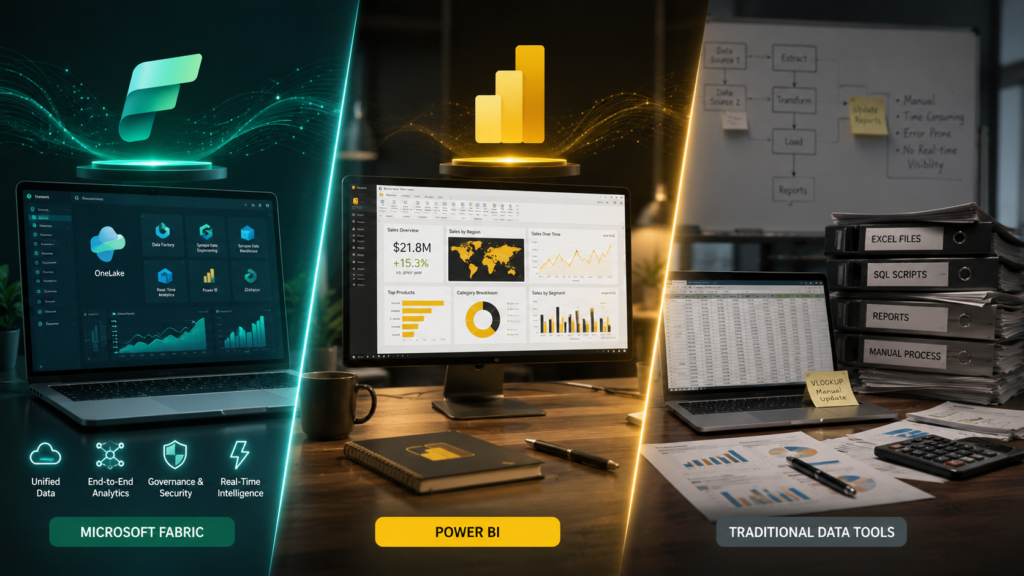
Comparison of Microsoft Fabric, Power BI, and traditional data tools displayed on modern business analytics dashboards in a corporate technology environment.
blogs

Microsoft Fabric vs Power BI vs Traditional Data Tools: What Companies Are Actually Using in 2026

Introduction: The Analytics Industry Is Going Through a Massive Transformation For many years, businesses relied on traditional reporting tools, spreadsheets, disconnected databases, and manual dashboards to manage their analytics workflows. These systems helped organizations generate reports and track business performance, but they were built for a very different era. In 2026, the business world has changed dramatically. Companies now generate massive amounts of data every second from: This explosion of data has created a major challenge for organizations:👉 Traditional analytics systems can no longer handle modern business complexity efficiently. As a result, companies are rapidly shifting toward: This is where platforms like: have become central to enterprise transformation strategies. But many professionals and organizations still feel confused about: This blog will give you a complete, practical, and business-focused understanding of the modern analytics landscape. Understanding Traditional Data Tools (How Companies Worked Before Modern Analytics Platforms) Before cloud analytics and AI-driven systems became mainstream, companies relied heavily on traditional data tools and manual reporting environments. These typically included: For many years, these tools worked effectively because business operations were simpler and data volumes were manageable. Traditional reporting workflows often looked like this: Although this process worked in earlier years, modern businesses now face several major challenges with traditional systems. 1. Data Silos Create Operational Problems One of the biggest issues with traditional tools is fragmentation. Different departments often use separate systems for: This creates isolated data silos. As a result: Modern businesses need connected ecosystems rather than disconnected tools. 2. Traditional Systems Struggle with Real-Time Analytics Today’s businesses require: Traditional systems often rely on scheduled updates and manual refresh cycles, which creates delays. This slows business responsiveness significantly. 3. Scaling Traditional Analytics Infrastructure Is Expensive As organizations grow, their data infrastructure becomes increasingly complex. Traditional systems often require: This increases operational costs and reduces flexibility. What Is Power BI and Why It Became So Popular Worldwide Microsoft Power BI became extremely popular because it simplified business intelligence and data visualization for organizations of all sizes. Power BI allows companies to: without requiring extremely complex infrastructure. One of the biggest reasons Power BI gained massive adoption is:👉 accessibility. It allowed businesses to move away from static reporting toward interactive analytics. How Power BI Changed Business Intelligence Earlier, dashboards often required: Power BI simplified this process dramatically. Organizations could now: This made analytics more accessible to: rather than limiting it only to technical teams. Why Companies Still Use Power BI in 2026 Even with the rise of modern analytics ecosystems, Power BI remains highly relevant because: Many companies still use Power BI extensively for: However, modern business complexity is creating demand for something even larger:👉 unified analytics ecosystems. This is where Microsoft Fabric enters the picture. What Is Microsoft Fabric? (The Biggest Analytics Shift in the Microsoft Ecosystem) Microsoft Fabric is Microsoft’s next-generation unified analytics platform designed to combine: inside a single ecosystem. Instead of using multiple disconnected tools, organizations can manage everything in one platform. This is one of the biggest reasons Microsoft Fabric is gaining rapid enterprise adoption. Why Microsoft Fabric Is Different from Traditional BI Platforms Traditional analytics environments often require multiple separate systems for: Fabric combines these capabilities into a unified environment. This reduces: It creates a much more scalable and AI-ready architecture. Fabric Is Designed for the AI Era One of the biggest advantages of Fabric is its AI-first approach. Modern businesses increasingly require: Fabric is designed to support: This makes it highly attractive for future-focused enterprises. Microsoft Fabric vs Power BI: What Is the Real Difference? This is one of the most common questions professionals ask. The confusion happens because Power BI is actually part of the Fabric ecosystem. However, their roles are different. Power BI Focuses Mainly on Visualization and Reporting Power BI is primarily used for: It is extremely powerful for presenting and analyzing data visually. Microsoft Fabric Focuses on the Entire Data Ecosystem Fabric goes much further. It handles: This means Fabric is not replacing Power BI. Instead:👉 Power BI becomes part of a larger intelligent ecosystem inside Fabric. What Companies Are Actually Using in 2026 The answer depends on: Small and Mid-Sized Businesses Many SMBs still heavily rely on: because they need: Large Enterprises Large enterprises are increasingly moving toward: because they manage: Traditional Tools Are Not Fully Disappearing Traditional systems still exist in many organizations. However:👉 they are rapidly losing strategic importance. Most enterprise modernization roadmaps now focus on: Why AI Is Accelerating the Shift Toward Fabric and Modern Analytics Platforms AI is one of the biggest reasons companies are modernizing analytics infrastructure. Traditional systems struggle to support: Modern platforms like Fabric are built specifically for:👉 AI-powered business operations. This makes them future-ready. Career Opportunities in Microsoft Fabric and Power BI Are Growing Rapidly As companies modernize their analytics infrastructure, demand for skilled professionals is increasing rapidly. Modern roles include: These roles are becoming highly valuable because organizations need professionals who understand: Why Professionals Should Learn Both Power BI and Microsoft Fabric One of the biggest mistakes professionals make is treating these technologies as competitors. In reality:👉 they complement each other. Power BI remains critical for: Fabric expands capabilities into: Professionals who understand both will have stronger long-term career opportunities. How TechnoEdgels Helps Professionals Become Future-Ready Analytics Experts TechnoEdgels helps professionals and organizations prepare for the future of analytics and AI-driven business intelligence. Instead of teaching outdated reporting-only approaches, TechnoEdgels focuses on: The goal is not just certification. The goal is:👉 building future-ready analytics professionals. Frequently Asked Questions 1. Is Microsoft Fabric replacing Power BI completely? No, Microsoft Fabric is not replacing Power BI completely. In fact, Power BI is becoming part of the broader Microsoft Fabric ecosystem. Power BI continues to play a major role in visualization, dashboards, and reporting, while Fabric expands capabilities into data engineering, AI integration, cloud analytics, and enterprise-scale data management. Organizations will continue using Power BI extensively, but increasingly within larger unified analytics environments. 2. Are traditional data tools becoming outdated in 2026? Traditional tools


Comparison of traditional data warehouse and Microsoft Fabric lakehouse architecture showing OneLake storage, unified analytics platform, AI integration, and scalable cloud infrastructure.
blogs

How Enterprises Are Using Microsoft Fabric to Replace Traditional Data Warehouses in 2026

Introduction: The End of Traditional Data Warehouse Dominance? For more than two decades, traditional data warehouses were the backbone of enterprise analytics. Organizations invested heavily in on-premise servers, structured ETL pipelines, centralized databases, and rigid reporting systems. These systems were powerful, stable, and predictable. However, the business environment of 2026 is very different from the early 2000s. Data volumes have exploded. Companies now deal with structured data, semi-structured data, streaming data, and AI-generated insights. The speed of decision-making has increased dramatically. Organizations need scalable, flexible, and AI-ready systems. Traditional data warehouses were not designed for this level of agility. This is where Microsoft Fabric enters the picture. Enterprises are not simply upgrading tools. They are rethinking their entire analytics architecture. Microsoft Fabric is becoming a replacement for traditional warehouse models because it offers integration, scalability, AI capability, and cost optimization within a unified ecosystem. This article explains in full depth: Understanding Traditional Data Warehouses: Strengths and Limitations Traditional data warehouses were built for structured, predictable environments. They store cleaned and transformed data in relational tables. They rely heavily on predefined schemas and structured ETL processes. Data must be transformed before it is stored. This approach works well when: However, modern enterprises face challenges that traditional warehouses struggle to handle efficiently. Unstructured data such as logs, images, streaming feeds, and AI outputs do not fit easily into rigid schemas. Scaling infrastructure requires expensive hardware or complex cloud migrations. Real-time analytics often requires additional tools layered on top of the warehouse. The architecture becomes fragmented and costly. What Microsoft Fabric Changes at the Architectural Level Microsoft Fabric introduces a unified analytics platform built around the concept of a lakehouse architecture. Unlike traditional warehouses that require structured transformation before storage, lakehouse architecture allows organizations to store raw data first and transform it later. Fabric integrates: This means enterprises no longer need multiple disconnected systems. Instead of maintaining separate infrastructure for storage, processing, and reporting, Fabric provides a centralized environment. This reduces architectural complexity significantly. Lakehouse vs Traditional Warehouse: A Structural Shift The key difference between traditional warehouses and Fabric’s lakehouse model lies in flexibility. In a traditional warehouse, data must be cleaned and structured before loading. This creates rigid pipelines. Any change in business requirements often requires pipeline redesign. In a lakehouse model, raw data is stored in OneLake, and transformations occur as needed. Structured views are created dynamically. This flexibility supports: Enterprises benefit from adaptability without sacrificing performance. Why Enterprises Are Migrating to Microsoft Fabric Several factors drive enterprise migration. First, cost optimization is a major factor. Maintaining legacy warehouse systems often involves high licensing fees, hardware costs, and maintenance overhead. Fabric’s unified environment reduces duplication of infrastructure. Second, scalability is critical. As data volumes grow, traditional warehouses struggle to scale efficiently. Fabric leverages cloud elasticity, allowing resources to expand dynamically. Third, AI readiness has become essential. Enterprises integrating predictive analytics and Generative AI require platforms capable of handling large datasets flexibly. Fabric supports AI integration natively. Fourth, governance and compliance are easier within a centralized ecosystem. These combined advantages make migration strategically attractive. Real Enterprise Migration Strategy Enterprises rarely replace warehouses overnight. Most adopt a phased migration strategy. Initially, they move non-critical workloads to Fabric to test performance and integration. Gradually, they migrate ETL pipelines into Fabric data pipelines. Over time, reporting layers shift to Power BI integrated within Fabric. Some organizations adopt hybrid models temporarily, running legacy warehouses alongside Fabric until stability is ensured. Successful migration requires careful planning, stakeholder alignment, and governance review. Performance and Scalability Considerations Performance concerns often arise when replacing traditional warehouses. Fabric addresses this through distributed cloud architecture and integrated compute resources. Instead of being limited by physical server capacity, Fabric scales dynamically according to workload demand. Enterprises handling seasonal spikes or unpredictable data growth benefit significantly from this elasticity. Scalability is no longer constrained by hardware limitations. Cost Implications: Short-Term vs Long-Term Migrating to Fabric may involve initial investment in training, architecture redesign, and cloud planning. However, long-term cost efficiency often improves because: Over time, unified systems reduce operational overhead. Career Impact: What This Means for Data Professionals For professionals working in traditional warehouse environments, this shift is important. Skills in SQL, ETL, and data modeling remain relevant. However, understanding Fabric architecture and lakehouse principles increases career value. Data professionals who adapt to unified cloud-based systems position themselves closer to enterprise digital transformation initiatives. Traditional warehouse expertise alone may not be sufficient in the future. Hybrid knowledge becomes essential. The Future of Enterprise Data Infrastructure Enterprise analytics infrastructure is moving toward integration and AI compatibility. Traditional warehouse-only strategies are becoming less sustainable in rapidly changing environments. Microsoft Fabric represents the direction toward: Enterprises adopting early gain competitive advantage.  Frequently Asked Questions   Are traditional data warehouses becoming completely obsolete? Traditional data warehouses are not disappearing immediately, and many enterprises still rely on them for stable, structured reporting workloads. However, their dominance is gradually decreasing as businesses demand greater flexibility and AI compatibility. Warehouses were built for a time when data was primarily structured and reporting cycles were predictable. Today’s data environments are far more dynamic. While warehouses may continue to serve certain use cases, lakehouse-based unified platforms like Microsoft Fabric are increasingly becoming the preferred architecture for future-focused enterprises. Is Microsoft Fabric suitable for all enterprise sizes? Microsoft Fabric is particularly powerful for medium to large enterprises with complex data environments and AI ambitions. These organizations benefit most from unified architecture and scalable storage. However, smaller enterprises can also adopt Fabric gradually as their data complexity grows. Because Fabric operates on a scalable cloud model, it can adapt to various organizational sizes. The key factor is data complexity rather than company size alone. Does migrating to Fabric eliminate the need for traditional database skills? No, it does not eliminate traditional skills. In fact, SQL, data modeling, and ETL concepts remain foundational. Fabric builds upon these skills rather than replacing them. Professionals who understand relational databases often adapt more easily to lakehouse architecture. The

Trust Us, One Call Can Make a Difference
Please enable JavaScript in your browser to complete this form.
Join As Trainer
Join As Trainer
Please enable JavaScript in your browser to complete this form.
Download Course Content
Please enable JavaScript in your browser to complete this form.
More than 5 People are attending Get On a Call with Us
Please enable JavaScript in your browser to complete this form.
More than 5 People are attending Get On a Call with Us
Scroll to Top