

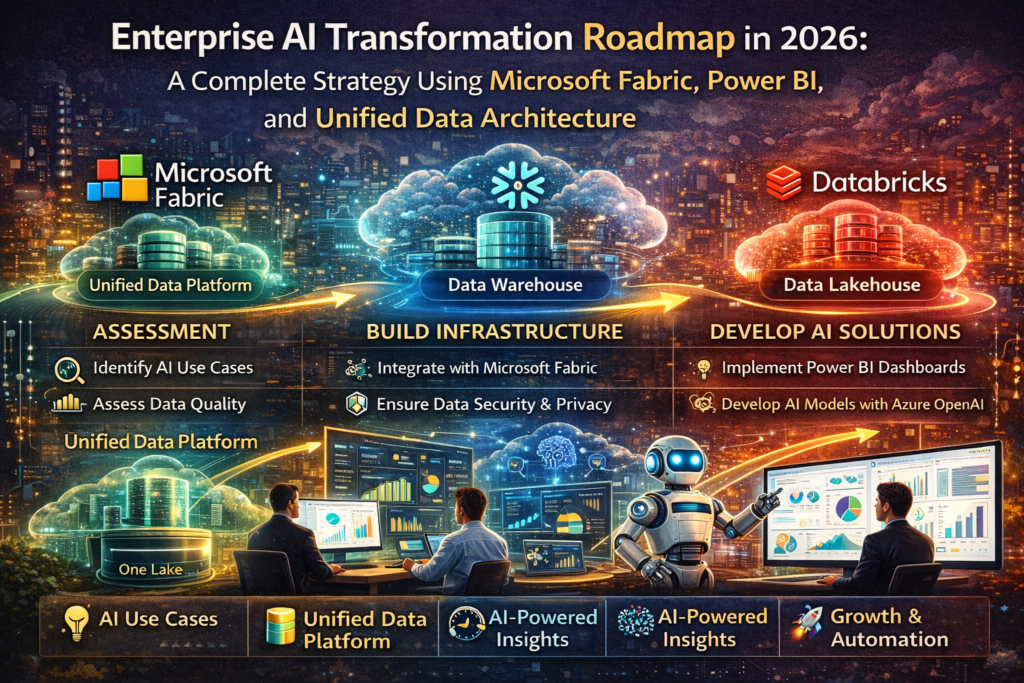
Enterprise AI Transformation Roadmap in 2026: A Complete Strategy Using Microsoft Fabric, Power BI, and Unified Data Architecture
Introduction: AI Transformation Is Not About Tools It Is About Architecture and Culture In 2026, almost every enterprise says it is “doing AI.” But very few organizations are truly AI-transformed. Many companies deploy AI chatbots. Some experiment with predictive dashboards. Others integrate Copilot into Power BI. However, isolated AI adoption does not equal transformation. True enterprise AI transformation requires: Artificial Intelligence is not a feature.It is a structural shift in how organizations operate. This article provides a complete enterprise roadmap for AI transformation using modern platforms such as Microsoft Fabric and Power BI. Phase 1: Data Foundation Modernization Before AI can deliver value, data must be structured, accessible, and reliable. Many enterprises still operate in siloed environments where: AI built on fragmented data produces unreliable outcomes. The first phase of transformation is consolidating data into a unified architecture. Platforms like Microsoft Fabric enable centralized storage through OneLake and lakehouse design. During this phase, enterprises must: Without this foundation, AI adoption will create more confusion than clarity. Phase 2: Business Intelligence Modernization Once the data foundation is stable, enterprises must modernize reporting systems. Traditional static dashboards must evolve into dynamic, real-time insight platforms. Power BI integrated within Fabric allows: This phase shifts organizations from descriptive reporting to predictive awareness. The goal is to reduce decision latency and build trust in unified analytics. Phase 3: AI Integration into Core Workflows After BI modernization, enterprises begin embedding AI into operational workflows. Examples include: At this stage, AI is no longer experimental.It becomes embedded in daily operations. Microsoft Fabric supports this by integrating data pipelines, AI workloads, and reporting within a single environment. The transformation here is operational, not cosmetic. Phase 4: Governance, Compliance, and Responsible AI As AI becomes embedded in decision-making, governance becomes critical. Enterprises must establish: Ignoring governance creates reputational and legal risk. AI transformation must include ethical safeguards. Platforms like Fabric simplify governance implementation through centralized controls, but leadership accountability remains essential. Phase 5: Workforce Reskilling and Cultural Adoption Technology alone cannot transform enterprises. Employees must be trained to: Resistance to AI often stems from fear of replacement. Successful transformation communicates augmentation rather than replacement. Data analysts evolve into AI-augmented strategists.Engineers evolve into AI workflow architects. Cultural readiness defines transformation success. Phase 6: Continuous Optimization and Strategic Scaling AI transformation is not a one-time project. Enterprises must continuously: Scalability becomes the defining factor. Unified platforms reduce operational complexity and support long-term growth. Transformation becomes sustainable only when optimization is ongoing. Why Many AI Transformations Fail Many enterprises fail because they: AI transformation requires structured progression. Skipping phases creates instability. Measuring AI Transformation Success Enterprises should measure success not only by technology adoption but by business outcomes. Key indicators include: Transformation must produce measurable value. Frequently Asked Questions (Expanded and Detailed) How long does enterprise AI transformation typically take? AI transformation timelines vary significantly depending on organization size and complexity. Smaller enterprises may see early results within a year, while large enterprises may require multi-year phased strategies. The process involves architectural redesign, cultural change, and governance implementation, which cannot be rushed without risk. Is Microsoft Fabric necessary for AI transformation? Fabric is not mandatory, but unified platforms simplify transformation significantly. Fragmented environments increase integration complexity and cost. Fabric offers architectural consolidation that supports scalable AI adoption. Can enterprises adopt AI without modernizing data architecture? Technically possible, but strategically risky. AI built on fragmented or inconsistent data leads to unreliable outcomes. Foundation-first transformation is essential. What is the biggest risk during AI transformation? The biggest risk is overestimating AI capability while underestimating governance and cultural resistance. Balanced implementation is critical. Does AI transformation reduce workforce size? AI often augments roles rather than eliminating them. Repetitive tasks decrease, while strategic roles increase. Reskilling determines impact. Final Conclusion Enterprise AI transformation in 2026 is not about deploying tools. It is about redesigning how organizations think, operate, and decide. The roadmap includes: Platforms like Microsoft Fabric and Power BI enable transformation but leadership and strategy define success. Organizations that approach AI transformation structurally gain long-term competitive advantage. Professionals who understand transformation frameworks gain strategic career leverage. Build Enterprise AI Expertise with TechnoEdgels For structured, deep insights on: Stay aligned with the future of enterprise AI and analytics strategy.