
How to Build an Employee Upskilling Plan in 90 Days?
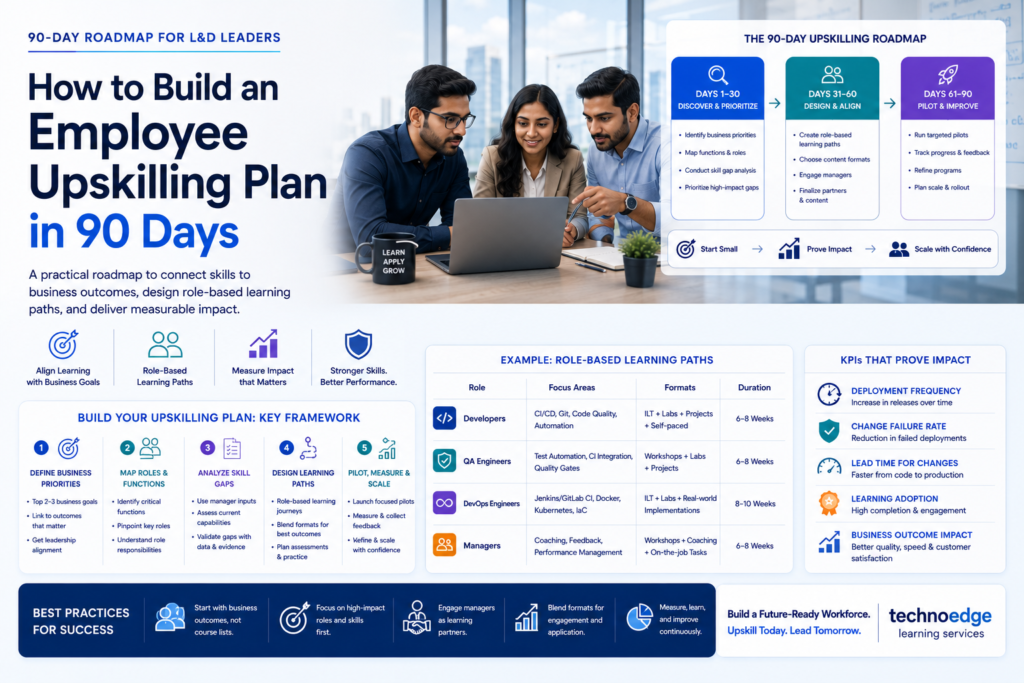
L&D teams in Indian enterprises often start upskilling with good intent but struggle to move from planning to measurable impact. The problem is usually not a lack of content, but a lack of structure, clarity, and alignment with business priorities. A disciplined workforce upskilling plan built over 90 days can turn that around. It gives you a practical way to connect skills to business outcomes, define learning paths by role, and launch pilots that prove value before scaling. In this guide, you’ll get a clear 90-day roadmap and a practical template for how to build employee upskilling plan initiatives that L&D leaders, CHROs, and business heads can actually execute. Why workforce upskilling plan initiatives often stall Many upskilling programmes start strong but lose momentum within weeks. The most common reasons include: As a result, pilots don’t scale, participation drops, and leadership loses confidence in L&D’s ability to deliver business value. A structured 90-day approach fixes this by forcing clarity on priorities, roles, and measurable outcomes from day one. Days 1–30: identify business priorities and critical skill gaps The first 30 days are about diagnosis and prioritisation, not content selection. Step 1: Clarify business priorities Work with business leaders to identify 2–3 key priorities for the next 6–12 months, such as: These priorities become the anchor for your upskilling plan. Step 2: Map priorities to functions and roles For each priority, identify: This narrows the scope from “upskill everyone” to “upskill these roles for these outcomes.” Step 3: Conduct targeted skill gap analysis Use a mix of: The goal is to identify specific gaps like: Step 4: Prioritise gaps by impact and feasibility Not all gaps can be addressed at once. Prioritise using: Focus the first 90 days on the highest-impact, feasible gaps. Days 31–60: map roles, learning paths, managers, and content formats Once gaps are clear, the next 30 days are about designing the learning journey and aligning stakeholders. Step 1: Define role-based learning paths For each priority role, create a learning path that includes: Example for developers: Step 2: Decide on content formats Match format to learning objective: Avoid over-reliance on one format. A blended approach works best for most enterprise programmes. Step 3: Involve managers early Managers are critical for: Engage managers by: Step 4: Select partners and content At this stage, decide: This is where how to build employee upskilling plan becomes concrete: you now have clear requirements to evaluate providers. Days 61–90: launch pilots, review progress, and refine implementation The final 30 days are about execution, learning, and refinement. Step 1: Run targeted pilots Start with a focused pilot: Pilot goals: Step 2: Track progress and gather feedback Use a simple dashboard to track: Collect feedback through: Step 3: Refine and prepare to scale Based on pilot results: Then plan the next phase: A practical template for how to build employee upskilling plan initiatives Use this template as a starting point for your workforce upskilling plan. 1. Business alignment 2. Skill gap summary Role Current level Target level Key gaps Priority (H/M/L) DevOps engineer Intermediate Advanced CI/CD, Kubernetes, automation H Mid-level manager Basic Intermediate Coaching, performance management H QA engineer Basic Intermediate Test automation, CI integration M 3. Learning path design Role Learning path name Formats Duration Provider Role Learning path name Formats Duration Provider DevOps engineer CI/CD Pipeline Track Instructor-led + labs + project 8 weeks External partner Mid-level manager Manager Effectiveness Track Workshops + coaching + on-job tasks 10 weeks Internal + external 4. Manager involvement plan 5. Measurement plan This template makes how to build employee upskilling plan initiatives concrete and actionable. KPIs for measuring workforce upskilling plan success To prove value, track KPIs that connect learning to business outcomes. Learning KPIs Behaviour KPIs Business KPIs Track these before and after the programme, ideally over 30–90 days post-training. How Technoedge helps with skill gap discovery, structured learning pathways, content mapping, training execution, and progress measurement At Technoedge, we support L&D teams through the full lifecycle of a workforce upskilling plan, from discovery to measurement. Our approach includes: 1. Skill gap discovery 2. Structured learning pathways 3. Content mapping 4. Training execution 5. Progress measurement This ensures that how to build employee upskilling plan initiatives move smoothly from planning to action, with clear evidence of impact. FAQs 1. How to build employee upskilling plan initiatives for enterprise teams? Start by clarifying 2–3 business priorities and mapping them to critical roles and functions. Then conduct a targeted skill gap analysis to identify specific capability gaps by role. Use this to design role-based learning paths with clear formats, timelines, and managers’ involvement. Launch pilots with focused teams, track progress using learning and business KPIs, and refine before scaling. This structured approach is the core of how to build employee upskilling plan initiatives that deliver real value. 2. Workforce upskilling plan: what should be included in a 90-day model? A 90-day model should include: Each phase should have clear outputs: prioritised gaps, learning path designs, pilot results, and a scaling plan. 3. How to build employee upskilling plan frameworks aligned with business goals? Align frameworks by starting with business goals, not learning topics. For each goal, identify the functions, roles, and capabilities needed to achieve it. Then design learning paths that directly support those capabilities. Measure success using business KPIs, not just learning metrics. This ensures the framework is business-driven and defensible to leadership. 4. Workforce upskilling plan: which KPIs matter most for L&D teams? The most important KPIs are those that connect learning to business outcomes: L&D teams should track these before and after the programme and report on them consistently. 5. Employee skill gap analysis India: how to connect skill gaps with upskilling priorities? Connect skill gaps with priorities by starting with the business problem, then identifying which roles and capabilities are bottlenecks. Use manager input, performance data, and assessments to validate gaps. Prioritise gaps based on impact on business goals and feasibility to address. This ensures that upskilling efforts focus on the areas that matter most for the organisation. Connect with us For L&D teams building a workforce