
CI/CD Pipeline Training: Why Your DevOps Teams Need Structured Learning (Not YouTube)
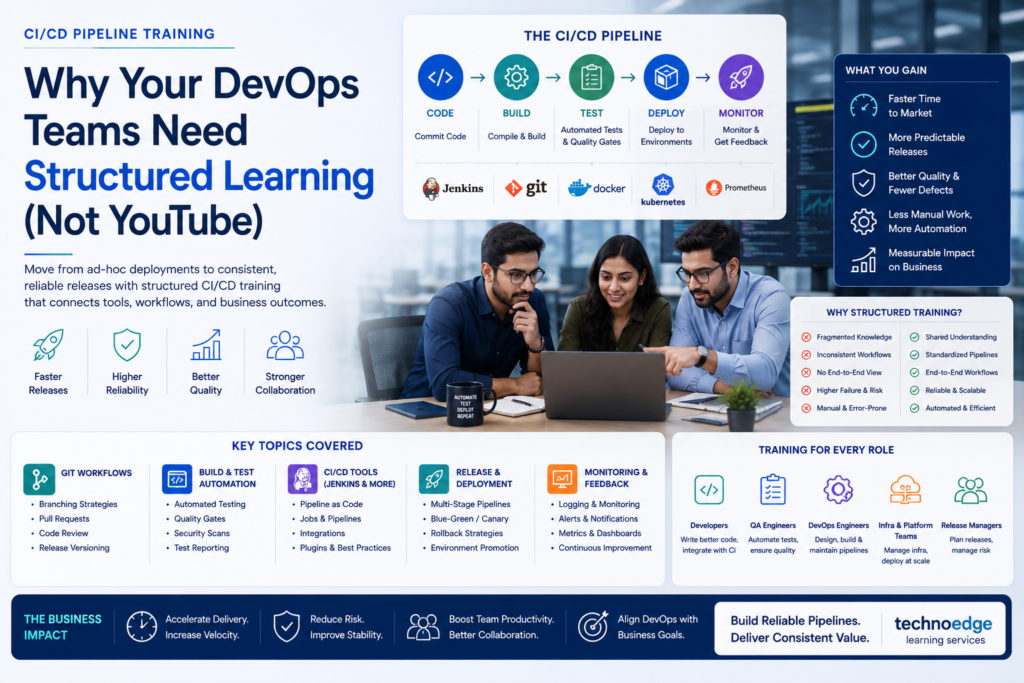
Your DevOps team can watch hours of CI/CD tutorials on YouTube, but that still won’t give you consistent pipelines, reliable releases, or a shared understanding of how code moves to production in your organisation. The missing piece is structured CI/CD training for employees that connects tools, workflows, and business outcomes in a way that video tutorials cannot. In enterprise settings, this is what separates ad-hoc deployments from repeatable, high-quality delivery. At Technoedge, we design DevOps corporate training programmes where CI/CD is taught as an end-to-end practice, not just a set of tools. Teams learn to build, test, and deploy with the same discipline that their production environment demands. Why informal CI/CD learning creates inconsistent execution Informal learning through videos, blogs, and random tutorials often leads to fragmented knowledge. One person learns Jenkins from a tutorial, another learns GitFlow from a different source, and a third tries to connect them using trial and error. What usually goes wrong: This creates a pipeline that works “sometimes” and fails unpredictably. When something breaks, it’s hard to diagnose whether the issue is in code, configuration, pipeline logic, or environment. In enterprise environments, inconsistency is expensive. It leads to: Structured learning solves this by establishing a common baseline for how CI/CD should work in your organisation. What structured ci cd training for employees should include Effective CI/CD training for employees must cover concepts, tools, and real-world workflows, all tied together in a coherent journey. A strong programme should include: Core CI/CD concepts Version control and Git workflows Build and test automation Release management and deployment pipelines Tooling and integration What usually goes wrong in training: What good looks like: This is what structured DevOps corporate training delivers, not ad-hoc knowledge. Jenkins, Git workflows, test automation, release management, and deployment pipelines A focused CI/CD curriculum should give teams hands-on experience with these core areas. Jenkins (or equivalent CI server) Git workflows Test automation Release management Deployment pipelines In enterprise training, these topics are best taught through labs where teams build and break pipelines, then fix them. That is how capability sticks. Role-based ci cd training for employees across DevOps functions One-size-fits-all CI/CD training rarely works well. Different roles need different depth and focus within the same pipeline ecosystem. Developers QA teams DevOps engineers Infrastructure and platform teams Release managers Common mistake: Better approach: This ensures that CI/CD training for employees is relevant and practical for each team member. Business impact of stronger pipeline maturity Stronger CI/CD pipeline maturity is not just a technical win; it directly impacts business outcomes. Organisations with mature pipelines typically see: From a business perspective, pipeline maturity translates to: What usually goes wrong: What good looks like: This is why structured DevOps corporate training is a business investment, not just a learning activity. Metrics to track after devops corporate training Training impact should be measured using engineering and business metrics, not just completion rates. Key metrics to track after CI/CD training include: Metric category Key metrics Speed Deployment frequency, lead time for changes Reliability Change failure rate, rollback frequency Quality Defect escape rate, test coverage, build failure rate Efficiency Manual steps eliminated, pipeline execution time Confidence Deployment success rate, mean time to recovery (MTTR) What usually goes wrong: What good looks like: This approach turns DevOps corporate training from a learning event into a performance improvement programme. How Technoedge helps with structured CI/CD learning journeys, lab-based training, workflow standardization, and project-relevant upskilling for DevOps teams At Technoedge, CI/CD training is designed as a capability-building journey, not a one-day workshop. We focus on structured learning paths, hands-on labs, and real-world pipeline implementation. Our approach includes: 1. Structured CI/CD learning journeys 2. Lab-based training 3. Workflow standardisation 4. Project-relevant upskilling This ensures that CI/CD training for employees translates into consistent, measurable improvements in how your teams deliver software. FAQs 1. CI CD training for employees: why is structured learning better than self-learning? Structured learning ensures that all team members share a common understanding of CI/CD concepts, workflows, and tools. Self-learning through videos and blogs often leads to fragmented knowledge, inconsistent practices, and gaps in critical areas like testing, security, and rollback. Structured DevOps corporate training provides a coherent curriculum, hands-on practice, and alignment to your organisation’s actual workflows. It also enables teams to learn from each other and adopt shared standards. 2. DevOps corporate training: what tools should be included in CI/CD pipeline training? CI/CD pipeline training should cover at least one major CI tool (Jenkins, GitLab CI, GitHub Actions), version control (Git), testing frameworks, container registries, and orchestration platforms like Kubernetes. It should also include tools for monitoring and logging post-deployment. The exact tools should match your stack, but the principles (branching, testing, pipeline design, deployment strategies) should be consistent regardless of the toolset. 3. CI CD training for employees: which employee groups need pipeline training the most? The groups that need pipeline training the most are developers, QA engineers, DevOps engineers, infrastructure teams, and release managers. Each group interacts with the pipeline differently, so role-based training is essential. Developers need to understand how to integrate code and tests. QA needs to embed automation. DevOps and infrastructure teams need to design and maintain the pipeline. Release managers need to coordinate deployments and manage risk. 4. DevOps corporate training: how does CI/CD training improve release quality and deployment speed? CI/CD training improves release quality by instilling practices like automated testing, quality gates, and consistent deployment strategies. It improves speed by reducing manual steps, automating repetitive tasks, and enabling more frequent, predictable releases. Training also helps teams diagnose and fix pipeline issues faster, reducing downtime and deployment delays. 5. CI CD training for employees: how to measure impact after enterprise pipeline training? Impact is best measured using metrics like deployment frequency, lead time for changes, change failure rate, mean time to recovery, and test coverage. Baseline metrics should be taken before training, and improvements tracked over 30–90 days afterward. Training impact should also be assessed through qualitative feedback from teams on confidence, collaboration, and ease of delivery. Connect with us For enterprises trying to improve CI/CD maturity, consistent team capability is usually