

TechnoEdge

Free Master Class

How to Plan Your AI Training Budget for FY26? (For CHROs & L&Ds)

Power BI Career Growth

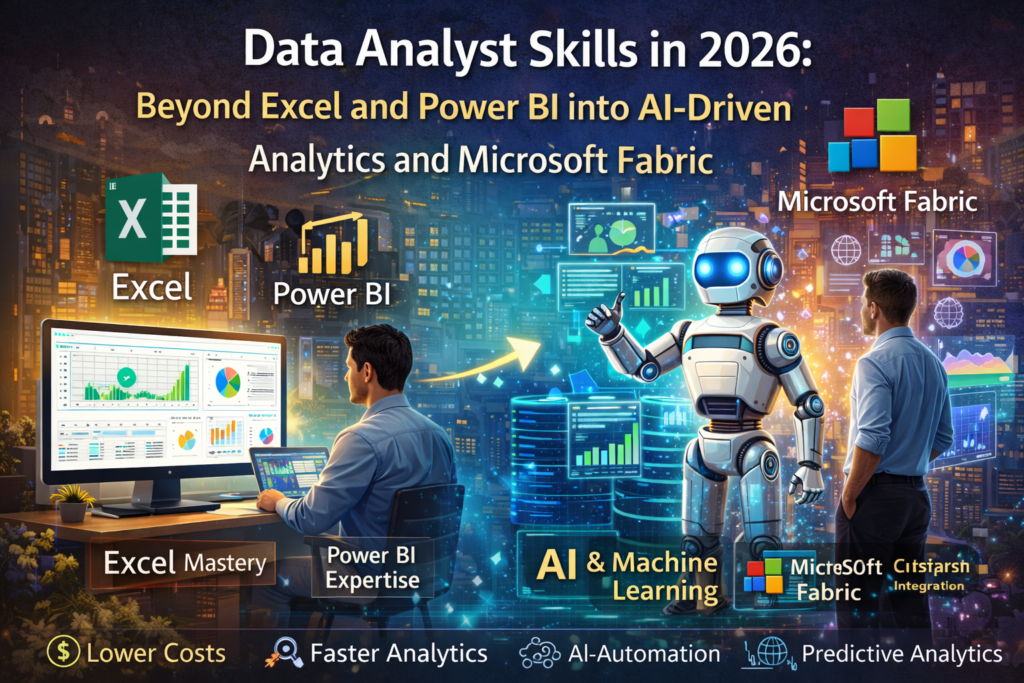
Modern data analyst in 2026 working with AI-powered Power BI, Microsoft Fabric lakehouse architecture, SQL modeling, governance controls, and real-time analytics dashboards.
blogs

Data Analyst Skills in 2026: Beyond Excel and Power BI into AI-Driven Analytics and Microsoft Fabric

Introduction: The Data Analyst Role Is Expanding Rapidly For many years, the role of a data analyst was clearly defined. Analysts worked with Excel, SQL, and tools like Power BI to clean data, build reports, and present insights. Their primary responsibility was descriptive analytics — explaining what happened in the business. In 2026, that definition is no longer sufficient. Enterprises now expect analysts to understand data pipelines, AI-assisted insights, real-time analytics, and cloud-based architecture. The modern data analyst is not just a report builder. They are becoming a bridge between raw data, AI systems, and executive strategy. The shift is not optional. It is happening across industries including finance, healthcare, retail, manufacturing, and technology. This article explains in detail: Why Excel and Basic BI Skills Are No Longer Enough Excel remains powerful and widely used. Power BI remains essential for business intelligence. However, relying only on these tools limits career growth. The volume and complexity of data have increased dramatically. Enterprises now manage structured databases, streaming logs, customer behavior data, IoT inputs, and AI-generated outputs. Managing this data requires more than spreadsheet-level manipulation. Additionally, executives expect predictive insights, not just historical reports. They want to know what is likely to happen and what actions should be taken. Traditional analyst skill sets focused on answering “what happened.”Modern enterprises demand answers to “why did it happen?” and “what will happen next?” To answer those questions, analysts must expand their capabilities. The New Skill Layer 1: Advanced Data Modeling and SQL Mastery In 2026, SQL is not optional for serious data professionals. Even with AI tools generating queries, understanding database logic remains critical. Advanced data modeling is equally important. Analysts must understand star schemas, snowflake schemas, normalization principles, and performance optimization strategies. Without strong modeling skills, AI-generated outputs may be inefficient or inaccurate. Data structure knowledge is the foundation of all advanced analytics. The New Skill Layer 2: Understanding Microsoft Fabric and Lakehouse Architecture As enterprises adopt unified platforms like Microsoft Fabric, analysts must understand how data flows across systems. This includes: Even if analysts are not responsible for engineering tasks, understanding the architecture allows them to collaborate effectively with data engineers. Modern analytics is team-based. System awareness improves influence and credibility. The New Skill Layer 3: AI Literacy and Generative AI Integration Artificial Intelligence is no longer reserved for specialized teams. Power BI integrates Copilot features. Fabric supports AI-ready architecture. Enterprises use predictive models and anomaly detection systems daily. Data analysts must understand: AI literacy does not require deep coding expertise. It requires conceptual understanding and practical validation skills. Analysts who understand AI workflows become significantly more valuable. The New Skill Layer 4: Business Context and Strategic Thinking Technical knowledge alone is insufficient. Enterprises increasingly value analysts who understand business drivers, operational processes, and financial metrics. An analyst who can connect technical insights to strategic outcomes influences decision-making more effectively. Communication skills, storytelling ability, and stakeholder management have become core competencies. The modern analyst is part technical expert, part strategist. The New Skill Layer 5: Data Governance and Compliance Awareness With stricter data privacy regulations and increasing cybersecurity risks, governance has become central to analytics operations. Analysts must understand: Even if governance teams exist, analysts contribute to responsible data usage. Ignoring governance knowledge can limit career advancement. Career Growth Path in 2026 and Beyond Data analysts who expand into these new skill layers unlock multiple growth paths. They can move toward: The career ceiling increases significantly when analysts understand both technical depth and enterprise strategy. Remaining limited to Excel and basic reporting restricts upward mobility. How to Build These Skills Strategically Skill expansion should be structured. First, strengthen SQL and modeling knowledge. Second, study Microsoft Fabric architecture and lakehouse fundamentals. Third, experiment with AI features inside Power BI and understand Copilot outputs critically. Fourth, improve business communication and stakeholder engagement skills. Learning should align with enterprise trends rather than isolated certifications. Frequently Asked Questions   Is Excel becoming irrelevant for data analysts in 2026? Excel is not becoming irrelevant. It remains widely used for quick analysis and operational tasks. However, relying exclusively on Excel limits scalability and advanced analytics capability. Modern enterprises require tools that handle large datasets, AI integration, and real-time reporting. Excel should be part of the toolkit, not the entire toolkit. Do data analysts need to become full data engineers? Data analysts do not need to become full data engineers, but they must understand engineering fundamentals. Knowing how data pipelines operate and how storage systems function improves collaboration and problem-solving. Hybrid knowledge increases career flexibility without requiring deep software development expertise.How important is AI knowledge for analysts today? AI knowledge is becoming essential. Analysts must understand how predictive models operate, how anomaly detection works, and how AI-generated insights should be validated. Even if analysts do not build models from scratch, understanding AI workflows prevents over-reliance and improves strategic decision-making. Is Microsoft Fabric mandatory for future analysts? Microsoft Fabric is not mandatory for every organization, but unified analytics platforms are becoming more common. Learning Fabric concepts positions analysts ahead of market shifts. Even if your organization has not adopted Fabric yet, understanding modern architecture prepares you for future transitions. Can fresh graduates directly learn AI-driven analytics? Yes, fresh graduates can begin learning AI-driven analytics early. However, foundational knowledge in statistics, SQL, and data modeling should come first. Building strong basics makes AI integration easier and more effective. What is the biggest mistake analysts make in 2026? The biggest mistake is assuming current skills are enough. Technology evolves quickly. Analysts who do not continuously update their knowledge risk stagnation. Adaptability and curiosity are essential for long-term growth. Final Conclusion The data analyst role in 2026 is broader, deeper, and more strategic than ever before. Excel and Power BI remain foundational, but they are no longer sufficient alone. AI literacy, Fabric architecture awareness, governance knowledge, and strategic thinking are now essential components of a successful career. Professionals who evolve with these changes will find expanded opportunities and higher earning potential. Those
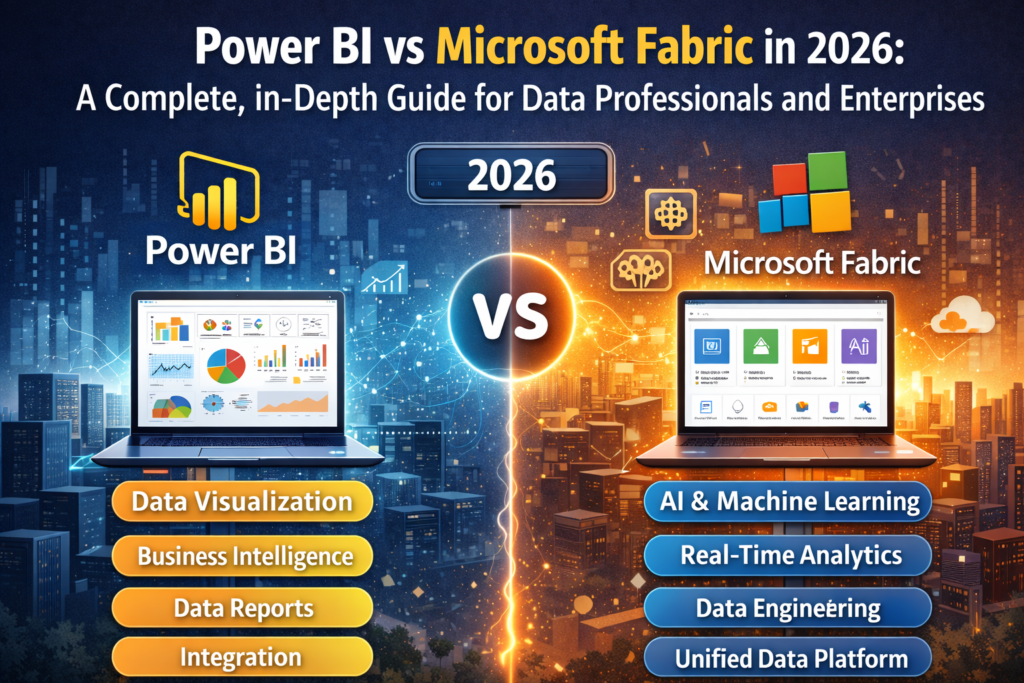

Comparison of Power BI and Microsoft Fabric in 2026 showing presentation layer vs full data ecosystem, including OneLake, lakehouse architecture, AI integration, and enterprise analytics.
blogs

Power BI vs Microsoft Fabric in 2026: A Complete, In-Depth Guide for Data Professionals and Enterprises

Introduction: Why This Debate Is Growing in 2026 The discussion around Power BI and Microsoft Fabric is not just a technical comparison. It reflects a major shift in how enterprises approach data analytics. For more than a decade, Power BI has been one of the most trusted business intelligence platforms in the world. Thousands of organizations built their reporting ecosystems around it. Many professionals built entire careers mastering DAX, modeling, and dashboard optimization. However, in 2026, enterprise expectations have evolved. Companies no longer want isolated reporting tools. They want unified analytics platforms that combine data storage, transformation, governance, AI integration, and reporting into a single, scalable system. This is where Microsoft Fabric changes the conversation. Many professionals are asking: Is Microsoft Fabric replacing Power BI?Should I stop learning Power BI?Is Fabric only for engineers?What will companies prefer in the future? To answer these questions properly, we must go beyond surface-level comparisons and understand architecture, enterprise strategy, career direction, and long-term data transformation trends. This blog explains everything in depth. Understanding Power BI in 2026: Its True Role Today Power BI in 2026 is far more advanced than it was a few years ago. It is not just a dashboard tool anymore. It includes AI-powered insights, Copilot assistance, enhanced security features, and enterprise-grade deployment options. At its core, Power BI specializes in turning structured data into understandable business insights. It focuses on modeling data, creating relationships, writing DAX measures, optimizing performance, and building interactive reports that executives can use for decision-making. The strength of Power BI lies in its ability to simplify complexity. It translates raw numbers into stories that business leaders can understand. However, despite its strength in reporting and modeling, Power BI does not fully manage the entire data lifecycle. It typically connects to external storage systems, data warehouses, or data lakes. It consumes data rather than controlling the infrastructure behind it. This distinction becomes important when comparing it with Microsoft Fabric. Understanding Microsoft Fabric: A Platform, Not Just a Tool Microsoft Fabric is not designed as a replacement for Power BI. It is designed as a unified analytics ecosystem. Fabric brings together multiple capabilities that were previously separated across different Microsoft services. It includes data engineering tools, data pipelines, lakehouse architecture, warehouse capabilities, real-time analytics, AI integration, and business intelligence — all within one platform. One of its most important components is OneLake, which acts as a centralized storage layer. Instead of storing data across disconnected systems, enterprises can manage everything in a unified environment. This fundamentally changes how organizations think about analytics. Instead of asking, “How do we build a dashboard?” enterprises now ask, “How do we design a complete data system that supports dashboards, AI, governance, and scalability?” Fabric operates at system level, not just visualization level. The Architectural Difference: Presentation Layer vs Full Data Ecosystem To truly understand the difference, imagine a building. Power BI is like the interior design of the building. It makes the information inside beautiful, understandable, and usable. It focuses on how insights are presented to decision-makers. Microsoft Fabric is the entire building structure. It includes the foundation, wiring, plumbing, security systems, storage rooms, and architecture. Power BI answers the question:“What insights can we see?” Microsoft Fabric answers:“How is the entire data system structured, governed, stored, processed, and delivered?” In enterprises that are growing rapidly, architecture becomes as important as presentation. Why Enterprises Are Moving Toward Fabric Enterprise data environments have become more complex. Organizations handle: Managing all this through disconnected services creates cost and inefficiency. Fabric simplifies this by unifying services into a single experience. This does not eliminate Power BI. It strengthens it by embedding it inside a larger architecture. Enterprises prefer integration over fragmentation. That is why Fabric adoption is growing. Career Impact: What This Means for Power BI Professionals For data professionals, this shift is significant. If you remain focused only on visualization and DAX modeling, your skills remain valuable. Many organizations still need strong Power BI specialists. However, professionals who expand into Fabric architecture gain broader influence. They understand: This positions them closer to decision-making and system design roles. In 2026, hybrid professionals are more competitive than specialists in isolated tools. Power BI knowledge remains the foundation. Fabric knowledge becomes the multiplier. When Power BI Alone Is Enough Not every organization requires full Fabric architecture. Small businesses and teams focused mainly on reporting may not need advanced data engineering systems. In such environments, Power BI continues to serve effectively. If your organization operates with limited data complexity, Power BI may remain sufficient. However, as companies grow and data complexity increases, system-level thinking becomes necessary. When Fabric Becomes Essential Fabric becomes critical when organizations: In these cases, Power BI alone is not enough. The broader ecosystem matters. Fabric aligns with long-term enterprise digital transformation. Is Microsoft Fabric Replacing Power BI? This is one of the most misunderstood topics. Microsoft Fabric is not replacing Power BI. It includes it. Power BI remains the reporting engine within Fabric. Your DAX skills, modeling knowledge, and visualization expertise do not become useless. Instead, they operate within a larger system. The shift is not elimination.It is integration. Professionals who understand this nuance will navigate the transition successfully. The Future of Business Intelligence in 2026 and Beyond The future of analytics is not tool-based. It is ecosystem-based. Business intelligence is evolving into integrated data intelligence. Visualization remains essential, but architecture and AI integration become equally important. Power BI continues as the visualization powerhouse.Microsoft Fabric represents the unified analytics backbone. Professionals who understand both layers will shape the future of enterprise data. Frequently Asked Questions   Is Microsoft Fabric better than Power BI? It is incorrect to say Fabric is better than Power BI. They serve different purposes. Power BI excels in reporting and data visualization. Fabric encompasses a much broader scope that includes engineering, storage, governance, and AI. Comparing them directly without context creates confusion. Fabric is an expansion of capabilities, not a superior replacement. Should I stop learning Power BI and

Trust Us, One Call Can Make a Difference
Please enable JavaScript in your browser to complete this form.
Join As Trainer
Join As Trainer
Please enable JavaScript in your browser to complete this form.
Download Course Content
Please enable JavaScript in your browser to complete this form.
More than 5 People are attending Get On a Call with Us
Please enable JavaScript in your browser to complete this form.
More than 5 People are attending Get On a Call with Us
Scroll to Top