
What Will Corporate Training Look Like in India by 2027? Trends, Predictions & What to Do Now
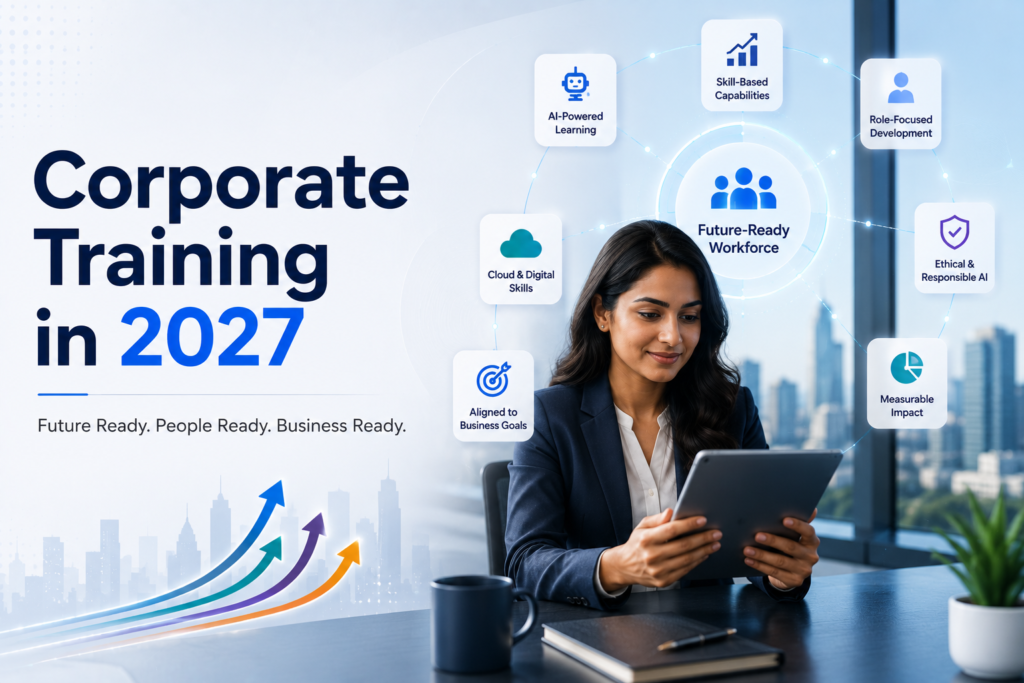
By 2027, corporate training in India will look fundamentally different from today. The shift is already visible: Indian enterprises in IT, BFSI, manufacturing, and GCCs are moving from generic, event-based training to structured, outcome-linked capability building. The focus is no longer just on “delivering sessions” but on building workforce readiness for AI, cloud, automation, and role-specific digital skills. For CHROs, L&D leaders, and business heads, the question is not whether corporate training will change, but how to prepare now. Organisations that invest in AI tools training for workforce, role-based academies, and business-linked learning models will outperform those that continue with the old model. At Technoedge, we are designing enterprise training programmes that anticipate these 2027 shifts—focusing on future-ready capability building, AI-enabled learning, and role-based design aligned with changing business demands. Why the corporate training model is changing in India The traditional corporate training model in India—off-the-shelf courses, one-day workshops, and generic soft skills programmes—is losing relevance. Several forces are driving this change: 1. Business priorities are evolving faster Enterprises are prioritising cloud migration, AI adoption, digital transformation, and automation. Training must now support these strategic shifts, not just general capability building. 2. Technology is changing the nature of work AI, automation, and cloud tools are reshaping how employees work. AI tools training for workforce is no longer optional; it is a baseline requirement for productivity. 3. Buyers are more demanding CHROs, L&D heads, and business leaders now expect training to show measurable outcomes, not just completion rates. They want to see ROI tied to business goals. 4. Internal capability systems are emerging Many organisations are building internal academies, communities of practice, and role-based learning paths rather than relying solely on external vendors. 5. Corporate training companies India are differentiating Providers are splitting into specialised categories: custom learning partners, technical upskilling specialists, leadership brands, and platform-led digital skills providers. Buying decisions are more nuanced. The result is a training market that rewards providers who can deliver business-relevant, measurable, and scalable capability building. AI tools training for workforce as a mainstream priority By 2027, AI tools training for workforce will be as mainstream as Microsoft 365 or email training is today. Every enterprise will need to prepare employees to use AI responsibly and effectively. What will change by 2027 What organisations need to do now Organisations that act early will see faster productivity gains and better adoption. Skill-based capability building and role-based academies By 2027, the most effective enterprises will move from “training programmes” to “capability systems” built around roles and skills. What this looks like Benefits What usually goes wrong What good looks like is role-based academies grounded in validated skill frameworks and business priorities. Outcome measurement and business-linked learning models By 2027, enterprise buyers will expect training to demonstrate clear business impact, not just learning completion. How measurement will evolve What buyers will demand Corporate training providers that cannot demonstrate outcomes will lose to those that can. Hybrid delivery, project-based learning, and internal capability systems The delivery model for corporate training will continue to evolve toward hybrid, project-based, and internally supported systems. Hybrid delivery Project-based learning Internal capability systems By 2027, the most successful organisations will combine external expertise with internal capability systems for sustained learning. What corporate training companies in India need to do differently Corporate training companies India that continue with the old model—generic courses, feature-focused training, and one-size-fits-all delivery—will struggle. Buyers will increasingly choose providers who can demonstrate: 1. Specialization 2. Customization 3. Outcome linkage 4. Scalable delivery 5. Partnership mindset Providers that embrace these shifts will win more enterprise business. How Technoedge helps with future-ready capability building, AI-enabled workforce training, role-based learning design, and enterprise training programs aligned with changing business demands At Technoedge, we are building enterprise training programmes that anticipate 2027 shifts, not just respond to current demand. Our approach includes: 1. Future-ready capability building 2. AI-enabled workforce training 3. Role-based learning design 4. Enterprise training programs aligned with business demands This ensures organisations are prepared for 2027 and beyond. FAQs 1. Corporate training companies India: what trends will shape corporate training by 2027? Key trends include AI tools training for workforce becoming mainstream, role-based academies and skill frameworks, outcome measurement and business-linked learning models, hybrid delivery and project-based learning, and internal capability systems. Corporate training companies India will need to specialise, customise, and demonstrate ROI. 2. AI tools training for workforce: how will AI change enterprise learning in India? AI will change enterprise learning by making AI literacy a baseline requirement, introducing function-specific AI use cases, embedding prompt engineering as a core skill, including ethics and governance, and using AI to personalise learning paths and support coaching. 3. Corporate learning strategy India: what should organizations start doing now for 2027 readiness? Organisations should start with AI literacy programmes, build role-based competency frameworks, design learning paths aligned to business priorities, invest in measurement and outcome tracking, and begin building internal capability systems like academies and communities of practice. 4. Corporate training companies India: how will enterprise buyers evaluate training partners in the future? Enterprise buyers will evaluate training partners based on specialization, customization depth, delivery quality, outcome linkage, scalability, and partnership mindset. Providers that can demonstrate business impact will win over those that only offer generic training. 5. Workforce upskilling plan: how should companies prepare for future skill shifts? Companies should build adaptable capability systems rather than isolated programmes, prioritise critical roles and skills, invest in AI and cloud readiness, create role-based learning paths, and measure capability maturity over time. Connect with us For organizations planning beyond immediate training needs, future readiness depends on building adaptable capability systems rather than isolated programs. Technoedge can help support that shift through learning strategies and enterprise training interventions designed around emerging workforce priorities. To explore how this can work for your context, you can connect with Technoedge at: https://technoedgelearning.com