

TechnoEdge

Free Master Class

How to Plan Your AI Training Budget for FY26? (For CHROs & L&Ds)

Python for AI

Python for AI 2026
blogs

Python for AI: Complete Beginner to Job-Ready Roadmap for 2026

Why Python Has Become the Entry Point for Every AI Career In today’s technology-driven world, Artificial Intelligence is no longer limited to research labs or large tech companies. It has become a part of everyday business operations, from recommendation systems and chatbots to data analytics and automation. At the center of this transformation is one programming language Python. If you explore job roles such as Data Analyst, AI Engineer, Machine Learning Engineer, or even Automation Specialist, you will notice that Python is a common requirement across all of them. This is not just a trend; it reflects how deeply Python is integrated into the AI ecosystem. However, for beginners, especially those without a technical background, the idea of learning Python can feel intimidating. Many people assume that coding is complex, requires a strong technical foundation, and takes years to master. The truth is quite different. Python is specifically designed to be simple, readable, and beginner-friendly. More importantly, it allows learners to quickly move from understanding basic concepts to building real-world applications. The real challenge is not the difficulty of Python, but the lack of a clear roadmap. Without proper guidance, beginners often: This blog will provide a complete, structured, and practical roadmap that takes you from absolute beginner to job-ready level in Python for AI. What Makes Python the Most Powerful Language for AI? Python’s dominance in AI is not accidental. It is the result of a combination of simplicity, flexibility, and a strong ecosystem. First, Python is designed with readability in mind. Its syntax is simple and closely resembles natural language, which makes it easier for beginners to understand and write code. This reduces the initial learning barrier and allows learners to focus on logic rather than struggling with complex syntax. Second, Python has a rich ecosystem of libraries specifically built for AI and data-related tasks. For example, libraries like NumPy and Pandas allow efficient data manipulation, while libraries like Scikit-learn, TensorFlow, and PyTorch enable machine learning and deep learning. These libraries eliminate the need to build everything from scratch, allowing developers to focus on solving real problems. Third, Python integrates seamlessly with modern technologies such as cloud platforms, APIs, and data visualization tools. This makes it highly versatile and suitable for end-to-end AI solutions. Another important advantage is the strong community support. Since Python is widely used, learners have access to a large number of tutorials, forums, and resources, which makes learning easier and faster. In simple terms: Python reduces complexity and increases productivity That is why it is the backbone of AI development Can You Learn Python for AI Without Any Coding Background? One of the most common concerns beginners have is whether they can learn Python without any prior coding experience. The answer is yes, but it requires the right approach and mindset. Python is beginner-friendly, but AI is not just about coding. It also involves understanding data, logic, and problem-solving. Without these, even simple programming concepts can feel challenging. For non-technical learners, the key is to start slowly and build confidence step by step. Instead of focusing on becoming an expert programmer immediately, you should aim to: Over time, coding becomes more intuitive. It is also important to understand that you do not need to learn everything at once. Learning Python for AI is a gradual process, and progress comes with consistency. Complete Python for AI Roadmap (Step-by-Step Detailed Learning Path for 2026) A structured roadmap is essential to avoid confusion and ensure steady progress. Step 1: Build Strong Programming Fundamentals The first step is to understand the basics of programming. This includes learning how to write simple programs and understanding how logic works in coding. You should focus on concepts such as variables, data types, conditional statements, loops, and functions. These concepts form the foundation of all programming tasks. At this stage, the goal is not to memorize syntax but to understand how problems are solved using code. You should practice simple exercises that involve calculations, decision-making, and repetition. This step builds confidence and prepares you for more advanced topics. Step 2: Learn Data Handling and Data Structures Once you are comfortable with basic programming, the next step is to learn how to work with data. AI systems rely heavily on data, so understanding how to store, manipulate, and analyze data is essential. You will learn about data structures such as lists, dictionaries, and arrays. You will also start using libraries like Pandas to handle real-world datasets. This stage helps you understand how data is organized and processed in practical scenarios. Step 3: Learn Data Visualization and Interpretation Data visualization is an important skill because it helps you understand patterns and communicate insights. Using libraries like Matplotlib and Seaborn, you can create graphs and charts that represent data visually. This step is not just about creating visuals. It is about interpreting data and making sense of it. For example, identifying trends, anomalies, and patterns in data is a critical skill for AI and analytics roles. Step 4: Understand Machine Learning Concepts After building a strong foundation in Python and data, you can move into machine learning. Machine learning involves training models to learn from data and make predictions. At this stage, you should focus on understanding: Using libraries like Scikit-learn, you can build simple models and understand how they work. The emphasis should be on conceptual clarity rather than complex mathematics. Step 5: Build Real-World AI Projects This is the most important stage in your learning journey. Projects help you apply your knowledge and demonstrate your skills. You can build projects such as chatbots, recommendation systems, data dashboards, and automation tools. Working on projects helps you understand real-world challenges and prepares you for job roles. It also strengthens your portfolio, which is important for getting hired. Step 6: Learn Integration with AI Tools and Cloud Platforms In 2026, AI is not used in isolation. It is integrated with other technologies such as cloud platforms and business tools. At this stage, you should learn

How to Start Learning AI in 2026
blogs

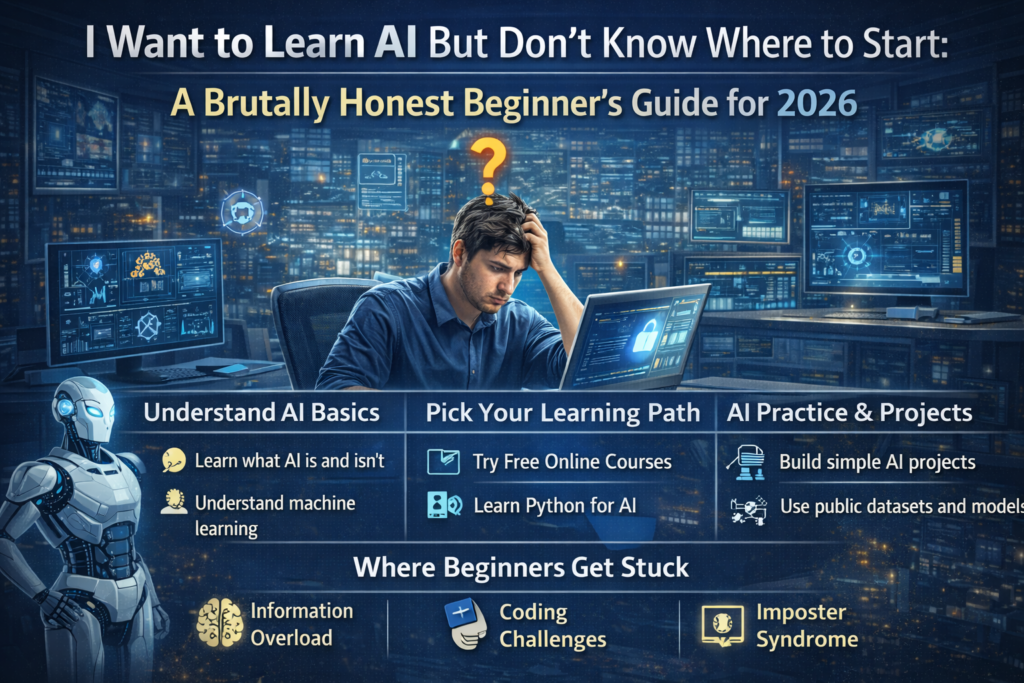
Want to Learn AI But Don’t Know Where to Start: A Brutally Honest Beginner’s Guide for 2026

Why Learning AI Feels So Confusing for Beginners In 2026, Artificial Intelligence is everywhere. You see it in social media, jobs, business tools, and even daily life applications. Naturally, many people feel excited and want to start learning AI. But instead of clarity, most beginners feel overwhelmed. This happens because AI is not a single subject. It is a combination of multiple domains such as data, programming, logic, machine learning, and tools. When beginners search for “how to learn AI,” they are exposed to advanced topics immediately without understanding the foundation. As a result, they feel lost, confused, and often give up before even starting properly. The real problem is not difficulty. The real problem is lack of direction. This guide will remove that confusion and give you a clear, structured, and practical path to start learning AI step by step. What Is AI Actually? (Clear and Practical Understanding) Artificial Intelligence is often misunderstood as something extremely complex or only for experts. But in reality, AI simply refers to systems that can perform tasks that normally require human intelligence. These tasks include understanding language, recognizing patterns, making decisions, and learning from data. However, AI is not one single technology. It is made up of multiple components that work together. Machine Learning allows systems to learn from data. Deep Learning takes this further using advanced neural networks. Natural Language Processing helps machines understand human language. Generative AI enables systems to create content such as text, images, and code. In 2026, the biggest change is that AI has become more accessible. You can now use AI tools without writing complex code. But to build a career, you must understand how AI works behind the scenes, not just how to use tools. Why Most Beginners Fail in AI (Detailed Reality Check) Before you start learning, it is important to understand why many people fail. This will help you avoid common mistakes. The first major mistake is starting without a roadmap. Beginners often jump between videos, courses, and tools without any structured plan. This creates confusion instead of progress. The second mistake is focusing only on tools. Many people use tools like ChatGPT or image generators and believe they are learning AI. But tool usage without understanding concepts leads to shallow knowledge. The third mistake is trying to learn everything at once. AI includes coding, data science, and machine learning. Trying to learn all of these simultaneously overwhelms beginners. The fourth mistake is not practicing. Watching tutorials gives a false sense of learning, but real understanding comes only when you build projects and apply concepts. The key takeaway is simple: 👉 AI is not difficult👉 The wrong approach makes it difficult The Complete AI Learning Roadmap for 2026 (Step-by-Step Detailed Explanation) Now let’s understand the correct way to learn AI in a structured manner. Step 1: Build Strong Thinking and Data Understanding Before touching any AI tool or programming language, you must develop your thinking ability. AI is based on data and logic, so understanding how data works is essential. You need to learn how data is collected, structured, and used to make decisions. This stage helps you build analytical thinking, which is the foundation of AI. Without this step, you may learn tools, but you will not understand their output. Step 2: Start with AI Tools to Understand Practical Usage At this stage, you begin using AI tools such as ChatGPT, Canva AI, or Notion AI. The goal here is not mastery but understanding. You learn how AI behaves, how prompts work, and how outputs are generated. This step is important because it connects theory with real-world application. It helps you understand how AI is actually used in business and daily tasks. Step 3: Learn Basic Programming (Python) Once you understand how AI works at a basic level, you should start learning Python. Python is the most commonly used language in AI because it is simple and powerful. You do not need advanced programming knowledge. Basic concepts such as variables, loops, functions, and data handling are enough to get started. This step allows you to move from using AI tools to building AI-based solutions. Step 4: Understand Machine Learning Concepts After learning basic programming, you move into machine learning. Here, you learn how models are trained using data, how predictions are made, and how different algorithms work. The focus should be on understanding concepts rather than memorizing formulas. You should understand why a model works, not just how to use it. Step 5: Apply AI in Real Scenarios At this stage, you start combining everything you have learned. You use AI to solve real problems such as automating tasks, analyzing data, or improving workflows. This is where your learning becomes practical and valuable. Step 6: Build Projects to Become Job-Ready Projects are the most important part of your learning journey. They help you: Examples include building chatbots, dashboards, or automation systems. Without projects, it is difficult to prove your skills. AI Career Paths (Detailed Explanation for Clarity) AI offers multiple career options, and choosing the right path is important. If you are a beginner, you can start as an AI tools specialist where you use AI tools for productivity and automation. If you are interested in data, you can become a data analyst using AI tools along with platforms like Power BI. If you prefer technical roles, you can become an AI engineer or machine learning engineer, which require coding and deeper understanding. Each path requires different skills, so your choice should depend on your interest and background. How TechnoEdgels Helps You Learn AI Properly Most learners struggle because they lack direction. TechnoEdgels provides a structured learning approach that solves this problem. Instead of random tutorials, you get a clear roadmap from beginner to advanced level. You learn through real-world projects, which helps you gain practical experience. The platform focuses on industry-relevant skills such as AI, data analytics, and cloud computing. This ensures that what you learn is aligned with current job

Trust Us, One Call Can Make a Difference
Please enable JavaScript in your browser to complete this form.
Join As Trainer
Join As Trainer
Please enable JavaScript in your browser to complete this form.
Download Course Content
Please enable JavaScript in your browser to complete this form.
More than 5 People are attending Get On a Call with Us
Please enable JavaScript in your browser to complete this form.
More than 5 People are attending Get On a Call with Us
Scroll to Top