

TechnoEdge

Free Master Class

How to Plan Your AI Training Budget for FY26? (For CHROs & L&Ds)

Responsible AI implementation

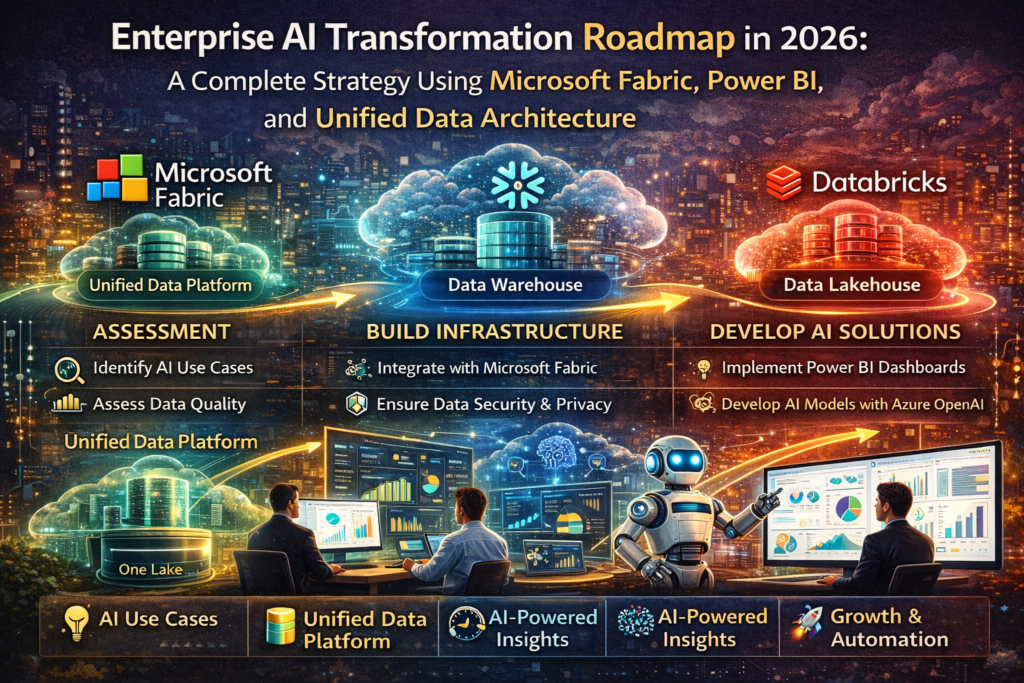
Enterprise AI transformation roadmap in 2026 showing Microsoft Fabric architecture, unified OneLake storage, Power BI dashboards, AI workflow integration, governance controls, and workforce reskilling phases.
blogs

Enterprise AI Transformation Roadmap in 2026: A Complete Strategy Using Microsoft Fabric, Power BI, and Unified Data Architecture

Introduction: AI Transformation Is Not About Tools It Is About Architecture and Culture In 2026, almost every enterprise says it is “doing AI.” But very few organizations are truly AI-transformed. Many companies deploy AI chatbots. Some experiment with predictive dashboards. Others integrate Copilot into Power BI. However, isolated AI adoption does not equal transformation. True enterprise AI transformation requires: Artificial Intelligence is not a feature.It is a structural shift in how organizations operate. This article provides a complete enterprise roadmap for AI transformation using modern platforms such as Microsoft Fabric and Power BI. Phase 1: Data Foundation Modernization Before AI can deliver value, data must be structured, accessible, and reliable. Many enterprises still operate in siloed environments where: AI built on fragmented data produces unreliable outcomes. The first phase of transformation is consolidating data into a unified architecture. Platforms like Microsoft Fabric enable centralized storage through OneLake and lakehouse design. During this phase, enterprises must: Without this foundation, AI adoption will create more confusion than clarity. Phase 2: Business Intelligence Modernization Once the data foundation is stable, enterprises must modernize reporting systems. Traditional static dashboards must evolve into dynamic, real-time insight platforms. Power BI integrated within Fabric allows: This phase shifts organizations from descriptive reporting to predictive awareness. The goal is to reduce decision latency and build trust in unified analytics. Phase 3: AI Integration into Core Workflows After BI modernization, enterprises begin embedding AI into operational workflows. Examples include: At this stage, AI is no longer experimental.It becomes embedded in daily operations. Microsoft Fabric supports this by integrating data pipelines, AI workloads, and reporting within a single environment. The transformation here is operational, not cosmetic. Phase 4: Governance, Compliance, and Responsible AI As AI becomes embedded in decision-making, governance becomes critical. Enterprises must establish: Ignoring governance creates reputational and legal risk. AI transformation must include ethical safeguards. Platforms like Fabric simplify governance implementation through centralized controls, but leadership accountability remains essential. Phase 5: Workforce Reskilling and Cultural Adoption Technology alone cannot transform enterprises. Employees must be trained to: Resistance to AI often stems from fear of replacement. Successful transformation communicates augmentation rather than replacement. Data analysts evolve into AI-augmented strategists.Engineers evolve into AI workflow architects. Cultural readiness defines transformation success. Phase 6: Continuous Optimization and Strategic Scaling AI transformation is not a one-time project. Enterprises must continuously: Scalability becomes the defining factor. Unified platforms reduce operational complexity and support long-term growth. Transformation becomes sustainable only when optimization is ongoing. Why Many AI Transformations Fail Many enterprises fail because they: AI transformation requires structured progression. Skipping phases creates instability. Measuring AI Transformation Success Enterprises should measure success not only by technology adoption but by business outcomes. Key indicators include: Transformation must produce measurable value. Frequently Asked Questions (Expanded and Detailed) How long does enterprise AI transformation typically take? AI transformation timelines vary significantly depending on organization size and complexity. Smaller enterprises may see early results within a year, while large enterprises may require multi-year phased strategies. The process involves architectural redesign, cultural change, and governance implementation, which cannot be rushed without risk. Is Microsoft Fabric necessary for AI transformation? Fabric is not mandatory, but unified platforms simplify transformation significantly. Fragmented environments increase integration complexity and cost. Fabric offers architectural consolidation that supports scalable AI adoption. Can enterprises adopt AI without modernizing data architecture? Technically possible, but strategically risky. AI built on fragmented or inconsistent data leads to unreliable outcomes. Foundation-first transformation is essential. What is the biggest risk during AI transformation? The biggest risk is overestimating AI capability while underestimating governance and cultural resistance. Balanced implementation is critical. Does AI transformation reduce workforce size? AI often augments roles rather than eliminating them. Repetitive tasks decrease, while strategic roles increase. Reskilling determines impact. Final Conclusion Enterprise AI transformation in 2026 is not about deploying tools. It is about redesigning how organizations think, operate, and decide. The roadmap includes: Platforms like Microsoft Fabric and Power BI enable transformation but leadership and strategy define success. Organizations that approach AI transformation structurally gain long-term competitive advantage. Professionals who understand transformation frameworks gain strategic career leverage.  Build Enterprise AI Expertise with TechnoEdgels For structured, deep insights on: Stay aligned with the future of enterprise AI and analytics strategy.

Professional using a multi-agent AI dashboard to manage cross-sector business workflows in a modern 2026 office setting.
blogs

AI Tools for Different Sectors in 2026: How People Use AI to Work Smarter, Grow Faster, and Build Long-Term Trust

Introduction Artificial Intelligence is no longer something only big tech companies use.In 2026, AI tools are part of daily life for bloggers, business owners, marketers, students, developers, and creators. Earlier, people worked manually and spent hours on tasks like research, writing, planning, editing, and analysis. Today, AI tools help reduce that effort and allow people to focus on thinking, strategy, and creativity. However, many people still make one big mistake. They either use AI blindly or avoid it completely. Both approaches are wrong. The real power of AI comes when you understand which AI tools are used in which sector and why. This blog explains AI usage sector by sector, with real tool names, deep explanations, and a clear understanding of how AI supports growth without replacing human intelligence. How Bloggers and Writers Use AI Tools in 2026 Blogging today is not just about writing words. It is about explaining topics clearly, publishing consistently, and building trust with readers and search engines. Bloggers use tools like ChatGPT, Claude, and Gemini to understand topics deeply, expand ideas, and improve the structure of long articles. These tools help bloggers think faster by organizing information logically, but the final explanation still comes from the blogger. For SEO and search intent alignment, bloggers use tools such as Surfer SEO, NeuronWriter, and Frase. These tools analyze top-performing content and show how deeply a topic should be explained to satisfy users and AI-based search systems. Editing tools like Grammarly and Hemingway Editor help bloggers simplify language, remove confusion, and improve readability especially important for Tier 2 and Tier 3 audiences. AI does not replace blogging skills.It strengthens clarity, consistency, and discipline. How Digital Marketers Use AI Tools to Scale Faster Digital marketing today involves content creation, SEO, ads, analytics, and social media. Managing all this manually is difficult. Tools like Jasper AI and Copy.ai help marketers write ad copies, emails, and landing page text faster. AI speeds up execution, while strategy still comes from humans. SEO and competitor analysis tools like Semrush, Ahrefs, and Moz use AI to analyze keywords, trends, and gaps. This allows marketers to make data-driven decisions instead of guessing. Social media tools like Predis.ai, Hootsuite AI, and Buffer AI help generate captions, analyze engagement, and schedule content efficiently. AI allows marketers to focus more on growth strategy and less on repetitive work. How Business Owners and Entrepreneurs Use AI Tools Small business owners often do not have large teams. AI tools help them operate efficiently. Tools like Notion AI and ClickUp AI help with planning, documentation, and workflow organization. Ideas become structured plans quickly. Customer support tools like Tidio, Zendesk AI, and Intercom AI answer common customer questions automatically, improving response time and customer satisfaction. For reports, proposals, and presentations, tools like Gamma AI and Beautiful.ai help create professional content without design skills. AI helps small businesses grow without increasing costs. How Developers and Tech Professionals Use AI Tools Developers use AI to reduce repetitive work and improve focus. Tools like GitHub Copilot and Codeium suggest code, complete functions, and reduce debugging time. Developers still design systems and logic, but AI saves mental energy. Documentation and security tools like Mintlify and Snyk AI help maintain quality and safety in codebases. AI does not replace developers.It improves productivity and reduces burnout. How Designers and Content Creators Use AI Tools Designers and creators use AI to speed up creative workflows. Tools like Midjourney, DALL·E, and Adobe Firefly help generate images, thumbnails, and visual concepts. Designers refine and customize outputs to maintain originality. Video tools like Runway ML, Pictory, and Descript help with editing, subtitles, and script improvement. AI helps creators move from idea to execution faster without losing creative control. How Students and Educators Use AI Tools In education, AI supports learning, not cheating. Students use ChatGPT, Perplexity AI, and Notion AI to understand difficult topics, summarize notes, and practice explanations. Educators use Canva AI, Quizizz AI, and Gradescope to create teaching materials, quizzes, and assessments more efficiently. When used ethically, AI improves understanding and saves time. AI Tools, Trust, and EEAT AI tools do not automatically create trust. Trust comes from how AI is used.When AI helps improve clarity, accuracy, and consistency, it supports Experience, Expertise, Authority, and Trust (EEAT). When AI output is copied blindly, trust is lost. Human responsibility is still the most important factor. Frequently Asked Questions (FAQs) Are AI tools really safe to use across different sectors? Yes, AI tools are safe across all sectors when used responsibly. Search engines, platforms, and users do not judge whether AI was used. They judge content quality, accuracy, and trust. If AI helps improve understanding and clarity, it is safe. Problems occur only when AI output is used without review or fact-checking. Can beginners use AI tools without harming quality? Yes, beginners benefit the most from AI tools. AI helps beginners structure content, understand topics, and avoid common mistakes. However, beginners must still read, understand, and edit AI output. AI should assist learning, not replace thinking. Do AI tools reduce originality and creativity? No. AI does not remove originality. Originality comes from human experience, explanation style, and perspective. AI only provides support. Content becomes generic only when humans stop adding context and insight. How do AI tools support EEAT instead of harming it? AI tools support EEAT by improving clarity, reducing errors, and helping maintain consistency. When humans control final decisions and explanations, AI strengthens expertise and trust rather than damaging it. Is AI-generated content safe for SEO and AI search? Yes, AI-assisted content is safe for SEO and AI search if it is helpful, accurate, and original. Search systems reward value, not the writing method. Low-quality content is penalized, not AI usage. Is WordPress suitable for AI-assisted workflows? Yes. WordPress works very well with AI-assisted blogging and SEO workflows. It supports clean structure, easy editing, and optimization, which aligns perfectly with AI-powered content creation. Final Conclusion AI tools are no longer optional in 2026.They are essential assistants across every sector.

Trust Us, One Call Can Make a Difference
Please enable JavaScript in your browser to complete this form.
Join As Trainer
Join As Trainer
Please enable JavaScript in your browser to complete this form.
Download Course Content
Please enable JavaScript in your browser to complete this form.
More than 5 People are attending Get On a Call with Us
Please enable JavaScript in your browser to complete this form.
More than 5 People are attending Get On a Call with Us
Scroll to Top