AI Upskilling for Teams 2026: How Enterprises Can Scale Capability Without Governance Risk
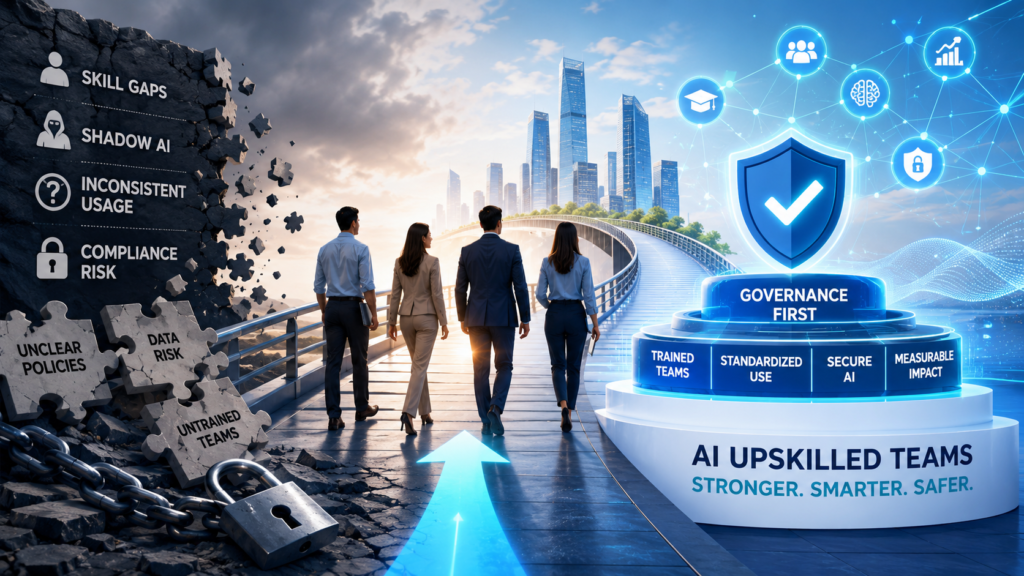
Quick Answer AI upskilling for teams in 2026 should be planned as a governed enterprise capability program, not a one-time AI awareness workshop. CIOs, CISOs, CTOs, CHROs, and L&D Heads should map AI use cases to role-based learning paths, approved tools, data protection rules, governance frameworks, Azure AI capabilities, and measurable business outcomes. The goal is not only to train employees to use generative AI. The real goal is to help teams use AI safely, productively, and responsibly inside approved business workflows. Context Setup: Why This Matters in 2026 Enterprise AI adoption has moved beyond experimentation. Business teams are using generative AI for research, summaries, documentation, reporting, analysis, customer support, sales enablement, and workflow automation. Technical teams are building AI apps, copilots, retrieval systems, and agents. Leadership teams are now asking a more difficult question: how can the organization scale AI capability without increasing governance risk? This is where AI upskilling for teams 2026 becomes a strategic priority. It is no longer enough to run a generic prompt engineering session for all employees. Enterprises need structured, role-based training that connects AI usage with security, compliance, business value, and accountability. The regulatory environment also makes this urgent. The European Commission states that the EU AI Act follows a risk-based approach, with prohibited practices and AI literacy obligations applying from February 2, 2025, GPAI obligations becoming applicable from August 2, 2025, and broader application from August 2, 2026, with some high-risk AI timelines extending later. TechnoEdge supports enterprise teams with role-based AI, Generative AI, Advanced Generative AI, Azure AI, cloud, cybersecurity, and workforce upskilling programs designed for practical adoption and governance alignment. What This Blog Covers In this guide, you will learn: 1. Why Enterprise AI Upskilling Must Start With Governance, Not Tools Many organizations make the same mistake when they begin AI training. They start with tools. They introduce employees to chatbots, copilots, image generators, prompt templates, automation platforms, or AI plugins before defining what employees are allowed to do with them. That approach creates shadow AI risk. Employees may upload confidential information into unapproved tools, automate decisions without review, trust incorrect outputs, bypass procurement rules, or use AI-generated content in sensitive business contexts without disclosure. The issue is not that employees are careless. The issue is that they have not been trained within clear operating boundaries. AI governance is the operating model that defines how AI is selected, approved, deployed, monitored, and controlled across an enterprise. For workforce training, governance should answer practical questions: Which tools are approved? Which data can employees use? Which tasks need human review? Which use cases are prohibited? Which workflows need legal, security, or compliance approval? A governance-first approach helps enterprises avoid a common AI adoption trap: building confidence faster than control. Employees may become fluent in prompts, but still lack the judgment needed to use AI safely inside real business processes. In 2026, enterprise AI training should therefore begin with safe-use principles, risk classification, data handling rules, and escalation paths. Tools should come after those foundations, not before them. 2. How to Build a Governance-Safe AI Upskilling Roadmap A strong enterprise AI training roadmap should connect learning to business workflows. The question is not “How many employees should we train?” The better question is “Which teams need which AI capabilities to improve specific business outcomes without increasing risk?” A governance-safe roadmap should start with approved AI use cases. For example, a marketing team may use GenAI for first-draft content, campaign research, and summarization. A finance team may use AI for report drafting and anomaly explanation, but not for final financial decisions without review. A software team may use AI for code assistance, documentation, test generation, and internal copilots, but must follow secure development practices. Once use cases are clear, enterprises should classify them by risk. Low-risk productivity use cases may require AI literacy and prompt safety. Medium-risk workflows may require manager review, documentation, and approved tool usage. High-impact workflows may require governance, auditability, human oversight, and technical controls. A practical roadmap can follow this sequence: Roadmap Step Enterprise Action Governance Benefit 1. Identify use cases Map AI opportunities by function and process Avoid random tool adoption 2. Classify risk Separate low, medium, and high-impact workflows Match training depth to risk 3. Segment roles Group learners by business, technical, leadership, and risk roles Avoid one-size-fits-all training 4. Select learning paths Build AI literacy, GenAI, Advanced GenAI, Azure AI, and governance tracks Create role-relevant capability 5. Add hands-on labs Use approved business scenarios and policy simulations Convert learning into behavior 6. Measure adoption Track usage quality, productivity, and risk indicators Prove ROI beyond attendance 7. Refresh regularly Update training as tools, policies, and regulations change Keep capability current This approach turns AI upskilling from a training calendar into a workforce capability system. 3. Role-Based AI Training: Why One Learning Path Will Not Work A finance analyst, HR manager, software developer, sales leader, cybersecurity analyst, and legal counsel do not need the same AI training. They may all need AI literacy, but they do not need the same depth of prompt engineering, automation, data handling, Azure AI, or AI governance. AI literacy is the baseline understanding employees need to use AI responsibly, recognize limitations, avoid risky inputs, validate outputs, and follow organizational rules. This should be the foundation for all employees, especially those working with business documents, customer data, internal reports, or decision-support workflows. Generative AI training should then be tailored by function. Business teams need productivity workflows, safe prompting, output review, approved-tool usage, and content verification. Managers need AI use-case approval, quality review, and team adoption practices. Technical teams need deeper coverage of retrieval-augmented generation, evaluation, orchestration, monitoring, integration, and secure deployment. Advanced Generative AI should be reserved for teams that build or manage AI-enabled workflows. These learners need to understand RAG, agents, evaluation, grounding, workflow automation, data access, observability, and failure handling. A practical enterprise segmentation model can look like this: Training Area Target Roles Risk Addressed Capability Built AI Literacy All employees Misuse,