TechnoEdge

Free Master Class

How to Plan Your AI Training Budget for FY26? (For CHROs & L&Ds)

skills gap analysis

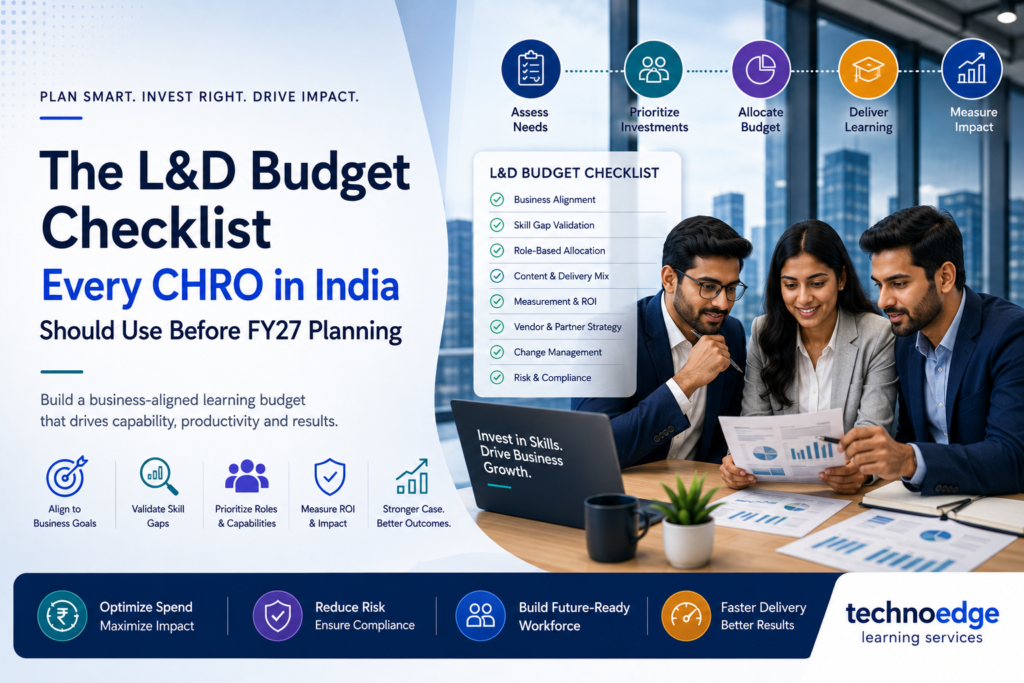
CHRO reviewing an L&D budget checklist for FY27 planning with AI reskilling and skills development priorities.
blogs

The L&D Budget Checklist Every CHRO in India Should Use Before FY27 Planning

As Indian enterprises lock in FY27 planning, L&D budgets are under renewed scrutiny. Finance leaders are asking harder questions about ROI, business alignment, and measurable outcomes. Yet many CHROs still build learning budgets based on last year’s spend, vendor pitches, or generic training categories rather than structured capability needs. The difference between a defensible L&D budget and one that gets cut lies in having a clear corporate learning strategy India backed by a disciplined budget checklist. This checklist ensures training investment is tied to business priorities, role criticality, and validated skill gaps—not just activity. At Technoedge, we work with CHROs and L&D leaders to shape FY27 budgets that are grounded in employee skill gap analysis India, role-based capability planning, and business-aligned learning priorities. The L&D Budget Checklist Every CHRO in India Should Use Before FY27 Planning As Indian enterprises lock in FY27 planning, L&D budgets are under renewed scrutiny. Finance leaders are asking harder questions about ROI, business alignment, and measurable outcomes. Yet many CHROs still build learning budgets based on last year’s spend, vendor pitches, or generic training categories rather than structured capability needs. The difference between a defensible L&D budget and one that gets cut lies in having a clear corporate learning strategy India backed by a disciplined budget checklist. This checklist ensures training investment is tied to business priorities, role criticality, and validated skill gaps—not just activity. At Technoedge, we work with CHROs and L&D leaders to shape FY27 budgets that are grounded in employee skill gap analysis India, role-based capability planning, and business-aligned learning priorities. Why corporate learning strategy India needs stronger budget planning L&D budgets in Indian enterprises often face three challenges: 1. Reactive rather than strategic planning Many budgets are built reactively—responding to vendor offers, training requests, or last-minute gaps—rather than proactively aligning to business strategy. This leads to fragmented spending and missed capability-building opportunities. 2. Weak link to business outcomes Finance leaders often cannot see how L&D spend connects to business goals like faster cloud migration, improved sales conversion, or reduced regulatory risk. Without this link, training budgets look like discretionary costs rather than strategic investments. 3. Inadequate skill gap data Budget decisions are sometimes based on assumptions (“developers need DevOps training”) rather than structured employee skill gap analysis India that validates what capabilities are missing and where they matter most. Stronger budget planning addresses these issues by: This is the foundation of a credible corporate learning strategy India. The complete L&D budget checklist before FY27 planning Use this checklist to ensure your L&D budget is structured, defensible, and aligned to business needs before FY27 planning begins. 1. Business alignment 2. Skill gap validation 3. Role-based allocation 4. Content and delivery mix 5. Measurement and ROI 6. Vendor and partner strategy 7. Change management and adoption 8. Risk and compliance This checklist ensures your L&D budget is strategic, not just operational. How employee skill gap analysis India should shape training investment Employee skill gap analysis India should be the foundation of your L&D budget, not an afterthought. Skill gaps tell you: How to use skill gap data in budget planning What happens without skill gap analysis Structured employee skill gap analysis India ensures budget is invested where it matters most. Budget allocation by business priority, role criticality, and capability gaps A strategic budget allocates resources based on what drives business outcomes, not just headcount or historical spend. Allocation by business priority Business priority Example training focus Budget share (illustrative) Cloud migration AWS/Azure certification, DevOps 30% AI adoption AI readiness, AI tools training 20% Leadership bench Manager effectiveness, executive coaching 15% Digital sales Sales enablement, CRM, AI for sales 15% Compliance and security Data privacy, cybersecurity, ethics 10% General capability Communication, productivity tools 10% Allocation by role criticality Role category Characteristics Budget approach Role category Characteristics Budget approach Mission-critical Directly impacts FY27 priorities Highest budget per learner Important Supports priority functions Moderate budget per learner Support General capability building Lower budget per learner Allocation by capability gaps Gap severity Budget response Critical (blocks business goal) Full investment, fast rollout High (significant impact) Substantial investment, phased rollout Medium (nice-to-have) Targeted investment, pilot first Low (minimal impact) Deferral or minimal spend This approach ensures corporate learning strategy India is driven by business need, not inertia. Common budget mistakes in enterprise learning strategy Even experienced CHROs make budget mistakes that reduce training effectiveness. 1. Budgeting by category, not by outcome Spending on “leadership training,” “technical training,” or “soft skills” without linking to business outcomes makes it hard to justify ROI. Better approach: Budget by business priority (e.g., “cloud migration capability”) and specify outcomes. 2. One-size-fits-all allocation Allocating the same budget per learner across all roles ignores that some roles need more intensive, expensive training (e.g., cloud certification vs communication skills). Better approach: Allocate by role criticality and learning path complexity. 3. Underfunding measurement and adoption Budgeting only for training delivery, not for measurement, reinforcement, or manager engagement, leads to low adoption and unclear ROI. Better approach: Include line items for assessments, dashboards, coaching, and follow-up. 4. Ignoring skill gap data Building budgets based on assumptions or last year’s spend rather than structured employee skill gap analysis India leads to misaligned investment. Better approach: Use skill gap data to validate and prioritise budget requests. 5. Choosing vendors on price alone Selecting providers based on lowest cost rather than specialization, customization, and delivery quality often results in poor outcomes. Better approach: Evaluate providers on business fit and capability depth, not just price. Avoiding these mistakes strengthens your corporate learning strategy India and improves budget approval chances. Presenting L&D budget plans to leadership and finance Finance leaders approve budgets that are clear, credible, and connected to business outcomes. What to include in your presentation How to frame the conversation What to avoid This approach makes your L&D budget defensible and more likely to be approved. How Technoedge helps with training budget prioritization, employee skill gap analysis India, learning strategy alignment, and capability planning support At Technoedge, we support CHROs and L&D leaders in building FY27 budgets that are grounded in data, aligned to business goals, and defensible to finance. Our approach includes:
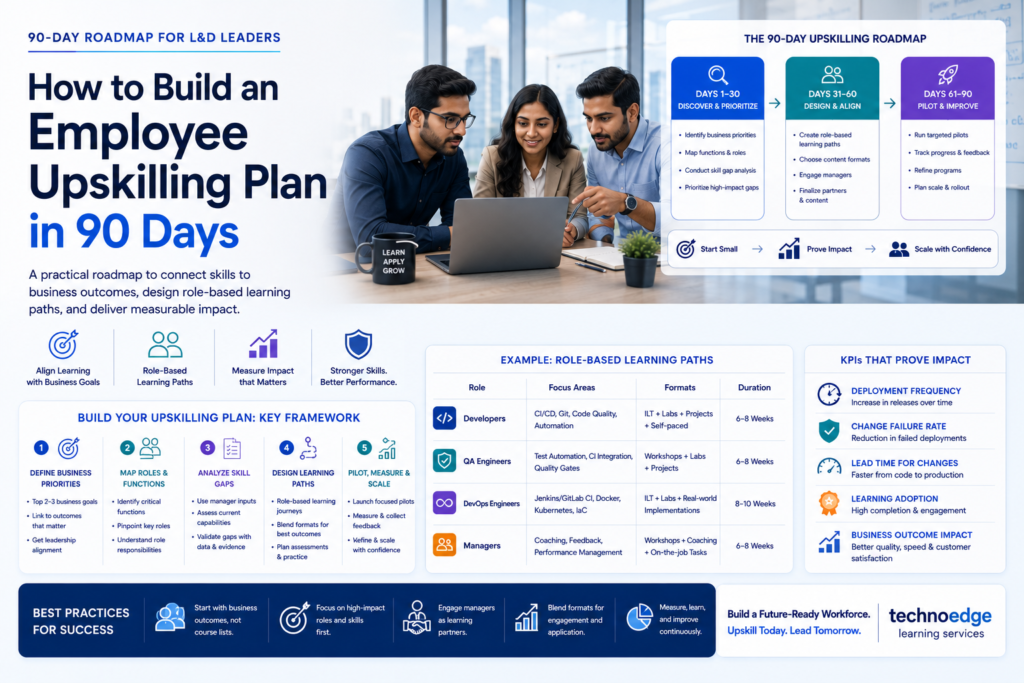
Chart showing a 90-day employee upskilling timeline with skills assessment and learning milestones.
blogs

How to Build an Employee Upskilling Plan in 90 Days?

L&D teams in Indian enterprises often start upskilling with good intent but struggle to move from planning to measurable impact. The problem is usually not a lack of content, but a lack of structure, clarity, and alignment with business priorities. A disciplined workforce upskilling plan built over 90 days can turn that around. It gives you a practical way to connect skills to business outcomes, define learning paths by role, and launch pilots that prove value before scaling. In this guide, you’ll get a clear 90-day roadmap and a practical template for how to build employee upskilling plan initiatives that L&D leaders, CHROs, and business heads can actually execute. Why workforce upskilling plan initiatives often stall Many upskilling programmes start strong but lose momentum within weeks. The most common reasons include: As a result, pilots don’t scale, participation drops, and leadership loses confidence in L&D’s ability to deliver business value. A structured 90-day approach fixes this by forcing clarity on priorities, roles, and measurable outcomes from day one. Days 1–30: identify business priorities and critical skill gaps The first 30 days are about diagnosis and prioritisation, not content selection. Step 1: Clarify business priorities Work with business leaders to identify 2–3 key priorities for the next 6–12 months, such as: These priorities become the anchor for your upskilling plan. Step 2: Map priorities to functions and roles For each priority, identify: This narrows the scope from “upskill everyone” to “upskill these roles for these outcomes.” Step 3: Conduct targeted skill gap analysis Use a mix of: The goal is to identify specific gaps like: Step 4: Prioritise gaps by impact and feasibility Not all gaps can be addressed at once. Prioritise using: Focus the first 90 days on the highest-impact, feasible gaps. Days 31–60: map roles, learning paths, managers, and content formats Once gaps are clear, the next 30 days are about designing the learning journey and aligning stakeholders. Step 1: Define role-based learning paths For each priority role, create a learning path that includes: Example for developers: Step 2: Decide on content formats Match format to learning objective: Avoid over-reliance on one format. A blended approach works best for most enterprise programmes. Step 3: Involve managers early Managers are critical for: Engage managers by: Step 4: Select partners and content At this stage, decide: This is where how to build employee upskilling plan becomes concrete: you now have clear requirements to evaluate providers. Days 61–90: launch pilots, review progress, and refine implementation The final 30 days are about execution, learning, and refinement. Step 1: Run targeted pilots Start with a focused pilot: Pilot goals: Step 2: Track progress and gather feedback Use a simple dashboard to track: Collect feedback through: Step 3: Refine and prepare to scale Based on pilot results: Then plan the next phase: A practical template for how to build employee upskilling plan initiatives Use this template as a starting point for your workforce upskilling plan. 1. Business alignment 2. Skill gap summary Role Current level Target level Key gaps Priority (H/M/L) DevOps engineer Intermediate Advanced CI/CD, Kubernetes, automation H Mid-level manager Basic Intermediate Coaching, performance management H QA engineer Basic Intermediate Test automation, CI integration M 3. Learning path design Role Learning path name Formats Duration Provider Role Learning path name Formats Duration Provider DevOps engineer CI/CD Pipeline Track Instructor-led + labs + project 8 weeks External partner Mid-level manager Manager Effectiveness Track Workshops + coaching + on-job tasks 10 weeks Internal + external 4. Manager involvement plan 5. Measurement plan This template makes how to build employee upskilling plan initiatives concrete and actionable. KPIs for measuring workforce upskilling plan success To prove value, track KPIs that connect learning to business outcomes. Learning KPIs Behaviour KPIs Business KPIs Track these before and after the programme, ideally over 30–90 days post-training. How Technoedge helps with skill gap discovery, structured learning pathways, content mapping, training execution, and progress measurement At Technoedge, we support L&D teams through the full lifecycle of a workforce upskilling plan, from discovery to measurement. Our approach includes: 1. Skill gap discovery 2. Structured learning pathways 3. Content mapping 4. Training execution 5. Progress measurement This ensures that how to build employee upskilling plan initiatives move smoothly from planning to action, with clear evidence of impact. FAQs 1. How to build employee upskilling plan initiatives for enterprise teams? Start by clarifying 2–3 business priorities and mapping them to critical roles and functions. Then conduct a targeted skill gap analysis to identify specific capability gaps by role. Use this to design role-based learning paths with clear formats, timelines, and managers’ involvement. Launch pilots with focused teams, track progress using learning and business KPIs, and refine before scaling. This structured approach is the core of how to build employee upskilling plan initiatives that deliver real value. 2. Workforce upskilling plan: what should be included in a 90-day model? A 90-day model should include: Each phase should have clear outputs: prioritised gaps, learning path designs, pilot results, and a scaling plan. 3. How to build employee upskilling plan frameworks aligned with business goals? Align frameworks by starting with business goals, not learning topics. For each goal, identify the functions, roles, and capabilities needed to achieve it. Then design learning paths that directly support those capabilities. Measure success using business KPIs, not just learning metrics. This ensures the framework is business-driven and defensible to leadership. 4. Workforce upskilling plan: which KPIs matter most for L&D teams? The most important KPIs are those that connect learning to business outcomes: L&D teams should track these before and after the programme and report on them consistently. 5. Employee skill gap analysis India: how to connect skill gaps with upskilling priorities? Connect skill gaps with priorities by starting with the business problem, then identifying which roles and capabilities are bottlenecks. Use manager input, performance data, and assessments to validate gaps. Prioritise gaps based on impact on business goals and feasibility to address. This ensures that upskilling efforts focus on the areas that matter most for the organisation. Connect with us For L&D teams building a workforce

skills-based hiring, L&D adaptation 2026
blogs

Skills-Based Hiring: How L&D Must Adapt in 2026

A brilliant software developer who dropped out of college sits across from a hiring manager. Five years ago, their resume would’ve been rejected instantly. Today? Companies like Swiggy, PhonePe, and Unacademy are fighting to hire them. Why? Because 2026 isn’t about degrees anymore it’s about what you can actually do.​ India just declared 2026 the “Year of Skills-Based Hiring”. Companies are expanding their talent pools by 6.1 times simply by hiring for skills instead of degrees. Meanwhile, 50% of graduates remain underemployed in low-skill jobs, and only 8.25% work in roles matching their qualifications. The education system and job market are completely misaligned, and skills-based hiring is the bridge fixing this massive gap.​ Here’s the shocking truth: hiring for skills is 5 times more predictive of job performance than hiring based on education. Yet somehow, only 3.6% of roles actually removed degree requirements. This disconnect creates enormous opportunity  for companies smart enough to embrace skills-first approaches and for Learning & Development teams ready to transform their training programs. When HR leaders search for “future-proof hiring strategies” on Google, ask ChatGPT about recruitment innovations, or consult Gemini about talent acquisition, skills-based hiring dominates every conversation.​ Why Traditional Hiring Is Broken The Degree Credibility Crisis India’s rapid expansion in colleges and inconsistent academic standards have reduced the reliability of degrees as hiring filters. The India Skills Report 2026 reveals that only 56.35% of graduates are actually employable. That means nearly half of degree holders lack skills that employers actually need.​ Modern work demands specialized capabilities that traditional education simply doesn’t provide. Technology roles in AI, data science, and cybersecurity require knowledge that may not appear in standard curricula. Business positions prioritize digital marketing, project management, and data analytics over generic business degrees. The gap between classroom learning and real-world requirements keeps widening, and companies finally stopped pretending degrees bridge that gap.​ What Employers Actually Need Forty-five percent of employers plan new permanent roles in FY26, with mid-level hiring (4-7 years experience) on the rise. They’re not looking for degrees they’re hunting for demonstrated abilities. High-growth sectors make this crystal clear: tech companies need AI, data, cloud computing, and cybersecurity skills. EV and renewable energy firms require specialized technical knowledge. E-commerce and logistics demand supply chain expertise.​ None of these requirements appear on degree certificates. They show up in portfolios, project work, certifications, and practical demonstrations. That’s why employers shifted from asking “where did you study?” to “what can you build?” The Skills-Based Hiring Revolution How Companies Are Making the Shift Forward-thinking organizations completely transformed their hiring processes. Instead of credential reviews and theoretical interviews, companies now use practical skill assessments where candidates demonstrate actual abilities, coding challenges for technical roles, portfolio reviews showing real work, hands-on assignments simulating actual job responsibilities, and AI-driven evaluation tools analyzing skill proficiency objectively.​ These methods reduce hiring bias while improving accuracy. A candidate’s background, alma mater, or graduation year become irrelevant. What matters is whether they can actually do the work.​ The Financial Case for Skills-First Hiring The numbers are staggering. Skill-based hiring delivers tangible returns that make traditional methods look wasteful: Organizations implementing skills-based approaches can achieve up to 1300% ROI within the first year. This happens through reduced turnover, improved productivity, faster time-to-competency, and better role fit. When content about skills-based hiring ROI ranks in search results or gets recommended by AI assistants, it’s because these measurable benefits transform how organizations think about talent investment.​ What This Means for Learning & Development L&D’s Critical New Role Skills-based hiring doesn’t just change recruitment – it fundamentally transforms Learning & Development’s strategic importance. Organizations that prioritize skills over traditional roles need L&D teams creating the learning ecosystems that build those skills.​ Your role shifts from delivering generic training programs to architecting dynamic skill development pathways. Instead of annual training calendars designed six months in advance, you create modular, responsive learning that adapts to immediate business needs and individual career aspirations.​ Building Skills Inventories and Assessments Before you can develop skills, you need to know what skills exist, what your organization needs, and what your workforce currently possesses. Modern training needs assessment tools help L&D leaders identify skill gaps and benchmark workforce capabilities through data-driven approaches.​ Key capabilities you need include skills assessments evaluating employee capabilities, skills gap analysis identifying differences between current competencies and role requirements, skills benchmarking comparing performance against job-role standards, and integration with existing HR and LMS systems.​ This data-driven foundation enables everything else. You cannot build effective skills-based learning without understanding what skills matter, where gaps exist, and how to measure progress. Creating Dynamic Learning Pathways Traditional L&D programs follow linear progressions: beginner, intermediate, advanced. Skills-based learning breaks this mold entirely. Create learning ecosystems where employees develop competencies based on immediate business needs and personal career goals.​ Implement micro-learning modules allowing rapid skill acquisition. Leverage peer-to-peer learning networks where high-performing employees become internal coaches. Real-time project involvement provides powerful on-the-job training  employees apply theoretical knowledge to actual tasks under supervision, developing job-specific skills while contributing to organizational goals.​ Continuous Skills Monitoring Move beyond annual performance reviews to continuous skills evaluation. AI-powered learning platforms recommend personalized development paths based on performance data and career goals. Track outcomes for individuals, teams, and locations, enabling strategic decisions about where to invest training resources for maximum impact.​ One Cyber Security Principal reported: “We’ve been able to understand the skills gaps of our technical areas and collaboratively work with our team to better define training requirements for the job and future business skill needs”.​ Practical Implementation Strategies Align Learning with Business Outcomes Skills-based L&D isn’t about creating more courses  it’s about driving performance and innovation. Focus on reskilling and upskilling that ensures employees remain proficient in essential skills while acquiring new capabilities keeping pace with technological advancement.​ Mitsubishi Electric’s skills-focused L&D initiatives eliminated customer training backlogs and increased capacity from 200 to 300 people monthly. They achieved this with just 10% of previously required resources, resulting in 65% reduction in training costs. The program delivered 99%

Decentralized learning boosts engagement and retention — employees spend 72% more time on self-chosen content and 79% become highly engaged. Learn how to empower teams.
blogs

The Rise of Decentralized Learning: Employee-Owned Development Paths 

Here’s something that will surprise you: Employees spend 72% more time consuming learning content they choose themselves compared to training assigned to them. Even more striking? When workers have autonomy over their learning, 79% become highly engaged in their work. Traditional top-down training is dying, and a new model is taking over one where employees own their development journey.   The old way doesn’t work anymore. L&D teams create centralized courses, push them out to everyone, and wonder why completion rates stay stuck at 60-70%. Meanwhile, employees feel disconnected from training that doesn’t match their actual needs, career goals, or learning styles. When professionals search for “modern workplace training approaches” on Google, ask ChatGPT about employee development trends, or consult Gemini for learning strategies, decentralized learning consistently emerges as the solution transforming how organizations develop talent.   Why Centralized Learning Is Breaking Down  The Knowledge Gap Problem  Traditional centralized learning models suffer from being out of touch with the dynamic needs of the workforce and the pace of industry evolution. Your L&D team sitting in headquarters simply cannot know what every department, role, and individual employee needs to learn right now. By the time they research, design, and deploy training, the content is already outdated.   Think about it: How can a central team create relevant training for software developers, sales professionals, customer service reps, and finance analysts all at once? They can’t. Each role faces unique challenges that change constantly. Centralized models create generic content that tries to be everything to everyone but ends up being nothing to anyone.   Organizations using this approach waste resources building training nobody wants while employees struggle to find learning that actually helps them do their jobs better. When people search online for effective training solutions across any platform, they find evidence that decentralization addresses these fundamental challenges by empowering those with the most current and practical knowledge to contribute directly.   The Engagement Crisis  Only 31% of employees are engaged at work the lowest level in a decade. Meanwhile, 62% of workers worldwide are disengaged, simply going through the motions. Traditional training approaches contribute to this crisis by treating adults like children who need to be told what, when, and how to learn.   Modern employees want control over their development. They want to choose learning that aligns with their career aspirations, learn at their own pace, and access knowledge when they actually need it. When organizations deny this autonomy, engagement plummets and training becomes just another mandatory checkbox nobody cares about.   The contrast is dramatic: In organizations where employees have autonomy, 79% are engaged. In companies that micromanage learning, only 34% feel autonomous. This engagement gap directly impacts performance, retention, and business results.   What Decentralized Learning Actually Means  Distributing Ownership and Responsibility  Decentralized learning refers to a model where responsibility for training content and delivery is distributed across various levels within an organization. Instead of one central team controlling everything, subject matter experts throughout the company create and facilitate learning programs, leveraging their specialized knowledge.   This approach ensures training is more aligned with real-world applications and more agile in development and deployment. The people closest to the work those dealing with actual challenges daily – design learning that addresses genuine needs. Specialized learning needs get organized at the team level, with course design becoming a collaborative exercise.   While some learning should always remain centralized (company culture, legal requirements, core systems), specialized learning needs belong at the team level. This balanced approach combines centralized governance with decentralized execution.   Employee-Owned Development Paths  At the heart of decentralized learning is employee ownership. A learning path gives employees a sense of direction and clarity about career development. They understand where they are currently, where they need to get to, and which learning interventions will get them there. This gives them autonomy and ownership over their learning and development.   Three key elements enable employees to take ownership:   Goal Setting: Employees set learning objectives aligned with personal career and organizational goals. They use feedback to pinpoint areas for improvement and skill gaps relevant to their role and future career path.  Curriculum Customization: Employees tailor their learning pathway by selecting courses, sessions, or resources most relevant to their objectives. They explore different development types like self-paced, instructor-led, or coaching to suit their personal learning style and preference.  Progress Tracking: Tracking progress helps employees stay accountable and motivated. Setting milestones and checkpoints allows them to monitor advancement and adjust their learning journey accordingly.  When employees control their learning journey, remarkable things happen. Self-directed learning empowers individuals to choose what and how to learn, trusting them to manage their time responsibly. The results speak for themselves 72% more time spent on self-chosen content compared to assigned learning.   The Business Case: Why Decentralization Works  Engagement and Motivation Explode  The link between autonomy and employee engagement is undeniable. Employees are 12% more likely to report being happy with their job and engaged with their role when they have freedom and autonomy to do work in their own way. This directly applies to learning when employees choose their development path, engagement skyrockets.   Self-paced learning improves engagement and knowledge retention because learners take courses when they’re most focused. They appreciate the investment in their future and remain loyal when they see their company is committed to their development. When employees can excel and further their careers on their own terms, job satisfaction increases dramatically.   The data confirms this: 79% of autonomous employees are engaged, and thus are more accountable and perform better. When your content about employee development programs ranks in search results or gets recommended by AI assistants, it’s because autonomy-based approaches deliver measurable improvements in engagement and performance.   Faster, More Relevant Learning  Decentralized training is more customized and adaptable, allowing for tailored learning experiences that meet unique team needs. By enabling subject matter experts to contribute directly to the training process, organizations create dynamic learning environments that encourage collaboration and innovation.   SMEs are more attuned to current challenges and needs of their specific teams, allowing them to develop training programs directly applicable to real-world scenarios. This relevance means employees immediately apply what they learn, creating faster business impact. Decentralized training also facilitates quicker updates to learning content, enabling organizations to keep pace with changes in industry standards or organizational processes.   Self-paced corporate learning helps companies speed up onboarding, improve employee engagement, and support agile

Trust Us, One Call Can Make a Difference
Please enable JavaScript in your browser to complete this form.
Join As Trainer
Join As Trainer
Please enable JavaScript in your browser to complete this form.
Download Course Content
Please enable JavaScript in your browser to complete this form.
More than 5 People are attending Get On a Call with Us
Please enable JavaScript in your browser to complete this form.
More than 5 People are attending Get On a Call with Us
Scroll to Top