
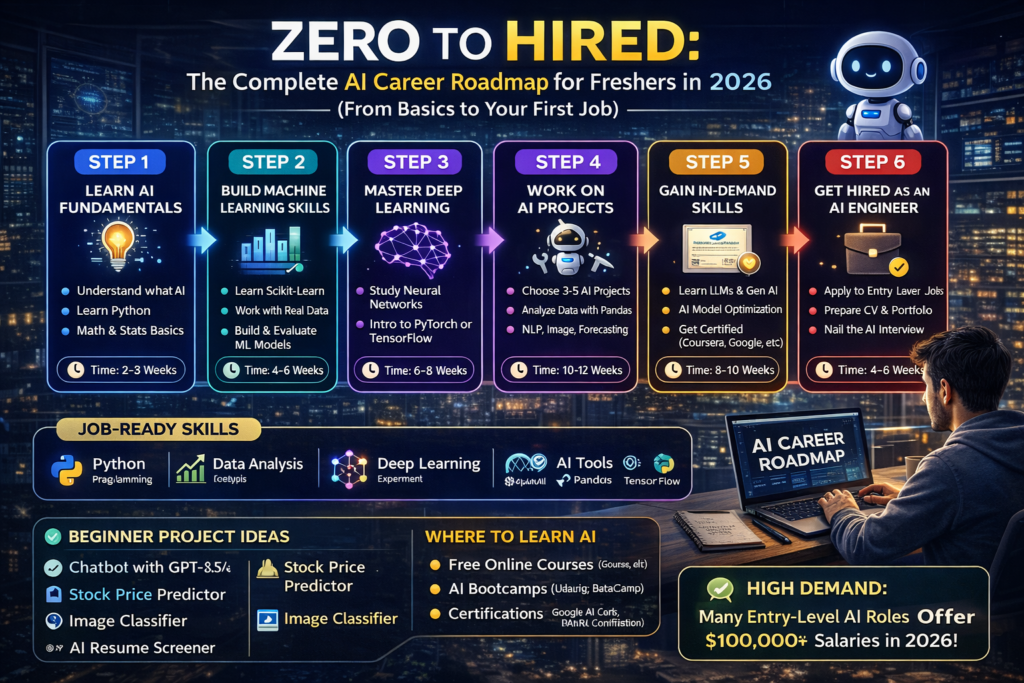
The Complete AI Career Roadmap for Freshers in 2026
Why Starting an AI Career Feels Overwhelming In 2026, Artificial Intelligence is no longer a future trend it has become a core part of how businesses operate. Companies are using AI to automate tasks, analyze data, improve customer experience, and make faster decisions. This rapid growth has created one of the biggest job opportunities in the modern tech world. However, for freshers, this opportunity often feels confusing instead of exciting. When someone decides to start a career in AI, they are immediately exposed to terms like machine learning, deep learning, data science, prompt engineering, automation, and many more. Without a clear structure, it becomes difficult to understand where to begin. This confusion leads to common problems: The reality is: AI is not impossible to learnBut it requires a clear roadmap and proper strategy This blog will give you exactly that a complete, step-by-step career roadmap that takes you from zero knowledge to getting your first job in AI. Understanding What Companies Actually Expect from Freshers in AI Roles Before starting your learning journey, it is very important to understand what companies are actually looking for when they hire freshers. Most beginners believe that companies expect deep technical expertise or advanced AI knowledge. But in reality, companies are looking for candidates who can solve problems using AI tools and data. In 2026, hiring trends show that companies prefer candidates who: This means that you do not need to be an expert in machine learning from day one. Instead, companies value: 👉 Practical skills over theoretical knowledge👉 Real projects over certificates This is an important mindset shift. Your goal is not just to learn AI it is to become job-ready. Step-by-Step AI Career Roadmap for Freshers (From Zero to Job-Ready Level) This roadmap is designed for beginners with no technical background. Step 1: Build a Strong Foundation in AI, Data, and Logical Thinking The first step is not coding. It is understanding how AI works at a basic level. You need to learn: This step builds your thinking ability. Without understanding these basics, learning advanced concepts becomes difficult. You should focus on developing logical thinking and problem-solving skills. This stage prepares your mind for everything that comes next. Step 2: Start Using AI Tools to Understand Real-World Applications Once you understand the basics, the next step is to start using AI tools. This is important because it helps you connect theory with real-world use. You should explore tools that are widely used in industries, such as: At this stage, you learn how AI behaves, how it responds to instructions, and how it can be applied in real scenarios. This builds practical confidence. Step 3: Learn Python and Data Handling (Core Skill Development) After getting comfortable with AI tools, you should move into Python. Python is important because it allows you to: You should also learn how to handle data using tools and libraries. This stage is where you move from being a user of AI to someone who can build with AI. It is important to take this step slowly and focus on understanding rather than rushing. Step 4: Understand Machine Learning Concepts in a Practical Way Once your Python and data basics are clear, you can move into machine learning. This stage involves understanding: You do not need to go deep into mathematics at the beginning. Instead, focus on understanding how these concepts are applied in real-world scenarios. This step helps you understand the “brain” behind AI systems. Step 5: Build Real Projects That Show Your Skills This is the most important stage of your journey. Projects are what make you job-ready. Without projects, your learning remains incomplete because you are not applying what you have learned. You should build projects such as: These projects help you: A strong portfolio can make a huge difference in getting your first job. Step 6: Learn Industry Tools (Power BI, Microsoft Fabric, AI Tools) To become job-ready, you need to align your skills with industry demand. Companies use tools such as Power BI for data visualization and Microsoft Fabric for data engineering and analytics. Learning these tools helps you: This step connects your learning with real-world job roles. Step 7: Prepare for Jobs (Resume, Portfolio, Interviews) The final step is preparing for job applications. Many candidates focus only on learning and ignore this stage, which leads to delays in getting hired. You need to: You should also start applying for jobs early instead of waiting for perfection. This step converts your learning into real opportunities. Common Mistakes That Stop Freshers from Getting Hired Many freshers struggle not because they lack ability, but because they follow the wrong approach. One common mistake is trying to learn everything at once. AI is a vast field, and learning everything together leads to confusion. Another mistake is focusing only on theory. Without practical experience, it becomes difficult to demonstrate skills. Some candidates also delay applying for jobs because they feel they are not ready. This slows down their progress. The correct approach is: 👉 Learn step by step👉 Build projects👉 Start applying early How TechnoEdgels Helps You Go from Beginner to Hired (Real Career Support) Most learners fail because they do not have a structured path. TechnoEdgels provides a complete system that takes you from beginner level to job-ready stage. It focuses on: Instead of teaching isolated topics, it connects AI with data and cloud technologies, which are highly in demand. This ensures that you are not just learning you are preparing for real jobs. 👉 Start your journey here:https://technoedgels.com/ Frequently Asked Questions 1. Can I really start an AI career with zero background? Yes, you can start an AI career with zero background. Many professionals today have transitioned into AI from non-technical fields. The key is to follow a structured roadmap and build skills step by step. Initially, you can start with AI tools and basic concepts, and gradually move into programming and advanced topics. Consistency and practice are more important than prior knowledge. 2. How