

TechnoEdge

Free Master Class

How to Plan Your AI Training Budget for FY26? (For CHROs & L&Ds)

Unified Analytics Platform

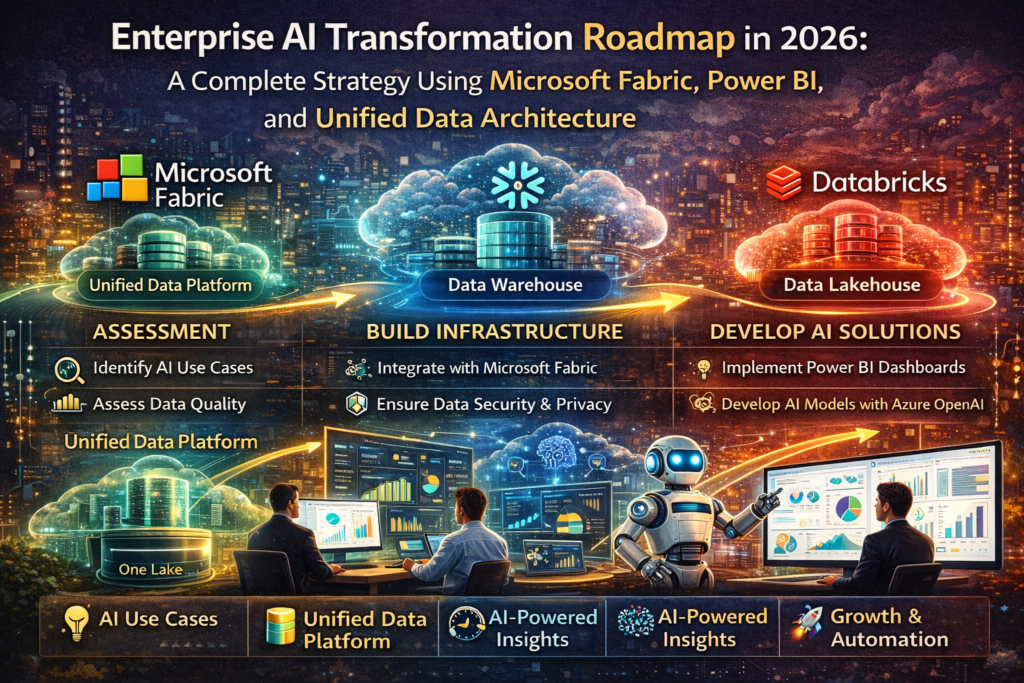
Enterprise AI transformation roadmap in 2026 showing Microsoft Fabric architecture, unified OneLake storage, Power BI dashboards, AI workflow integration, governance controls, and workforce reskilling phases.
blogs

Enterprise AI Transformation Roadmap in 2026: A Complete Strategy Using Microsoft Fabric, Power BI, and Unified Data Architecture

Introduction: AI Transformation Is Not About Tools It Is About Architecture and Culture In 2026, almost every enterprise says it is “doing AI.” But very few organizations are truly AI-transformed. Many companies deploy AI chatbots. Some experiment with predictive dashboards. Others integrate Copilot into Power BI. However, isolated AI adoption does not equal transformation. True enterprise AI transformation requires: Artificial Intelligence is not a feature.It is a structural shift in how organizations operate. This article provides a complete enterprise roadmap for AI transformation using modern platforms such as Microsoft Fabric and Power BI. Phase 1: Data Foundation Modernization Before AI can deliver value, data must be structured, accessible, and reliable. Many enterprises still operate in siloed environments where: AI built on fragmented data produces unreliable outcomes. The first phase of transformation is consolidating data into a unified architecture. Platforms like Microsoft Fabric enable centralized storage through OneLake and lakehouse design. During this phase, enterprises must: Without this foundation, AI adoption will create more confusion than clarity. Phase 2: Business Intelligence Modernization Once the data foundation is stable, enterprises must modernize reporting systems. Traditional static dashboards must evolve into dynamic, real-time insight platforms. Power BI integrated within Fabric allows: This phase shifts organizations from descriptive reporting to predictive awareness. The goal is to reduce decision latency and build trust in unified analytics. Phase 3: AI Integration into Core Workflows After BI modernization, enterprises begin embedding AI into operational workflows. Examples include: At this stage, AI is no longer experimental.It becomes embedded in daily operations. Microsoft Fabric supports this by integrating data pipelines, AI workloads, and reporting within a single environment. The transformation here is operational, not cosmetic. Phase 4: Governance, Compliance, and Responsible AI As AI becomes embedded in decision-making, governance becomes critical. Enterprises must establish: Ignoring governance creates reputational and legal risk. AI transformation must include ethical safeguards. Platforms like Fabric simplify governance implementation through centralized controls, but leadership accountability remains essential. Phase 5: Workforce Reskilling and Cultural Adoption Technology alone cannot transform enterprises. Employees must be trained to: Resistance to AI often stems from fear of replacement. Successful transformation communicates augmentation rather than replacement. Data analysts evolve into AI-augmented strategists.Engineers evolve into AI workflow architects. Cultural readiness defines transformation success. Phase 6: Continuous Optimization and Strategic Scaling AI transformation is not a one-time project. Enterprises must continuously: Scalability becomes the defining factor. Unified platforms reduce operational complexity and support long-term growth. Transformation becomes sustainable only when optimization is ongoing. Why Many AI Transformations Fail Many enterprises fail because they: AI transformation requires structured progression. Skipping phases creates instability. Measuring AI Transformation Success Enterprises should measure success not only by technology adoption but by business outcomes. Key indicators include: Transformation must produce measurable value. Frequently Asked Questions (Expanded and Detailed) How long does enterprise AI transformation typically take? AI transformation timelines vary significantly depending on organization size and complexity. Smaller enterprises may see early results within a year, while large enterprises may require multi-year phased strategies. The process involves architectural redesign, cultural change, and governance implementation, which cannot be rushed without risk. Is Microsoft Fabric necessary for AI transformation? Fabric is not mandatory, but unified platforms simplify transformation significantly. Fragmented environments increase integration complexity and cost. Fabric offers architectural consolidation that supports scalable AI adoption. Can enterprises adopt AI without modernizing data architecture? Technically possible, but strategically risky. AI built on fragmented or inconsistent data leads to unreliable outcomes. Foundation-first transformation is essential. What is the biggest risk during AI transformation? The biggest risk is overestimating AI capability while underestimating governance and cultural resistance. Balanced implementation is critical. Does AI transformation reduce workforce size? AI often augments roles rather than eliminating them. Repetitive tasks decrease, while strategic roles increase. Reskilling determines impact. Final Conclusion Enterprise AI transformation in 2026 is not about deploying tools. It is about redesigning how organizations think, operate, and decide. The roadmap includes: Platforms like Microsoft Fabric and Power BI enable transformation but leadership and strategy define success. Organizations that approach AI transformation structurally gain long-term competitive advantage. Professionals who understand transformation frameworks gain strategic career leverage.  Build Enterprise AI Expertise with TechnoEdgels For structured, deep insights on: Stay aligned with the future of enterprise AI and analytics strategy.
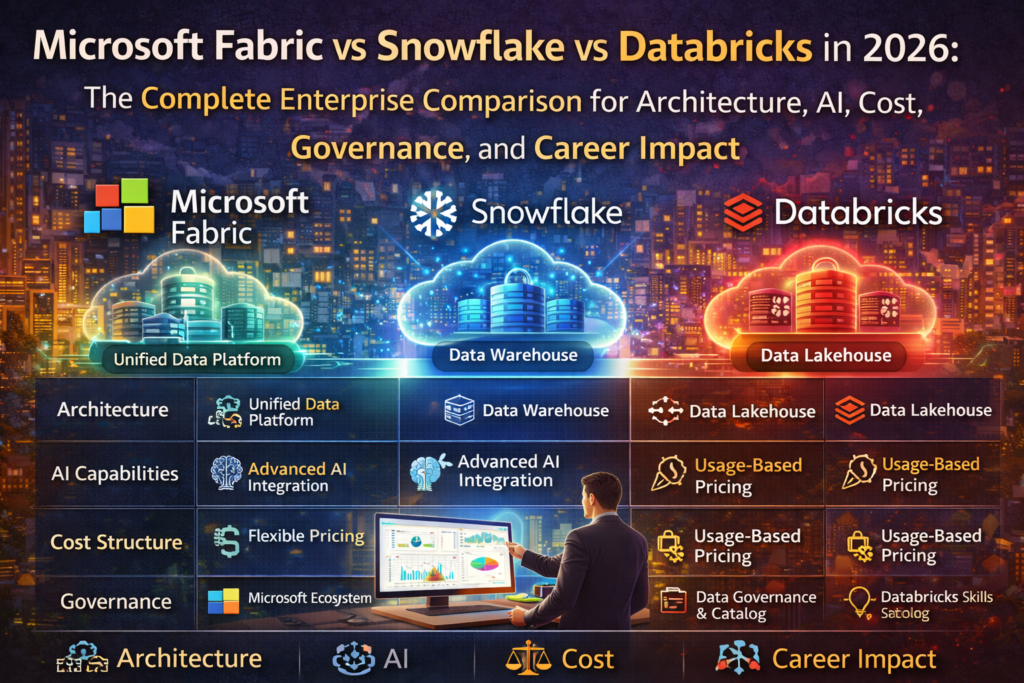
Comparison of Microsoft Fabric, Snowflake, and Databricks architectures in 2026 showing unified ecosystem, cloud-native warehousing, lakehouse model, AI capabilities, and governance layers.
blogs

Microsoft Fabric vs Snowflake vs Databricks in 2026: The Complete Enterprise Comparison for Architecture, AI, Cost, Governance, and Career Impact

Introduction: Why This Comparison Matters More in 2026 Than Ever Before In 2026, enterprise data strategy is no longer about choosing a reporting tool or selecting a storage solution. It is about selecting the backbone of digital transformation. Organizations are not simply buying technology. They are defining how data flows, how AI operates, how governance is enforced, and how decisions are made at scale. Three major platforms dominate this strategic conversation: Each platform represents a different philosophy of enterprise analytics. Microsoft Fabric promotes unified integration within a single ecosystem.Snowflake focuses on high-performance cloud-native warehousing and data sharing.Databricks emphasizes large-scale data engineering and AI-driven lakehouse architecture. For CIOs, data leaders, analytics engineers, and BI professionals, understanding the structural differences between these platforms is critical. This article provides a comprehensive, deeply detailed analysis of all three platforms across architecture, AI capabilities, governance, cost structure, enterprise adoption patterns, and long-term career implications. The Architectural Philosophy of Microsoft Fabric Microsoft Fabric is built around integration. Rather than requiring organizations to assemble multiple separate services for storage, transformation, engineering, and reporting, Fabric unifies them inside a single platform. At the center of Fabric is OneLake, which acts as a centralized enterprise data repository. Instead of duplicating datasets across multiple tools, enterprises store data once and reuse it across workloads. Fabric integrates: This architecture reduces friction between departments. In traditional environments, data engineers manage pipelines, BI teams build dashboards separately, and AI teams operate in isolated systems. Fabric collapses these silos into a unified ecosystem. For enterprises already using Azure and Power BI, Fabric feels like a natural extension. The strength of Fabric lies in architectural coherence. Snowflake’s Architectural Strength: Cloud-Native Specialization Snowflake is fundamentally a cloud-native data warehouse platform. Its architecture separates storage and compute, allowing independent scaling of each component. This flexibility enables enterprises to optimize cost and performance dynamically. Snowflake excels in: Unlike Fabric, Snowflake does not bundle reporting directly into its core architecture. It integrates with external BI tools such as Power BI or Tableau. Snowflake’s strength lies in its specialization. It is extremely strong in structured warehousing and cross-organizational data exchange. However, AI workflows often require additional integration layers. Databricks: Engineering-First and AI-Centric Architecture Databricks is built around Apache Spark and distributed processing frameworks. Its architecture emphasizes large-scale data processing and advanced machine learning workflows. Databricks pioneered the lakehouse model before it became mainstream. It combines data lake flexibility with warehouse-like performance. Key strengths include: Databricks is often preferred by enterprises with large data science teams and AI research initiatives. However, its engineering-first nature can make it less accessible to traditional BI teams. Integration vs Modularity: The Core Strategic Difference The most important difference between these platforms is philosophical. Microsoft Fabric prioritizes integration and ecosystem consolidation.Snowflake prioritizes modular, high-performance warehousing.Databricks prioritizes AI-driven engineering flexibility. If an enterprise values simplicity and centralized control, Fabric often aligns well. If an enterprise values modular flexibility and high-performance structured queries, Snowflake excels. If an enterprise prioritizes machine learning experimentation and advanced data science, Databricks stands out. There is no universal winner. Strategy determines choice. AI Capabilities: Which Platform Is Most Future-Ready? AI readiness is a decisive factor in 2026. Microsoft Fabric integrates AI directly into its analytics workflows. Copilot in Power BI enables conversational BI, automated summaries, and formula generation. Databricks offers deep support for machine learning frameworks, custom model training, and distributed AI workloads. It is highly attractive to data scientists. Snowflake supports AI workloads but often requires integration with external machine learning platforms. If an organization wants AI deeply embedded into everyday BI workflows, Fabric offers accessibility. If an organization prioritizes custom AI model development at scale, Databricks provides stronger flexibility. Governance and Security Comparison Governance in 2026 is not optional. Microsoft Fabric benefits from Azure’s mature enterprise security infrastructure. Access control, compliance monitoring, and audit logging are integrated within the ecosystem. Snowflake also offers robust security features, including encryption and fine-grained access controls. Databricks supports governance through structured catalog systems and enterprise security features, but configuration often requires deeper technical management. Organizations prioritizing governance simplicity may prefer unified ecosystems. Cost Structure and Long-Term Efficiency Cost models vary significantly. Fabric typically operates under capacity-based pricing models integrated within Azure subscriptions. Snowflake uses a consumption-based model, where storage and compute are billed separately based on usage. Databricks pricing depends heavily on compute consumption and workload complexity. While consumption models offer flexibility, they can create unpredictability if not managed carefully. Unified ecosystems may reduce integration overhead costs over time, but platform choice must align with usage patterns. Enterprise Adoption Trends in 2026 Enterprises heavily invested in Microsoft ecosystems are increasingly consolidating around Fabric. Organizations with multi-cloud strategies and strong cross-company data sharing needs continue to adopt Snowflake. Enterprises focused on AI-driven transformation and big data engineering initiatives often lean toward Databricks. Market dynamics show coexistence rather than dominance by a single platform. Career Impact: What Professionals Should Learn For professionals, platform choice influences career trajectory. Microsoft Fabric skills align closely with Power BI and Azure, making it accessible to BI professionals. Snowflake expertise is valuable in data warehousing-focused organizations. Databricks skills are highly sought after in AI-heavy and data science-driven enterprises. Professionals who understand architectural principles across platforms gain maximum flexibility. Specialization creates depth. Cross-platform understanding creates resilience. Frequently Asked Questions   Is Microsoft Fabric replacing Snowflake and Databricks? Microsoft Fabric is not universally replacing these platforms. Instead, it competes strategically in certain enterprise scenarios. Organizations deeply embedded in Microsoft ecosystems may consolidate workloads into Fabric. Others with specialized needs may continue leveraging Snowflake or Databricks depending on performance and AI requirements. Which platform is best for AI-heavy enterprises? Databricks is often preferred for organizations prioritizing advanced machine learning and AI experimentation. However, Fabric integrates AI into BI workflows more seamlessly for business users. Snowflake can support AI but typically relies on additional integration. Is Snowflake losing relevance in 2026? Snowflake remains highly relevant, particularly for structured analytics and secure data sharing across organizations. Its specialization continues to attract enterprises focused on scalable warehousing.

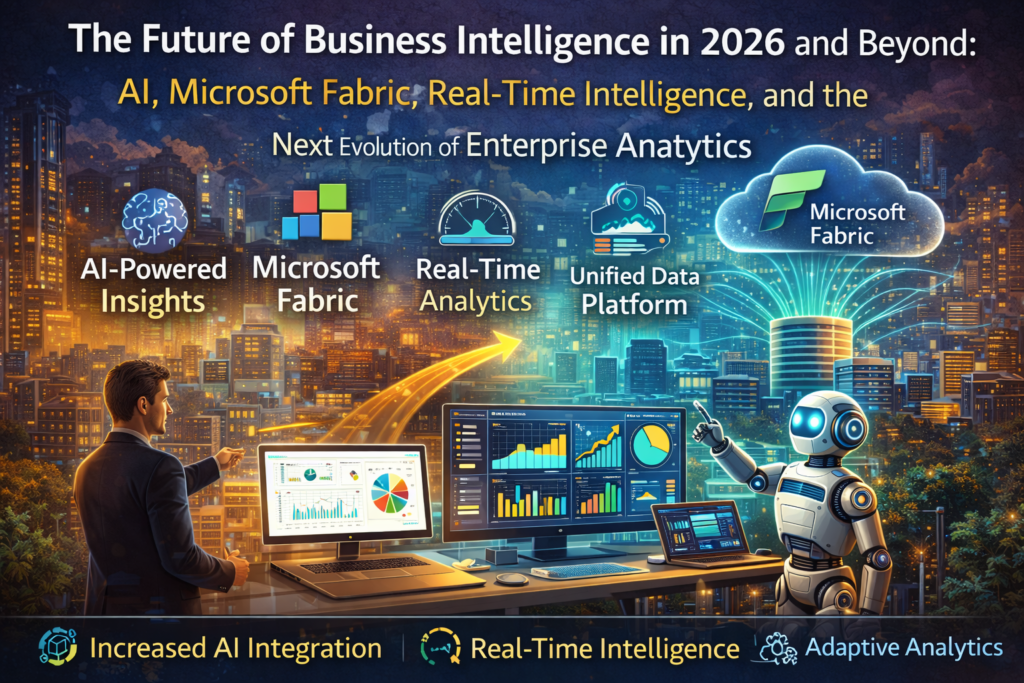
AI-powered business intelligence system in 2026 using Microsoft Fabric, OneLake lakehouse architecture, real-time analytics dashboards, predictive insights, and prescriptive decision recommendations.
blogs

The Future of Business Intelligence in 2026 and Beyond: AI, Microsoft Fabric, Real-Time Intelligence, and the Next Evolution of Enterprise Analytics

Introduction: Business Intelligence Is No Longer About Reports It Is About Intelligent Decision Systems For decades, business intelligence was primarily focused on reporting. Organizations built dashboards to understand historical performance. Monthly revenue charts, quarterly trend analysis, and operational KPIs were the center of BI conversations. However, in 2026, the role of business intelligence has fundamentally shifted. Enterprises are no longer satisfied with understanding what happened. They want to know: This shift represents a movement from passive reporting toward active intelligence. Modern business intelligence systems, powered by Artificial Intelligence and unified platforms like Microsoft Fabric, are evolving into intelligent decision ecosystems. These systems do not merely visualize data. They analyze, predict, recommend, and assist in execution. The future of BI is not an upgrade in visualization design.It is a transformation in enterprise thinking. The Maturity Shift: From Descriptive Analytics to Prescriptive Intelligence To understand the future, we must understand the stages of BI evolution. In the early stages, BI was descriptive. Dashboards answered simple questions: What were last month’s sales? Which region performed best? As tools improved, predictive analytics emerged. Statistical models and machine learning algorithms forecasted trends and projected revenue growth. In 2026, enterprises are entering the prescriptive era. Prescriptive BI systems go beyond prediction. They suggest actions. For example, if customer churn is predicted to increase, prescriptive BI systems can recommend targeted marketing interventions or pricing adjustments. This transformation is possible because of AI integration and scalable cloud architecture. Prescriptive intelligence reduces decision latency. Instead of waiting for analysts to interpret data manually, systems provide structured guidance. However, human validation remains essential. The future is collaborative, not automated dictatorship. Artificial Intelligence: The Core Driver of BI Transformation Artificial Intelligence is not an optional add-on in modern BI systems. It is becoming the foundation. Generative AI capabilities integrated within Power BI allow users to interact with data conversationally. Executives can ask complex business questions in natural language and receive structured responses instantly. AI algorithms analyze massive datasets to detect anomalies, identify correlations, and highlight potential risks before they escalate. Machine learning models embedded in Fabric ecosystems allow real-time forecasting based on streaming data. This dramatically reduces manual analysis workload. However, AI’s value depends on data quality and governance. Without proper architecture and oversight, AI may amplify errors. Therefore, the future of BI requires both intelligence and responsibility. Microsoft Fabric: The Architectural Backbone of Future BI Technology alone does not define the future. Architecture does. The reason Microsoft Fabric plays such a significant role in the future of BI is its unified design philosophy. Traditional analytics environments relied on separate tools for data engineering, warehousing, reporting, and AI integration. This fragmentation slowed innovation and increased complexity. Fabric unifies: This integration reduces data movement friction and ensures consistent governance. Future BI systems will likely favor unified ecosystems over disconnected tool stacks. Architectural coherence enables AI acceleration. Real-Time Intelligence: Shrinking the Gap Between Event and Decision One of the most significant changes in future BI systems is the shift toward real-time analytics. Historically, decision cycles were delayed because data had to be processed in batches. By the time reports were generated, conditions had already changed. Streaming analytics integrated into Fabric ecosystems now allow dashboards to update dynamically as new data arrives. This reduces the time between event occurrence and managerial response. For example, in supply chain management, real-time visibility into shipment delays allows immediate corrective action. In retail, real-time customer behavior analysis supports instant pricing optimization. Real-time BI transforms reactive organizations into proactive ones. Conversational and Democratized Analytics Future BI systems are becoming more accessible to non-technical users. Conversational interfaces powered by AI allow executives to interact with dashboards without deep technical knowledge. Instead of navigating filters and writing queries, leaders can ask direct questions and receive contextualized answers. This democratization expands the reach of analytics across organizations. However, democratization must be balanced with governance. Wider access increases responsibility. Embedded AI and Autonomous Analytics Looking beyond 2026, BI systems may evolve into semi-autonomous decision environments. AI could automatically: While full autonomy remains unlikely due to governance concerns, automation will increase steadily. Organizations will shift from manual data monitoring to AI-assisted operational ecosystems. Governance, Ethics, and Regulatory Alignment As BI systems become more powerful, governance becomes foundational. Future BI environments must ensure: Organizations that ignore governance risk reputational damage and regulatory penalties. The future of BI is not only intelligent. It is accountable. The Evolution of Analytics Careers The future of BI will redefine professional roles. Traditional report developers may evolve into analytics engineers who understand architecture and AI integration. Data analysts will transition into insight strategists capable of interpreting AI outputs and influencing enterprise decisions. Professionals who combine: will shape the next generation of analytics leadership. Frequently Asked Questions   Will AI completely replace traditional business intelligence roles? AI will not replace business intelligence roles entirely. Instead, it will transform them. Repetitive tasks such as manual anomaly detection and formula generation will be automated. However, strategic thinking, contextual interpretation, and governance oversight require human expertise. The future lies in human-AI collaboration rather than full automation. Is Microsoft Fabric essential for organizations planning long-term BI strategy? While not the only platform available, Microsoft Fabric represents the direction toward unified analytics ecosystems. Organizations prioritizing scalability, AI integration, and architectural simplicity are increasingly adopting such platforms. Learning Fabric concepts prepares professionals and enterprises for modern BI evolution. Will business intelligence systems become fully autonomous? Full autonomy is unlikely in the near future due to ethical, regulatory, and governance considerations. However, partial automation will increase. BI systems will provide more proactive recommendations and reduce manual monitoring workload. Human validation will remain central. How should professionals prepare for the future of BI? Professionals should strengthen technical foundations such as SQL and data modeling, expand into unified architecture platforms like Fabric, develop AI literacy, and cultivate business communication skills. Continuous learning and adaptability are critical. Is BI becoming more technical or more strategic? It is becoming both simultaneously. Technical complexity is increasing due to AI integration and architectural

Enterprise analytics dashboard using Power BI and Microsoft Fabric showing cost optimization, predictive insights, AI anomaly detection, unified OneLake architecture, and productivity metrics.
blogs

Real Corporate Case Studies in 2026: How Power BI and Microsoft Fabric Reduced Costs, Improved Productivity, and Transformed Enterprise Operations

Introduction: Why Modern Enterprises Use Analytics for Cost Control — Not Just Reporting For many years, business intelligence tools were used primarily for visibility. Companies built dashboards to understand sales performance, track revenue trends, and monitor KPIs. While these insights were helpful, analytics was often reactive. It explained what had already happened. In 2026, the role of analytics inside enterprises has evolved dramatically. Power BI, deeply integrated within Microsoft Fabric, has become part of a strategic cost and productivity engine. Enterprises now use unified analytics platforms to identify inefficiencies early, optimize resource allocation, automate decision-making workflows, and reduce operational waste. This shift is not about prettier dashboards. It is about structural optimization. Organizations that successfully integrate Microsoft Fabric with Power BI are not only seeing improved reporting. They are experiencing measurable financial impact. Let us explore this transformation through detailed corporate scenarios. Case Study 1: Global Manufacturing Firm Reducing Supply Chain Costs Through Unified Analytics A multinational manufacturing enterprise faced persistent supply chain volatility. Inventory levels fluctuated unpredictably, transportation costs were rising, and vendor reliability varied across regions. The company previously relied on a traditional warehouse system that produced weekly summary reports. These reports showed cost overruns but did not identify root causes in time. After implementing Microsoft Fabric, the organization centralized all procurement, logistics, and production data into OneLake. Real-time shipment tracking data, vendor delivery metrics, and inventory movement were integrated into a unified lakehouse architecture. Power BI dashboards were rebuilt to show real-time visibility into: AI-powered anomaly detection inside Fabric identified recurring delivery delays tied to specific geographic routes. Predictive models forecasted potential inventory shortages based on historical demand patterns. Instead of reacting to shortages, the company proactively adjusted procurement schedules and renegotiated supplier contracts. Within twelve months, transportation costs dropped significantly. Excess inventory was reduced. Production downtime decreased because raw materials were better aligned with demand forecasts. The cost reduction was not achieved through layoffs. It was achieved through system-level insight. Case Study 2: Retail Enterprise Transforming Inventory and Margin Management A retail organization operating hundreds of stores struggled with inconsistent margins across regions. Overstocking of slow-moving products led to heavy discounting, while high-demand products frequently went out of stock. Legacy reporting systems provided historical data but lacked predictive capability. After migrating to Microsoft Fabric, the company integrated point-of-sale transactions, customer behavior data, and supply chain inputs into a unified architecture. Power BI dashboards were enhanced with AI-generated trend analysis. Copilot-generated executive summaries highlighted performance gaps automatically. AI-driven forecasting models predicted seasonal demand shifts with higher accuracy. Store managers no longer relied solely on intuition. They received automated recommendations for inventory rebalancing and pricing adjustments. Within a year, markdown losses decreased substantially. Inventory turnover improved. Profit margins stabilized across multiple regions. The key factor was predictive insight combined with unified architecture. Case Study 3: Financial Services Organization Enhancing Risk and Compliance Efficiency In the financial sector, compliance and risk monitoring are resource-intensive operations. A financial services company faced rising compliance costs due to manual transaction reviews and regulatory audits. Traditional warehouse reports provided historical compliance metrics but lacked real-time anomaly detection. By adopting Microsoft Fabric, the firm integrated transactional data, audit logs, and compliance indicators into a centralized environment. AI algorithms analyzed transaction patterns continuously. Power BI dashboards displayed dynamic risk scores for different business units. Copilot-generated summaries allowed compliance officers to understand anomalies quickly without manually reviewing raw data. Manual review workloads decreased significantly. Regulatory reporting became more streamlined. Risk detection accuracy improved. Compliance costs dropped because fewer human hours were required for manual oversight. This example demonstrates how unified analytics directly impacts operational expense. Case Study 4: Healthcare Network Improving Workforce and Resource Allocation A healthcare network operating multiple hospitals faced rising operational costs due to unpredictable patient inflow and inefficient staff allocation. Without integrated data systems, administrators relied on delayed reports to make staffing decisions. By implementing Microsoft Fabric, patient admissions data, emergency room logs, and staffing schedules were unified. AI-driven predictive models identified peak admission patterns based on historical trends and seasonal indicators. Power BI dashboards allowed administrators to adjust staffing schedules proactively. Overtime expenses decreased. Patient wait times improved. Staff satisfaction increased due to better scheduling alignment. Operational efficiency improved not because more resources were added, but because existing resources were used more intelligently. Structural Advantage: Why Unified Architecture Drives Measurable Results The common thread across these case studies is architectural integration. Traditional warehouse environments often create data silos. Moving data between systems introduces delays and inconsistencies. Microsoft Fabric reduces fragmentation by unifying storage, engineering, AI, and reporting into a single ecosystem. This reduces: Power BI becomes the presentation layer of a deeply integrated system rather than a disconnected reporting tool. This structural coherence drives sustainable cost reduction. Why Productivity Improves Alongside Cost Reduction Cost reduction and productivity improvement often occur together. When AI automates repetitive tasks such as anomaly detection and trend identification, employees can focus on strategic decision-making. When dashboards provide real-time visibility, managers act faster. When predictive analytics forecasts problems early, operational disruptions decrease. Productivity improves because friction is removed from workflows. Frequently Asked Questions   Are these types of cost reductions achievable for most enterprises, or only large corporations? Cost optimization through unified analytics is achievable across enterprise sizes, but the scale of impact varies. Large corporations often experience more visible financial reductions due to higher operational complexity. However, mid-sized organizations can also benefit significantly, especially in areas like inventory management and workforce optimization. The key factor is not company size, but the quality of implementation and data maturity. Does implementing Microsoft Fabric automatically guarantee ROI? No technology guarantees return on investment automatically. ROI depends on strategic alignment, data quality, governance frameworks, and employee adoption. Organizations that treat Fabric as a transformation initiative rather than a simple software upgrade are more likely to realize measurable benefits. How long does it typically take to see measurable improvements? Short-term efficiency gains can sometimes be observed within months, particularly when addressing obvious inefficiencies. However, full-scale transformation involving predictive analytics and

Comparison of traditional data warehouse and Microsoft Fabric lakehouse architecture showing OneLake storage, unified analytics platform, AI integration, and scalable cloud infrastructure.
blogs

How Enterprises Are Using Microsoft Fabric to Replace Traditional Data Warehouses in 2026

Introduction: The End of Traditional Data Warehouse Dominance? For more than two decades, traditional data warehouses were the backbone of enterprise analytics. Organizations invested heavily in on-premise servers, structured ETL pipelines, centralized databases, and rigid reporting systems. These systems were powerful, stable, and predictable. However, the business environment of 2026 is very different from the early 2000s. Data volumes have exploded. Companies now deal with structured data, semi-structured data, streaming data, and AI-generated insights. The speed of decision-making has increased dramatically. Organizations need scalable, flexible, and AI-ready systems. Traditional data warehouses were not designed for this level of agility. This is where Microsoft Fabric enters the picture. Enterprises are not simply upgrading tools. They are rethinking their entire analytics architecture. Microsoft Fabric is becoming a replacement for traditional warehouse models because it offers integration, scalability, AI capability, and cost optimization within a unified ecosystem. This article explains in full depth: Understanding Traditional Data Warehouses: Strengths and Limitations Traditional data warehouses were built for structured, predictable environments. They store cleaned and transformed data in relational tables. They rely heavily on predefined schemas and structured ETL processes. Data must be transformed before it is stored. This approach works well when: However, modern enterprises face challenges that traditional warehouses struggle to handle efficiently. Unstructured data such as logs, images, streaming feeds, and AI outputs do not fit easily into rigid schemas. Scaling infrastructure requires expensive hardware or complex cloud migrations. Real-time analytics often requires additional tools layered on top of the warehouse. The architecture becomes fragmented and costly. What Microsoft Fabric Changes at the Architectural Level Microsoft Fabric introduces a unified analytics platform built around the concept of a lakehouse architecture. Unlike traditional warehouses that require structured transformation before storage, lakehouse architecture allows organizations to store raw data first and transform it later. Fabric integrates: This means enterprises no longer need multiple disconnected systems. Instead of maintaining separate infrastructure for storage, processing, and reporting, Fabric provides a centralized environment. This reduces architectural complexity significantly. Lakehouse vs Traditional Warehouse: A Structural Shift The key difference between traditional warehouses and Fabric’s lakehouse model lies in flexibility. In a traditional warehouse, data must be cleaned and structured before loading. This creates rigid pipelines. Any change in business requirements often requires pipeline redesign. In a lakehouse model, raw data is stored in OneLake, and transformations occur as needed. Structured views are created dynamically. This flexibility supports: Enterprises benefit from adaptability without sacrificing performance. Why Enterprises Are Migrating to Microsoft Fabric Several factors drive enterprise migration. First, cost optimization is a major factor. Maintaining legacy warehouse systems often involves high licensing fees, hardware costs, and maintenance overhead. Fabric’s unified environment reduces duplication of infrastructure. Second, scalability is critical. As data volumes grow, traditional warehouses struggle to scale efficiently. Fabric leverages cloud elasticity, allowing resources to expand dynamically. Third, AI readiness has become essential. Enterprises integrating predictive analytics and Generative AI require platforms capable of handling large datasets flexibly. Fabric supports AI integration natively. Fourth, governance and compliance are easier within a centralized ecosystem. These combined advantages make migration strategically attractive. Real Enterprise Migration Strategy Enterprises rarely replace warehouses overnight. Most adopt a phased migration strategy. Initially, they move non-critical workloads to Fabric to test performance and integration. Gradually, they migrate ETL pipelines into Fabric data pipelines. Over time, reporting layers shift to Power BI integrated within Fabric. Some organizations adopt hybrid models temporarily, running legacy warehouses alongside Fabric until stability is ensured. Successful migration requires careful planning, stakeholder alignment, and governance review. Performance and Scalability Considerations Performance concerns often arise when replacing traditional warehouses. Fabric addresses this through distributed cloud architecture and integrated compute resources. Instead of being limited by physical server capacity, Fabric scales dynamically according to workload demand. Enterprises handling seasonal spikes or unpredictable data growth benefit significantly from this elasticity. Scalability is no longer constrained by hardware limitations. Cost Implications: Short-Term vs Long-Term Migrating to Fabric may involve initial investment in training, architecture redesign, and cloud planning. However, long-term cost efficiency often improves because: Over time, unified systems reduce operational overhead. Career Impact: What This Means for Data Professionals For professionals working in traditional warehouse environments, this shift is important. Skills in SQL, ETL, and data modeling remain relevant. However, understanding Fabric architecture and lakehouse principles increases career value. Data professionals who adapt to unified cloud-based systems position themselves closer to enterprise digital transformation initiatives. Traditional warehouse expertise alone may not be sufficient in the future. Hybrid knowledge becomes essential. The Future of Enterprise Data Infrastructure Enterprise analytics infrastructure is moving toward integration and AI compatibility. Traditional warehouse-only strategies are becoming less sustainable in rapidly changing environments. Microsoft Fabric represents the direction toward: Enterprises adopting early gain competitive advantage.  Frequently Asked Questions   Are traditional data warehouses becoming completely obsolete? Traditional data warehouses are not disappearing immediately, and many enterprises still rely on them for stable, structured reporting workloads. However, their dominance is gradually decreasing as businesses demand greater flexibility and AI compatibility. Warehouses were built for a time when data was primarily structured and reporting cycles were predictable. Today’s data environments are far more dynamic. While warehouses may continue to serve certain use cases, lakehouse-based unified platforms like Microsoft Fabric are increasingly becoming the preferred architecture for future-focused enterprises. Is Microsoft Fabric suitable for all enterprise sizes? Microsoft Fabric is particularly powerful for medium to large enterprises with complex data environments and AI ambitions. These organizations benefit most from unified architecture and scalable storage. However, smaller enterprises can also adopt Fabric gradually as their data complexity grows. Because Fabric operates on a scalable cloud model, it can adapt to various organizational sizes. The key factor is data complexity rather than company size alone. Does migrating to Fabric eliminate the need for traditional database skills? No, it does not eliminate traditional skills. In fact, SQL, data modeling, and ETL concepts remain foundational. Fabric builds upon these skills rather than replacing them. Professionals who understand relational databases often adapt more easily to lakehouse architecture. The

Trust Us, One Call Can Make a Difference
Please enable JavaScript in your browser to complete this form.
Join As Trainer
Join As Trainer
Please enable JavaScript in your browser to complete this form.
Download Course Content
Please enable JavaScript in your browser to complete this form.
More than 5 People are attending Get On a Call with Us
Please enable JavaScript in your browser to complete this form.
More than 5 People are attending Get On a Call with Us
Scroll to Top