

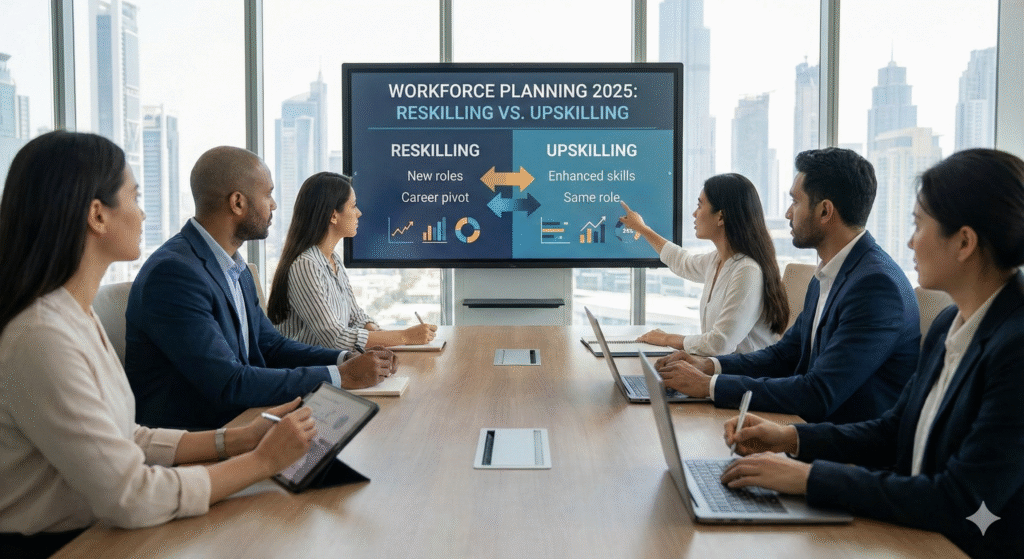
Reskilling vs Upskilling: Strategic Workforce Planning for 2025
Your organization is standing at a fork in the road. On one side, you have employees with valuable experience but outdated skills. On the other side, you have rapidly changing business needs that demand entirely new capabilities. The question that determines your competitive future is simple but critical: do you reskill or upskill? A financial services company faced exactly this dilemma in late 2024. They had talented risk analysts who had spent 15 years mastering traditional financial models. But the market was shifting toward algorithmic trading and machine learning-based risk assessment. The analysts’ deep expertise in the old system was becoming less valuable every day. The company could have fired everyone and hired new talent. Instead, they made a strategic decision. Half the team received upskilling training in machine learning and Python programming, building on their existing expertise. The other half transitioned into new roles using their analytical foundation but applying it to different business areas. Within 18 months, the organization had both preserved institutional knowledge and acquired the capabilities needed for future success. This isn’t just a nice HR story. It’s the difference between organizations that thrive and those that struggle in 2025. Yet most leaders don’t understand the difference between reskilling and upskilling. They use the terms interchangeably. They treat them as the same investment. And they make poor strategic decisions because of this confusion. In 2025, understanding when to reskill versus when to upskill has become a critical competitive advantage. The organizations that get this decision right will attract and retain top talent while building future-ready workforces. Those that don’t will face chronic skill shortages, higher turnover, and inability to adapt to market changes. Understanding the Core Difference Before you can make strategic workforce decisions, you need to understand what reskilling and upskilling actually mean. They sound similar, but they’re fundamentally different concepts with very different implications: Upskilling Upskilling means teaching existing employees new skills that build on or complement their current expertise. It’s about moving someone up in their current career path or into an adjacent role that leverages their foundational knowledge. An employee with 10 years of experience in customer service upskills when they learn advanced data analytics to improve customer insights. A software developer upskills when they learn cloud architecture while continuing as a developer but taking on more complex responsibilities. Upskilling is additive. It says, “You’re already good at this. Now let’s make you exceptional by adding complementary skills.” It’s typically faster to implement and has higher success rates because employees are building on existing strengths. Reskilling Reskilling means teaching employees to work in entirely different roles that may not be directly related to their current position. It’s a career pivot. A manufacturing plant manager who spent 20 years managing production lines reskills when they transition into supply chain management or operations planning. A call center representative reskills when they move into data entry and quality assurance. Reskilling is transformative. It says, “Your current role is becoming obsolete, but your foundational capabilities and work ethic are valuable. Let’s prepare you for an entirely different career.” It requires more time, more investment, and more commitment from both the employee and organization. Why This Distinction Matters for 2025 The difference between reskilling and upskilling isn’t just semantic. It has massive practical implications for your workforce strategy: Timeline and Cost Upskilling typically takes 3 to 6 months for basic competency and 6 to 12 months for mastery. Reskilling typically requires 6 months to 2 years depending on how different the new role is. The cost implications are equally different. Upskilling costs roughly 30% to 50% of external hiring costs. Reskilling costs roughly 60% to 80% of external hiring costs. Employee Buy-In Employees embrace upskilling because it’s a natural progression of their careers. They see it as growth and recognition of their potential. Reskilling feels risky and uncertain for many employees. It requires overcoming fear, uncertainty, and the emotional challenge of starting fresh in an unfamiliar field. Success Rates Upskilling has success rates above 80%. When employees see upskilling as career growth, they engage fully. Reskilling success rates typically range from 50% to 70%, depending on how well the organization manages the transition and how aligned the new role is with employee capabilities. Business Continuity Upskilling lets organizations maintain business continuity while building new capabilities. You keep experienced people doing valuable work while adding new skills. Reskilling creates temporary capability gaps as people transition into new roles. When to Upskill Your Workforce Upskilling is the right strategic choice in specific circumstances. Understand these situations and you’ll make better workforce decisions: Emerging Needs Within Existing Roles When your business needs new capabilities that naturally extend current roles, upskilling is ideal. If your company is adopting AI-powered tools across departments, upskilling your current teams to use these tools makes perfect sense. If you’re transitioning to cloud infrastructure, upskilling your on-premise IT experts into cloud architects preserves knowledge while building necessary capabilities. Preparing for Predictable Growth When you anticipate business growth in areas requiring more expertise, upskilling current employees beats external hiring. A growing fintech company needs more experienced traders. Upskilling existing analysts into trading roles is faster and cheaper than hiring experienced traders externally. They already understand your business, your systems, and your culture. Addressing Specific Skill Gaps When you identify specific missing capabilities that complement existing expertise, upskilling is efficient. A marketing team that doesn’t understand data analytics can upskill quickly. They already understand marketing strategy and customer psychology. Adding analytical skills creates more valuable marketing professionals than hiring data analysts unfamiliar with marketing. Responding to Technology Changes When your industry adopts new technologies, upskilling preserves domain expertise. When accounting firms adopted cloud-based systems, upskilling existing accountants into cloud accounting specialists was far more effective than hiring new accountants who didn’t understand accounting complexity. Supporting Career Progression When high-performing employees are ready for advancement, upskilling develops them for larger roles. Your top manager is ready for a director-level position. Upskilling them in strategic planning, P&L management, and executive presence prepares them for advancement. When to Reskill Your Workforce Reskilling is the strategic choice when roles become obsolete or when business transformation requires fundamentally different capabilities: Roles Becoming Obsolete When automation or industry disruption makes current roles less relevant, reskilling is necessary. Telecom companies reskilled directory assistance operators into customer service roles as automated systems replaced traditional directory services. Newspaper printing plant workers reskilled into digital production roles as print advertising declined. Major Business Pivots When your organization fundamentally changes its business model, reskilling becomes necessary. When a retail company shifts from brick-and-mortar to e-commerce, store managers reskill into digital marketing, supply chain, or fulfillment