

TechnoEdge

Free Master Class

How to Plan Your AI Training Budget for FY26? (For CHROs & L&Ds)

Workplace productivity

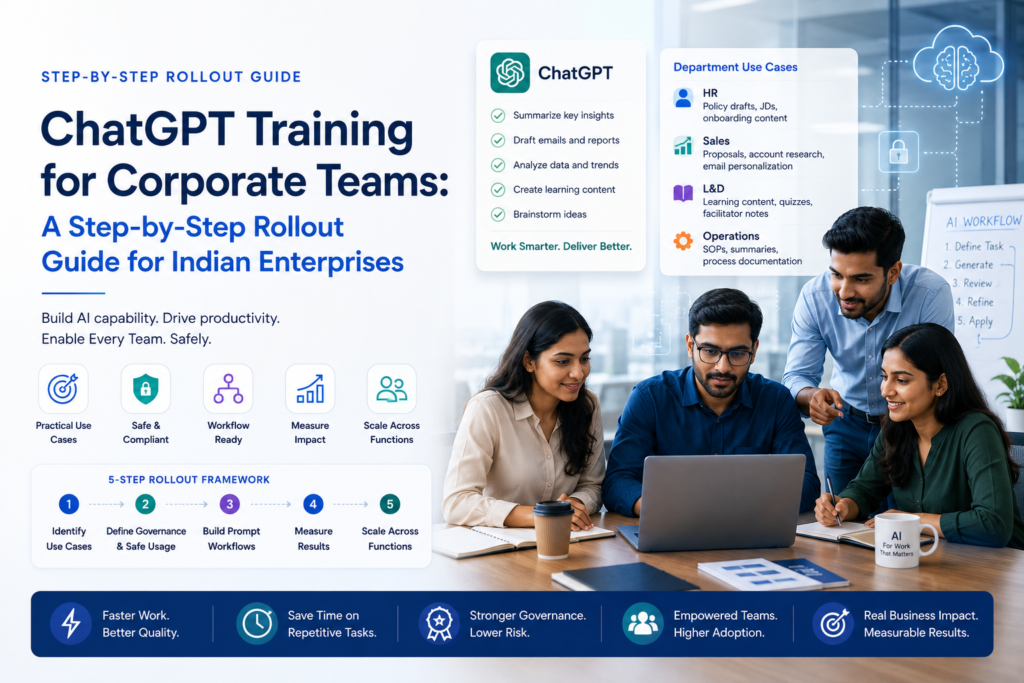
Corporate team planning a ChatGPT training rollout for an Indian enterprise.
blogs

ChatGPT Training for Corporate Teams: A Step-by-Step Rollout Guide for Indian Enterprises

Indian enterprises are moving past the “should we use AI?” stage and into the harder question: how do we use it safely, consistently, and with measurable business value? That is why chatgpt training for teams has become a practical capability-building priority, not just a technology experiment. For HR, L&D, sales, operations, and support teams, the real challenge is not access to AI tools. It is turning those tools into repeatable workflows that improve speed, quality, and decision-making without creating privacy, compliance, or quality risks. That is where structured ai tools training for workforce becomes essential. Why chatgpt training for teams matters in 2026 In 2026, AI is no longer a side topic in corporate learning. It is becoming part of everyday work across writing, analysis, ideation, summarization, and internal communication. Teams that know how to use ChatGPT well can move faster, but only if they understand where it helps, where it fails, and how to use it responsibly. For Indian enterprises, this matters even more because use cases are often distributed across functions. A sales team may need proposal support, an L&D team may need content drafts, HR may need policy communication assistance, and operations may need process documentation. Without structured training, employees tend to use AI inconsistently, which reduces output quality and increases risk. The strongest training programmes focus on practical use, not abstract AI theory. They help people learn how to ask better questions, review outputs critically, and apply the tool to real work. Common mistakes in ai tools training for workforce Many enterprises begin AI training with excitement but no rollout discipline. The result is usually awareness without adoption, or experimentation without control. Common mistakes include: Another common issue is overestimating what employees can safely do on day one. If teams are not shown clear boundaries, they may paste sensitive information into public tools or rely too heavily on generated outputs without review. Good training reduces this risk by making safe use part of the learning design. Step 1: identify department-specific AI use cases The first rollout step is to identify where ChatGPT can create the most value in each function. A single enterprise-wide use case list is usually too broad to drive adoption. Start by asking each department where time is spent on repetitive, text-heavy, or research-supported work. For example: The goal is not to automate everything. The goal is to find the tasks where AI can save time, improve consistency, or help teams start faster. Step 2: define governance, data privacy, and acceptable usage Once use cases are clear, governance must come next. Enterprises need rules for what employees can and cannot enter into AI tools, how outputs should be reviewed, and where human approval is mandatory. A practical governance framework should cover: This is especially important in regulated sectors and in organisations handling customer, employee, financial, or proprietary data. Training should not just explain policy in theory; it should show employees how the policy affects day-to-day work. Step 3: build prompt workflows for HR, sales, L&D, and operations Prompting works best when it is connected to a workflow, not treated as a standalone skill. Employees should learn prompt patterns that map to their actual tasks, review steps, and expected output formats. For HR, a prompt workflow may include drafting, refinement, and compliance review. For sales, it may include research, personalization, proposal structure, and final human editing. For L&D, the workflow may include content creation, simplification, knowledge checks, and learner-level adaptation. A useful training approach is to create: This makes training more practical and easier to retain because people learn by doing work they already recognise. Step 4: measure productivity and output quality If the enterprise cannot measure results, AI training will remain a feel-good initiative. Measurement should look at both productivity and quality, because speed alone can create poor outputs. Useful metrics include: It also helps to compare outputs before and after training on real business tasks. For example, measure how long it takes to create a client email, a training outline, or an internal memo before the rollout and after employees begin using ChatGPT with a workflow. Step 5: scale chatgpt training for teams across business functions Scaling should happen after pilot groups prove value and governance is stable. The best programmes begin with a few functions, refine the content, and then expand into other teams. A scalable rollout usually includes: This is also where leadership support matters. When managers show what good AI-assisted work looks like, adoption becomes much stronger than when training is left only to the L&D team. How Technoedge helps with AI readiness, use-case-based ChatGPT training, workflow-oriented prompting, safe adoption practices, and business team enablement Technoedge helps enterprises move from AI awareness to structured adoption. That starts with identifying the highest-value use cases by function, so training is relevant to the work teams actually do. From there, we design learning journeys that combine practical prompting, governance awareness, and workflow application. We also support safe adoption by helping organisations define boundaries, review practices, and department-level use scenarios that reduce risk. Our delivery approach focuses on business enablement, not just skill transfer. That means teams learn how to use ChatGPT in ways that improve speed, quality, and consistency in daily work. For enterprises exploring chatgpt training for teams, the biggest challenge is usually turning generic AI enthusiasm into safe, useful workflows. Technoedge can help shape that journey through role-specific training, practical prompts, and adoption frameworks that support everyday work without adding complexity. FAQs 1. ChatGPT training for teams: what should be included in a corporate rollout plan? A corporate rollout plan should include use-case discovery, governance rules, department-wise learning paths, prompt practice, and measurement. It should also include leadership alignment so the training is seen as a business capability initiative rather than a one-time workshop. The rollout plan works best when it balances speed and control. That means employees get enough freedom to explore value, but also enough structure to protect data, quality, and compliance. 2. AI tools training for workforce: which departments benefit


Soft Skills in the AI Era: Why Emotional Intelligence Matters More Than Ever
blogs

Soft Skills in the AI Era: Why Emotional Intelligence Matters More Than Ever 

Last week, a manager walked into my office with a problem. His team had the best technology, the smartest AI tools, and access to every resource they needed. Yet productivity was dropping. People were quitting. Deadlines were missed.  “What am I doing wrong?” he asked.  The answer surprised him. He wasn’t lacking technical skills or better software. He was missing something far more powerful: emotional intelligence.  In 2025, we live in a world where robots can do almost everything. They analyze data faster than any human. They write reports, create designs, and solve complex math problems in seconds. But here’s what they can’t do: they can’t feel. They can’t understand when someone is struggling. They can’t inspire a team or build trust.  That’s where you come in. Your ability to connect with people, understand emotions, and lead with empathy is now the most valuable skill you can have. Let’s talk about why emotional intelligence has become the superpower of the AI era.  Understanding Emotional Intelligence in Simple Terms  Emotional intelligence, or EQ, is your ability to recognize and manage emotions. It’s knowing when you feel angry and choosing how to respond. It’s noticing when your teammate looks worried and asking if they need help. It’s staying calm when things go wrong instead of panicking.   Think of EQ as your emotional GPS. Just like GPS helps you navigate roads, emotional intelligence helps you navigate relationships, conflicts, and stressful situations.  Here’s something that will surprise you: emotional intelligence contributes to 58% of your job performance, which is more than your IQ or technical skills. People with high EQ earn an average of $29,000 more each year than those with low emotional intelligence.   Even better? Workers with strong emotional intelligence perform 127% better than those with weaker emotional skills. Companies that focus on building emotional intelligence are 22 times more likely to beat their competitors.   Why Machines Cannot Replace Human Connection  Artificial intelligence is amazing at technical work. It can process millions of data points, predict trends, and automate boring tasks. But AI has a critical weakness: it cannot understand human emotions.   When Satya Nadella took over as CEO of Microsoft, he didn’t focus on technology alone. He transformed the company by leading with empathy. He listened to employees, understood their struggles, and created a culture where people felt valued. This human-centered approach helped Microsoft become one of the world’s most successful companies.   Another great example is Daniel Lubetzky, who founded KIND Snacks. He built his entire business around empathy and understanding people deeply. He discovered that connecting with others emotionally gave him a competitive advantage that technology could never provide.   These leaders prove something important: in the age of AI, your humanity is your greatest strength.  The Five Core Skills of Emotional Intelligence  Emotional intelligence is built on five essential abilities that anyone can learn and practice:   Self-Awareness This means knowing your own emotions, strengths, and weaknesses. When you understand what makes you stressed or angry, you can control your reactions better instead of letting emotions control you.  Self-Regulation This is about managing your emotions wisely. It includes staying calm under pressure, controlling impulses, and handling stress in healthy ways.   Social Awareness This skill helps you understand other people’s emotions and perspectives. You learn to read body language, pick up on social cues, and show genuine empathy for others.   Relationship Management This involves building strong connections, resolving conflicts peacefully, and inspiring others. Leaders with high EQ create teams where people trust and support each other.  Motivation This is having the inner drive to achieve goals and stay positive even when facing setbacks. Emotionally intelligent people bounce back from failures and keep moving forward.  The Growing Demand for Emotional Intelligence  The World Economic Forum lists emotional intelligence among the top 10 most important skills through 2025 and beyond. In fact, 71% of employers now value emotional intelligence over technical skills when evaluating leaders.   Research shows that leaders with high emotional intelligence achieve 23% higher profitability and 18% greater productivity because they engage their teams better and make smarter decisions.   Here’s a startling reality: only 36% of people worldwide are emotionally intelligent. This creates a massive opportunity for those who develop these skills.   The demand for emotional skills is projected to grow by 26% by 2030. As AI handles more technical work, human-centered abilities become the skills that separate successful professionals from everyone else.   Real Results: How Emotional Intelligence Changes Workplaces  The impact of emotional intelligence isn’t just theory. Real companies see real results when they invest in EQ development.  Higher Employee Engagement 76% of employees with highly empathetic leaders report being engaged at work, compared to just 32% with less empathetic leaders.   More Innovation 61% of employees with empathetic leaders feel innovative at work, versus only 13% with less empathetic leadership.   Better Mental Health The World Health Organization reports that promoting mental health in the workplace through emotionally intelligent leadership improves well-being and increases productivity.   Stronger Teams Google’s famous Project Aristotle study found that psychological safety, created through emotional intelligence, is the top factor in high-performing teams.   Increased Confidence One company saw a 92% increase in positivity and 89% increase in confidence after implementing emotional intelligence training.   Practical Ways to Build Your Emotional Intelligence  The best news about emotional intelligence is that you can improve it at any age, unlike IQ which stays mostly the same. Here are simple steps you can start today.​  Practice Active Listening When someone speaks to you, give them your complete attention. Listen to their words, notice their tone, and watch their body language. Don’t interrupt or think about your response while they’re talking.   Create a Daily Reflection Habit Spend just 10 minutes each day thinking about your emotions. What made you frustrated today? Why did that comment bother you? What brought you happiness? This builds self-awareness.  Learn to Manage Stress Try simple techniques like deep breathing, short walks, or meditation. When you manage your own stress well, you handle difficult situations better.   Ask for Honest Feedback Talk to trusted friends or colleagues about how you come across in emotional situations. Their perspective helps you see blind spots you might miss.  Consider Professional Training Many organizations now offer emotional intelligence training programs and certification courses. These structured programs teach specific techniques for developing EQ skills that you can use immediately.   Your Human Advantage in an Automated World  As artificial intelligence takes over more technical tasks,

Trust Us, One Call Can Make a Difference
Please enable JavaScript in your browser to complete this form.
Join As Trainer
Join As Trainer
Please enable JavaScript in your browser to complete this form.
Download Course Content
Please enable JavaScript in your browser to complete this form.
More than 5 People are attending Get On a Call with Us
Please enable JavaScript in your browser to complete this form.
More than 5 People are attending Get On a Call with Us
Scroll to Top