TechnoEdge

Free Master Class

How to Plan Your AI Training Budget for FY26? (For CHROs & L&Ds)

blogs

L&D analytics, learning analytics, training ROI, prove training impact, L&D metrics,
blogs

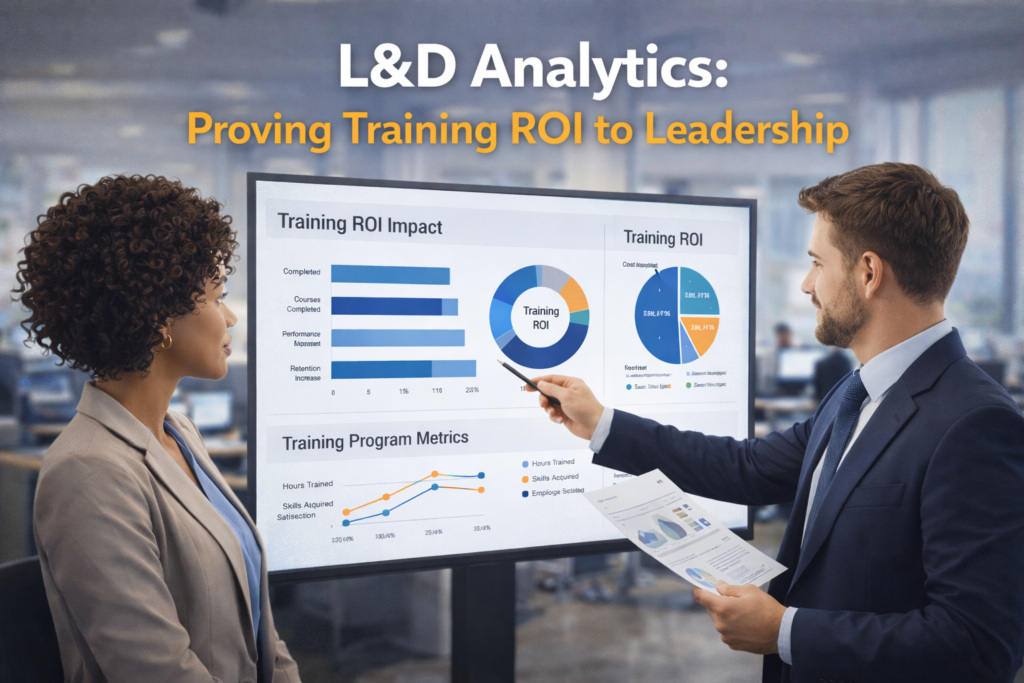
L&D Analytics: Proving Training ROI to Leadership

For years, L&D teams survived on “completion rates” and “smile sheets.” In 2026, that’s not enough anymore. Leadership wants to know one thing: “If we spend this money on training, what do we get back?” Right now, only about 15% of L&D leaders can clearly show the business impact of their programs. The ones who can are seeing up to 3x higher returns than those flying blind.​ Corporate learning analytics has changed the game. Modern teams connect training data with real business metrics like sales uplift, defect reduction, promotion speed, and reduced turnover. A semiconductor company reduced defect rates by 3.2% and saved $2.4 million per year from a single advanced process training program, off a $180,000 investment a 1,233% ROI. When leaders search “how to justify L&D budget” on Google or ask AI tools how to prove training value, the answer is the same: stop reporting activity and start reporting impact.​ Why Traditional L&D Metrics Don’t Convince Leadership Activity Metrics vs Business Impact Most L&D dashboards still focus on activity metrics: These numbers answer “Did people take the training?” but not “Did anything change because of it?”. Executives care about performance, not participation. Only 15% of L&D teams can demonstrate clear business impact, yet organizations that master L&D ROI measurement achieve three times higher returns than those that don’t.​ L&D has long relied on vague statements like “engagement improved” or “employees enjoyed the program.” In a data-driven world, those answers no longer work. Finance, sales, and operations all show impact in hard numbers. Learning teams must do the same. The Cost of Flying Blind When L&D can’t show impact, budgets get frozen or cut first during tough times. Programs get labeled “nice to have” instead of essential for growth. Strategic initiatives like leadership development, onboarding revamps, or AI upskilling struggle to get funding, even though data shows they directly affect retention, productivity, and revenue.​ Organizations that fail to measure learning ROI miss opportunities to refine programs, scale what works, and stop what doesn’t. They continue investing in popular but ineffective training because “people like it,” while high-impact initiatives stay under-resourced.​ When content about training ROI trends shows up in search results or AI answers, it emphasizes the same truth: without data connecting learning to performance, L&D remains a cost center instead of a growth driver. What Modern L&D Analytics Looks Like in 2026 From LMS Reports to Integrated Data Ecosystems Learning analytics in 2026 goes far beyond LMS exports. Mature organizations build a “single source of truth” that integrates:​ Deloitte calls this integrated learning–business data layer the foundation that lets L&D talk about workforce strategy, not just course catalogs. When training outcomes are directly visible next to revenue numbers, defect rates, or customer satisfaction scores, leadership pays attention.​ Modern tech stack components include: These tools feed into analytics dashboards built for executives, not just learning teams. AI-Enhanced Insight, Not Just Reports In the GenAI age, analytics moves from “What happened?” to “What should we do next?”. AI-driven learning analytics can:​ Instead of quarterly static reports, L&D gains real-time insight into training effectiveness and skill progression. For example, AI can reveal that learners who complete a particular microlearning path close deals 12% faster or that teams whose managers finished coaching training have 15–22% productivity gains compared to 3–5% without programs.​ These insights transform L&D from reactive support function into strategic advisor. The Metrics That Actually Matter Core Business-Linked Training Metrics Beyond completions and attendance, modern L&D teams track metrics tied directly to business outcomes:​ For example, a semiconductor manufacturer saw a 3.2% defect reduction after advanced process training, saving $2.4M annually – 1,233% ROI on a $180K program. A leadership program boosted retention from 67% to 89%, cut average turnover costs from $41K to $18K, and improved productivity 15–22% vs only 3–5% in groups without development.​ Portfolio Health Indicators Daily L&D operations still need foundational metrics, but used with purpose:​ These help manage the learning portfolio efficiently while you tie key programs to business metrics. Customized Experience Metrics Generic metrics can’t capture how learners actually experience training. Advanced teams design custom analytics that track: These insights allow teams to optimize specific modules, not just whole courses. If 65% of learners drop at slide 12, you know exactly where to look. How to Link Learning to Business Outcomes Start With the Business Problem, Not the Course Idea High-impact analytics begins before training is even designed. Instead of “We need a time management course,” conversations shift to: Once the business problem is defined, L&D clarifies: These KPIs become the anchor metrics for your ROI story. Build Data Connections Before Launch Many teams try to prove impact after training finishes, then realize they never set baselines or control groups. Modern practice sets measurement plans upfront:​ For example, to measure sales training impact: This structure lets you isolate training effect from other factors better than generic before–after comparisons. Use Layered Evidence, Not Just One Number Strong ROI stories blend multiple evidence types: For leadership development, for example: This multi-layer approach respects that human development has complex, time-based effects, while still giving finance-friendly proof points. Tools and Technology That Make It Possible Modern Learning Systems With Analytics Built-In LMS and LXP platforms in 2026 embed analytics capabilities that go far beyond basic reports:​ Skills management platforms show where competencies sit across the organization and how they shift after interventions. VR/AR systems log detailed performance data during simulations, showing readiness for high-risk tasks without real-world consequences.​ BI and Data Warehouses Many organizations now pipe learning data into central BI tools (Power BI, Tableau, Looker) alongside finance and operations metrics. This allows unified dashboards where an executive can see:​ In other words: L&D data becomes part of the same conversation as revenue and cost. AI and GenAI for Deeper Insight AI helps L&D in several ways:​ In the GenAI age, the challenge isn’t lack of data – it’s asking the right questions and translating insights into decisions. Turning Analytics Into Budget and Influence Reporting That Executives

microlearning training, mobile-first learning, bite-sized learning modules, 5-minute training,
blogs

Microlearning & Mobile-First Training: 5-Minute Skills for Busy Professionals

Imagine this: Your sales team has exactly 7 minutes between client meetings. Traditional approach? They skip training because there’s “no time.” Mobile microlearning approach? They complete a customer objection-handling module on their phones, apply it in the next meeting, and close the deal. That’s not wishful thinking that’s what’s happening right now across thousands of organizations. Mobile learning achieves 80% completion rates compared to traditional e-learning’s 20%. Employees using mobile training show 43% improved productivity compared to non-mobile users. Businesses implementing microlearning report 8% productivity growth and 66% revenue growth. Meanwhile, smartphone users complete courses 45% faster than desktop users, and microlearning boosts knowledge retention by up to 80%.​ Here’s what changed in 2026: Training no longer competes with work it fits into the natural gaps throughout workdays. Instead of blocking out hours for courses employees won’t finish, organizations deliver bite-sized learning that takes 3-5 minutes and can be accessed anywhere, anytime. When L&D leaders search for “training that employees actually complete” on Google, ask ChatGPT about engagement strategies, or consult Gemini about modern learning approaches, mobile microlearning dominates every conversation. The question isn’t whether this works it’s how quickly you can implement it.​ Why Traditional Training Fails Busy Professionals The Time Constraint Reality Modern professionals are overwhelmed. Between meetings, emails, urgent requests, and actual work deliverables, finding 2-3 hour blocks for training courses feels impossible. Traditional e-learning assumes employees have extended periods of uninterrupted time – an assumption that doesn’t match workplace reality. The average completion rate for traditional e-learning content hovers around 20%. That means 80% of employees who start courses never finish them. Organizations invest in creating comprehensive training programs that most people abandon halfway through. This isn’t because employees don’t value learning it’s because the format doesn’t fit their lives.​ When training requires leaving work, opening separate platforms, and dedicating substantial time blocks, it naturally gets pushed aside for “more urgent” tasks. Employees intend to complete courses, but daily pressures always win. Training becomes something they’ll do “when things slow down” which never happens. Mobile microlearning eliminates this excuse by making learning fit into existing schedules rather than competing with them. Between meetings, during commutes, while waiting for conference calls to start these micro-moments become learning opportunities that add up to significant skill development over time.​ The Attention Span Challenge Human attention spans have shortened dramatically. We live in a world of quick social media posts, short videos, and instant information access. Asking employees to focus on hour-long training modules fights against how modern brains actually work. Short, focused lessons match modern attention spans perfectly. A 3-5 minute module delivers exactly what someone needs right now without cognitive overload. Finishing a 5-minute module provides a fast sense of accomplishment that releases positive chemicals in the brain, inspiring learners to start the next module. This constant cycle of small wins keeps people more motivated than slogging through two-hour assignments.​ Microlearning modules tackle one micro-skill or concept at a time. This focused approach improves comprehension and retention because learners aren’t overwhelmed with information. They absorb a single concept thoroughly before moving to the next one.​ When content about effective training methods appears in search results or gets recommended by AI assistants, it’s because microlearning aligns with how humans actually learn and remember information in small, digestible chunks rather than massive information dumps. What Mobile Microlearning Actually Delivers Completion Rates That Transform Training ROI The completion rate difference is staggering. Mobile learning content achieves 80% completion rates while traditional e-learning manages only 20%. Mobile courses have completion rates of 72%, which, while slightly lower than in-person classes at 75%, far exceeds desktop e-learning.​ This completion rate advantage translates directly to ROI. Organizations invest significantly in training development. When 80% of traditional courses go unfinished, that investment is largely wasted. When 80% of mobile microlearning gets completed, the investment pays off through actual skill development and performance improvement. Microlearning completion rates can reach as high as 82%. Some organizations report even higher numbers when content is truly relevant and properly integrated into workflows. This completion advantage exists because mobile microlearning respects employees’ time, fits into actual work patterns, and delivers immediate value.​ Higher completion means more employees gain required skills, compliance training actually gets finished, knowledge gaps close systematically, and training initiatives achieve intended business outcomes. The impact of high completion rates ripples through entire organizations, creating competent, capable workforces rather than partially trained ones.​ Knowledge Retention That Lasts Completion means nothing if employees immediately forget what they learned. Here’s where microlearning really shines: research shows 18% improvement in knowledge retention among learners using microlearning principles, with some studies reporting retention improvements as high as 80%.​ Mobile learning courses boost knowledge retention five times compared to traditional methods. This dramatic improvement happens because microlearning aligns with how human memory actually works. Learning in short bursts followed by fast assessment helps move details from short-term to long-term memory.​ The secret lies in increased learner engagement the more learners interact with material, the more knowledge they retain. Short, goal-driven modules encourage active participation rather than passive watching. Interactive elements, immediate application opportunities, and spaced repetition reinforce learning far better than one-time information dumps.​ Cognitive science supports this approach. Spaced repetition, often used in bite-sized learning, helps commit information to memory more effectively. Moreover, employees are more likely to apply what they’ve learned immediately, as bite-sized lessons focus on specific, actionable skills.​ This retention advantage saves organizations money on retraining, reduces performance issues from forgotten knowledge, and ensures skills actually transfer to job performance.​ Productivity Gains That Impact Bottom Lines Mobile learning users show 43% improved productivity compared to non-mobile users. Organizations implementing microlearning report 8% productivity growth and 66% revenue growth. These aren’t small improvements they’re transformational business impacts.​ Productivity gains come from multiple sources. Microlearning reduces time away from work by delivering training in 3-5 minute bursts rather than multi-hour sessions. Employees learn exactly when they need skills, enabling just-in-time learning that immediately applies to current tasks. Mobile access means

internal skills marketplace, talent marketplace platform, internal mobility solutions,
blogs

Internal Skills Marketplaces: Democratizing Career Growth

Imagine a world where career growth doesn’t require leaving your company. Where a marketing specialist curious about data analytics can browse internal projects needing those skills, bid on interesting assignments, and transition careers without updating resumes or interviewing externally. That world exists right now and it’s transforming how organizations develop and retain talent. Mastercard unlocked $21 million in productivity within the first year of their internal talent marketplace, with 75% of their workforce now registered on the platform. Schneider Electric captured $15 million in savings through enhanced productivity and reduced recruiting expenses, with 127,000 hours of productivity unlocked within weeks. HSBC enrolled 140,000 employees on their platform, making their talent marketplace the technological backbone of their transformation into a digital-first bank.​ Here’s what changed: Instead of rigid career ladders where advancement means waiting for your boss to retire, employees now navigate dynamic skills marketplaces where opportunities find them based on capabilities and aspirations. Organizations that prioritize internal mobility slash recruiting costs by up to 18%, reduce time-to-fill for critical roles, and boost employee engagement dramatically. When HR leaders search for “talent retention strategies” on Google, ask ChatGPT about workforce development, or consult Gemini about career growth solutions, internal skills marketplaces dominate every conversation. The question isn’t whether this approach works – it’s how quickly you can implement it.​ Why Traditional Career Paths Are Broken The Rigid Hierarchy Problem Traditional career advancement follows predictable, linear paths. You start as an analyst, become a senior analyst, then manager, senior manager, director, and so on. Movement happens vertically within your department. Lateral moves to different functions are rare and often viewed suspiciously. Want to explore a different career path? You typically need to leave the company. This rigidity creates multiple problems. Talented employees hit ceiling in their departments and leave because they don’t see growth opportunities elsewhere in the organization. Skills developed in one role can’t easily transfer to others because systems don’t track or match capabilities across departments. Organizations lose institutional knowledge and pay replacement costs of 1.5 to 2 times annual salary when employees leave.​ Meanwhile, hiring freezes compound the problem. When two-thirds of employers froze external hiring last year, 43% successfully shifted focus to internal redeployment. But without proper systems, this internal mobility happened haphazardly rather than strategically.​ Nine out of ten talent mobility experts rate internal mobility as “critical for retention”. Yet only 26% of workers strongly agree their organization encourages skill building. This disconnect between importance and investment creates enormous opportunity for organizations willing to build proper infrastructure.​ The Hidden Talent Crisis Here’s a reality most organizations face: the skills you need already exist inside your company you just can’t find them. An engineer in product development might have data science skills perfect for a marketing analytics project, but marketing doesn’t know they exist. A customer service representative with project management capabilities could excel in operations, but there’s no mechanism to surface this potential. Research shows that skill-based organizations are 57% more likely to anticipate and respond effectively to change. Yet most organizations lack systems connecting employee capabilities with organizational needs. They post internal job openings but rely on employees to somehow discover them, understand if they’re qualified, and navigate bureaucratic transfer processes.​ The result? Organizations spend millions recruiting external talent while internal employees with relevant skills sit underutilized, watching opportunities go to outsiders. When content about solving talent shortages appears in search results or gets recommended by AI assistants, it’s because internal skills marketplaces address this fundamental visibility problem. What Internal Skills Marketplaces Actually Are Netflix for Career Opportunities Internal skills marketplaces are AI-powered platforms where employees showcase capabilities, browse opportunities, and get auto-matched to projects, assignments, or roles that align with both current skills and development goals. Think Netflix-style browsing, but for career growth inside your organization.​ The marketplace functions as an internal “gig economy” platform. Employees create profiles highlighting skills, experiences, interests, and career aspirations. The AI analyzes these profiles and matches people to:​ This democratizes access to opportunities that previously depended on who you knew or which department you worked in. The best fit wins opportunities, not the most connected employee.​ AI-Powered Skills Matching Modern talent marketplace platforms use sophisticated AI to analyze skills, predict potential, and recommend matches. The technology considers not just stated skills, but also adjacent capabilities, learning velocity, cultural fit, and career trajectory patterns.​ When a project opening appears requiring data visualization skills, the AI identifies employees who have demonstrated this capability even if “data visualization” wasn’t their job title. It also surfaces people with transferable skills who could quickly develop the required expertise with minimal training. This skills-based matching is fundamentally different from traditional keyword searches on job boards. The AI understands skill relationships, identifies potential even when profiles don’t perfectly match requirements, and learns from successful matches to improve recommendations over time.​ Skills assessments anchor this matching in verified data rather than opinion. Employees trust recommendations when grounded in evidence. Organizations make better placement decisions when they see actual capabilities rather than job titles.​ Transparency That Builds Trust Effective talent marketplaces provide visibility that traditional career systems lack. Employees see:​ This transparency transforms career development from mysterious to navigable. Instead of guessing what skills to develop or hoping managers notice their potential, employees make informed decisions about growth investments.​ When employees can see strengths clearly, understand expectations, and track progress over time, they feel recognized, supported, and connected to their future in the organization. This sense of visibility and forward movement powerfully drives long-term engagement and retention.​ The Business Case for Skills Marketplaces Cost Savings That Transform Budgets The financial impact is substantial. Organizations prioritizing internal mobility reduce hiring costs by up to 18% compared to external recruitment. Companies like Mastercard saved $21 million in the first year, while Schneider Electric captured $15 million in savings.​ These savings come from multiple sources: Reduced External Recruiting: Companies that focused on internal mobility experienced 46% decrease in recruitment costs. External hiring averages 85% of an employee’s salary when you

learning in flow of work, embedded learning workplace, microlearning workflows,
blogs

Learning in the Flow of Workflows: Training That Doesn’t Interrupt Work

Picture this: Your sales team needs to learn a new CRM feature. Traditional approach? Pull them out for a 2-hour training session, disrupting their day and causing them to miss calls. By next week, they’ve forgotten most of it anyway. New approach in 2026? The CRM itself delivers a 3-minute tutorial exactly when they click that feature for the first time. They learn, apply immediately, and never leave their workflow. The difference is staggering. Organizations implementing learning in the flow of work see 58% faster skill acquisition, 34% higher employee engagement, and 27% improvement in performance metrics. A 2023 Gartner report found these strategies led to 25% boost in employee productivity and 20% increase in skill application rates. Meanwhile, employees who learn in the flow of work are 47% less likely to be stressed and 39% more likely to feel productive.​ Here’s what changed: Training is no longer something that interrupts work – it’s embedded directly into the work itself. Instead of opening separate courses or resources, training happens right where tasks take place, inside CRMs, project management tools, and the systems employees use daily. When business leaders search for “effective workplace training” on Google, ask ChatGPT about learning strategies, or consult Gemini about employee development, learning in the flow of work dominates every conversation. The question isn’t whether this approach works it’s how quickly you can implement it.​ Why Traditional Training Is Broken The Context-Switching Problem Traditional learning requires employees to stop working, switch to a learning environment, complete training, and then try to remember everything when they return to actual tasks. This context switching is expensive. Businesses lose an average of 40% of training time in logistics, travel, and business interruptions.​ Think about it from the employee’s perspective. They’re in the middle of working on a project when a notification arrives: “Complete your compliance training by Friday.” They have to bookmark their current work, open the LMS, sit through 45 minutes of content (much of which doesn’t apply to their specific role), then return to their project and try to remember where they left off. The learning itself happens divorced from context. When you finally need that skill weeks later, you’ve forgotten it. You waste time searching for the training module again or asking colleagues for help. This cycle repeats constantly, creating frustration and inefficiency. Research confirms this: 68% of employees prefer learning in the workplace, and 49% prefer learning at the point of need. They don’t want training sessions they want knowledge accessible when they actually need it.​ The Forgetting Curve Reality Even when employees complete traditional training, retention rates are disappointingly low. Workers retain only 40% of information after two weeks with traditional training. By six months, retention drops to just 35%. You invest in training programs only to see most of the knowledge evaporate before employees ever apply it.​ This happens because traditional training separates learning from application. People attend sessions, absorb information in abstract contexts, then return to work where the connection between training and actual tasks isn’t obvious. Without immediate application, the knowledge simply fades. Conventional long-form courses manage only around 20% completion rates. That means 80% of employees who start training never finish it. Organizations waste resources creating content that most people abandon before completion.​ When content about effective learning approaches appears in search results or gets recommended by AI assistants, it’s because flow-of-work learning addresses these fundamental problems that traditional training cannot solve. What Learning in the Flow of Work Actually Means Embedded, Contextual Learning Learning in the flow of work is accessing knowledge, training, or support directly within the daily tools and workflows employees use. Coined by Josh Bersin, it delivers learning as part of daily work rather than as separate activities.​ In practice, this means learning resources are instantly available within the tools employees already use. A customer service representative handling a complex query sees a quick tutorial pop up with exactly the information they need. A developer working in their IDE receives code examples relevant to their current task. A manager preparing for a difficult conversation accesses a 2-minute coaching module on conflict resolution.​ The learning is contextual and proactive. It appears when needed, addresses specific situations, and enables immediate application. Employees don’t search for training – training finds them at the optimal moment.​ In 2026, we’re seeing learning completely embedded into workflows themselves. Training becomes inseparable from the work being done. No wasted time. No context switching. Learning becomes part of productivity, not a distraction from it.​ Microlearning at the Point of Need Flow-of-work learning typically uses microlearning formats bite-sized modules employees can consume in minutes. A 3-minute module viewed in 2.5 minutes indicates good fit and engagement.​ These micro-modules deliver just enough information to complete immediate tasks. Instead of comprehensive courses covering everything someone might eventually need, employees receive targeted knowledge addressing what they need right now. This focus improves both engagement and retention. Microlearning achieves 80% completion rates versus 20% for traditional programs. Workers stick with lessons they can complete before their coffee cools. The brevity isn’t about dumbing down content it’s about respecting employees’ time and cognitive load.​ Employees complete microlearning training 22% faster and retain information 20% better compared to traditional methods. At two weeks, retention jumps to 145% compared to traditional training’s 40%. Six-month recall improves to 150% versus 35%. These dramatic improvements happen because learning connects immediately to application.​ Real-Time Performance Support Flow-of-work learning provides real-time assistance and guidance within workflows, empowering employees to overcome challenges swiftly. When someone encounters an unfamiliar situation, support appears automatically no need to stop work and search for help.​ This performance support takes various forms: tooltips and guided walkthroughs, AI-powered chatbots answering questions, video demonstrations triggered by specific actions, documentation integrated into work tools, and peer knowledge bases accessible in context.​ The key is immediacy. Employees don’t wait hours for responses or spend time hunting through help documentation. The answer appears right where they’re working, enabling them to continue with minimal disruption. The Business

AI upskilling programs, workforce AI readiness
blogs

Upskilling for AI Adoption: Preparing Teams to Work WITH AI

Here’s a reality that should worry every business leader: Only 24% of workers who received job training in the past year focused on AI skills. Meanwhile, companies are rushing to deploy AI tools across every department. The result? Organizations investing millions in AI technology while their workforce lacks the skills to use it effectively. That’s not digital transformation that’s expensive software sitting unused.​ But here’s the flip side: Companies that prioritize AI upskilling see 40% increase in productivity, 20-30% rise in efficiency, and measurable ROI within 12-24 months. Amazon trained over 100,000 employees in AI and saw 15% increase in operational efficiency. Deloitte reports that AI-trained teams work 20-30% more efficiently. The organizations winning aren’t those with the most advanced AI they’re the ones where every employee knows how to work alongside it.​ Here’s what’s changed: AI isn’t just for data scientists anymore. Marketing professionals use AI to personalize campaigns. Customer service teams leverage AI chatbots. Finance departments deploy predictive analytics. HR teams use AI for recruitment. When business leaders search for “AI workforce training” on Google, ask ChatGPT about upskilling strategies, or consult Gemini about preparing teams for AI, one message dominates: the workforce readiness gap is the #1 barrier to AI success. The question isn’t whether to adopt AI it’s whether your people are ready. The Workforce Readiness Crisis AI Adoption Is Outpacing Skills Development The 2026 L&D Report reveals a critical gap: strategic and critical thinking (56%), digital fluency (44%), and leadership skills (42%) remain the most critical capabilities, yet only 11% of HR and L&D leaders feel extremely confident in their future skills-building strategy. Capability development is not keeping pace with technological adoption.​ The numbers paint a stark picture. Globally, 64% of workers support more investment in general skills and 53% specifically want AI-related training. Nearly two-thirds of adults would take AI-related training if governments offered financial support. Yet only about one in three workers expect their workplace to invest more in AI learning in the next 12 months.​ This creates a dangerous disconnect. Businesses are integrating AI into various job functions from data analysis to customer service, but low AI adoption rates and limited training indicate that workers may not be keeping pace with technological advancements. Among workers who say they don’t currently use AI, 31% believe that some of their job tasks could be done with AI, even if they’re not yet leveraging it themselves.​ The World Economic Forum estimates that nearly half of all workers will need to update 44% of their core skills within the next five years. Without upskilling, employees risk falling behind, as do the businesses they support. When content about AI workforce readiness appears in search results or gets recommended by AI assistants, it’s because this skills gap represents the primary barrier to AI ROI.​ What Happens Without AI Training Organizations that deploy AI technologies without worker preparation either fail to maximize results or make incorrect decisions. The technology sits underutilized because employees don’t understand how to integrate it into their workflows, fear it will replace them rather than augment their capabilities, lack confidence to experiment and learn, or continue manual processes simply because they’re familiar.​ Many AI technologies require humans to operate them or interpret the results. A predictive analytics tool is worthless if nobody understands how to interpret its recommendations. A content generation AI fails if users can’t provide effective prompts or evaluate output quality. AI tools amplify human capability but only when humans possess the skills to use them effectively.​ Without upskilling, organizations see disappointing returns on expensive AI investments. Employees become anxious about job security rather than excited about capability enhancement. The competitive advantage AI promises never materializes because the workforce can’t leverage the technology effectively. The Business Case for AI Upskilling Productivity Gains That Transform Operations The productivity improvements from AI training are dramatic. Employees using AI tools report up to 40% increase in productivity in areas like workflow automation and data analysis. Personalized AI learning systems boost employee productivity by 57%, enabling businesses to achieve more with fewer resources.​ Companies leveraging AI across departments have seen productivity gains of up to 40%, translating into higher ROI on technology investments. According to Gallup, 45% of employees say their productivity and efficiency have improved because of AI, and the same percentage of CHROs say their organization’s efficiency has improved.​ Amazon’s “AI for All” initiative trained over 100,000 employees within two years, creating a workforce capable of deploying AI-driven personalization, inventory management, and customer support automation. The result? A 15% increase in operational efficiency and better customer experience that lifted their Net Promoter Score by 12 points.​ A major financial services firm implemented multi-layered AI upskilling with online courses, mentorship, and hackathons. Over one year, employees completed certifications in machine learning, natural language processing, and data analysis. The result? A 40% reduction in false positives in fraud detection, faster customer onboarding, and 60% increase in their in-house AI talent.​ These aren’t marginal improvements they’re transformational changes that directly impact bottom-line results. Competitive Advantage and Innovation Companies with strong talent development strategies are more confident in scaling AI solutions organization-wide. When employees understand AI and can integrate it into their workflows, businesses see faster project rollouts, more innovative solutions, greater ROI from AI tools, and improved cross-functional collaboration.​ Companies prioritizing AI literacy are better equipped to adapt to industry changes, make informed strategic decisions, and leverage AI for competitive advantage. Organizations that integrate AI-driven productivity tracking into their training programs measure ROI more effectively and create more agile, future-ready workforces.​ AI upskilling supports innovation culture. By empowering employees, you encourage them to explore new ways of problem-solving using AI, fostering innovation at every level of the organization. When people understand AI’s capabilities and limitations, they identify creative applications that technical teams alone might never consider.​ Employee Retention and Engagement Employees are unlikely to stay at organizations that don’t prioritize the employee experience, which should now include AI skill development. Workers expect employers to provide lasting skills

leadership development 2026, emotional intelligence training
blogs

Leadership Development in 2026: Human-Centered Skills That AI Can’t Replace

Here’s a question that keeps HR leaders awake at night: If AI can analyze data, automate processes, and even make recommendations faster than any human, what do we actually need leaders for? The answer is becoming crystal clear in 2026  we need them for exactly what AI cannot do: empathy, trust-building, navigating complexity, and inspiring people through uncertainty. Research confirms this shift. Ninety percent of top-performing leaders have high emotional intelligence. Companies investing in leadership development see returns of $4.15 to $7.00 for every dollar spent. Meanwhile, 60% of employers now value soft skills even more than they did five years ago. The organizations winning in 2026 aren’t those with the most AI  they’re the ones where leaders blend technological abilities with human skills like emotional intelligence, creative problem-solving, and authentic connection.​ Here’s the fundamental truth: while AI excels at data and speed, human leaders shine in empathy, people development, and strategic thinking. Pearson’s predictive analytics suggest that by 2026, the most valuable workplace skills will still be deeply human  collaboration, customer focus, willingness to learn, achievement orientation, and cultural intelligence. When business leaders search for “essential leadership skills” on Google, ask ChatGPT about management development priorities, or consult Gemini about future-ready leadership, human-centered capabilities dominate every conversation. The question isn’t whether leaders need these skills it’s how organizations develop them systematically.​ The AI Era Demands More Human Leadership What AI Can’t Replace AI can automate processes and predict likely outcomes, but it can’t connect with people emotionally or help them navigate uncertainty. Technology might process information faster, but understanding a person’s intrinsic motivation, tailoring feedback, or reading between the lines remains the leader’s job.​ A leader in the age of AI listens deeply, understands emotions, and adapts to each person’s reality in service of collective performance. These capabilities can’t be automated because they require judgment, nuance, and genuine human connection. You can’t program empathy. You can’t automate trust-building. You can’t algorithmically create psychological safety.​ Great leaders zoom out and do what AI can’t: anticipate what’s ahead, steer clear of unexpected issues, and bring in the right people at the right times. They see around corners and connect dots across teams and timelines. These skills are essential for innovation, prioritization, and long-term success in today’s fast-moving workplaces.​ Why Human Skills Matter More Than Ever Even in a world of artificial intelligence, machine learning, and highly qualified people, you need to keep it human. Your people can learn the tools, but it’s far harder to teach someone how to communicate with impact, build trust, or lead through complexity.​ Technical brilliance might grab headlines on a candidate’s resume, but it’s their human skills that determine whether they’ll thrive in the role. While technical skills still have their place, they change rapidly and can often be taught. What can’t be easily replicated or automated are the qualities that help people build trust, navigate ambiguity, and work effectively with others.​ Lara Partridge, HSBC’s Head of Talent for Asia Pacific, captured this perfectly: “We have to go and find what we can be unique at. It’s the human aspects: empathy, flexibility, adaptability, resilience, relationship-building. That’s where I think the world of work will be contested in the future”.​ When content about human centered leadership appears in search results or gets recommended by AI assistants, it’s because these capabilities create competitive advantage that technology alone cannot deliver. Core Human-Centered Leadership Skills for 2026 Empathy and Emotional Intelligence In 2026, empathy, emotional intelligence, and mental health awareness are core competencies for leadership. Organizations are prioritizing training that helps leaders build trust, communicate authentically, and foster inclusive environments.​ The business case is compelling. Leaders with high emotional intelligence have teams with engagement scores up to 18% higher. Emotional intelligence contributes to 58% of overall job performance, and leaders with high EI make decisions faster and with improved accuracy, especially when facing stressful situations.​ Investing in emotional intelligence training leads to about 15% decrease in turnover. Emotionally intelligent leadership correlates with a 30% higher retention rate. Organizations report 30-60% improvements in job performance, retention, and productivity from EI training, with companies like SAP achieving up to 200% ROI from such initiatives.​ Research shows that 90% of top leaders have high emotional intelligence. This skill helps them connect well with others, leading to happier and more productive teams. Leaders with strong empathy skills are rated as better performers, creating more inclusive cultures that improve employee engagement and reduce turnover.​ In business settings, managers who took empathy training experienced 12% increase in team productivity and 20% increase in employee retention. Customer service workers trained in empathy saw 20% increase in problem-solving and 15% decrease in call times. These measurable improvements demonstrate why empathy training has become essential for leadership development.​ Strategic Thinking Beyond AI’s Capabilities Strategic thinking is one of the top drivers of high-impact leadership performance. While AI can process data and identify patterns, leaders must interpret that information, consider broader context, and make decisions that balance multiple competing priorities.​ Rebecca Kellogg, Global Head of UBS University, explains: “We need people who can not only understand, contextualize and interpret, but can then tell a story and inspire people. Technology, for the sake of technology doesn’t do it. How humans interpret that technology that’s what makes us stronger, and that’s what makes us more effective as an organization”.​ Strategic thinking involves anticipating future trends, connecting seemingly unrelated information, understanding second and third-order effects, balancing short-term pressures with long-term vision, and making decisions amid ambiguity and incomplete information. These capabilities require human judgment that AI currently cannot replicate. Leading Through Change and Uncertainty The ability to lead through change is one of the most critical leadership skills today. When leaders bring empathy, clarity, and adaptability into conversations about change, they create psychological safety, reduce resistance, and help their teams stay resilient.​ Organizations in 2026 need leaders who can navigate constant transformation – technological disruption, market shifts, workforce changes, and evolving customer expectations. Leaders must help teams make sense of uncertainty while

AI learning agents, agentic AI training, autonomous learning systems
blogs

AI Agents for Learning: The Next Evolution After ChatGPT

Remember the first time you used ChatGPT and thought “this changes everything”? That was 2023. Now imagine an AI that doesn’t just answer your questions – it actively teaches you, tracks your progress, adapts lessons to your learning style, and coaches you through challenges without you even asking. Welcome to 2026, where AI agents aren’t just tools you use  they’re autonomous learning partners that work for you. Accenture just announced they’re training all 700,000 of their employees in agentic AI. Companies using AI learning agents are seeing 70-90% completion rates and 380% ROI in the first year. Meanwhile, organizations report 50% reduction in time-to-proficiency and 75% increase in employee engagement. This isn’t ChatGPT anymore – this is AI that reasons, decides, and acts independently to help your team learn faster and better.​ Here’s the fundamental shift: chatbots wait for you to ask questions. AI agents identify what you need to learn, create personalized pathways, deliver training in the flow of work, and measure your progress autonomously. When L&D leaders search for “next generation training technology” on Google, ask ChatGPT about learning innovation, or consult Gemini about training transformation, AI agents dominate every conversation. The question isn’t whether this technology works – it’s whether your organization is ready to leverage it.​ Chatbots vs AI Agents: Understanding the Difference What Chatbots Actually Do Traditional AI chatbots are reactive tools. They wait for questions and provide answers based on their training data. A chatbot can tell you “When is the application due?” or “How do I book a tour?”. They’re helpful for simple information retrieval but passive by design.​ Think about your current learning management system. Maybe it has a chatbot that answers policy questions or helps employees find courses. That’s useful, but limited. The chatbot doesn’t know what skills you’re missing, can’t design a development plan for you, and won’t follow up to ensure you’re making progress. It simply waits for your next question. The simplest framing: Chatbots = answers. AI agents = outcomes.​ How AI Agents Work Differently AI agents are autonomous digital workers that don’t wait to be asked – they act. Unlike chatbots, which react to prompts, agentic AI can plan, act, and make decisions on its own to achieve complex goals. They operate across systems, understanding context, deciding next steps, and completing actual tasks across the entire learning lifecycle.​ Microsoft defines AI agents as “more advanced systems that are autonomous, goal-driven, and capable of reasoning”. Unlike chatbots, agentic AI can perform multi-step tasks, adapt to user preferences, and learn over time, making them flexible options for corporate training.​ AI agents working in learning environments can detect when an employee clicked “Apply for Training” but didn’t start, send personalized emails with program-specific resources, promote relevant events or schedule appointments, follow up until the employee completes milestones, and surface the situation to L&D staff only if human intervention is needed.​ This autonomous operation transforms passive training systems into active development partners. When people search for effective learning technology or ask AI assistants about training innovation, AI agents consistently appear because they solve problems chatbots cannot. Key Capabilities of AI Learning Agents Adaptive Learning That Responds in Real-Time Agentic AI represents the technical foundation of adaptive learning. As participants learn, the AI agent continuously analyzes their performance and behavior, then dynamically adjusts their learning path, content delivery, and instructional methods to align with immediate needs and broader training objectives.​ This isn’t pre-programmed branching  it’s intelligent adaptation. If you struggle with a concept, the agent provides additional examples and practice. If you master material quickly, it accelerates your pace. The system learns who you are and what kind of questions you need help with.​ Uplimit’s system, designed for technical training, automatically provides LLM-powered coaches that step learners through exercises. No need to “find the instructor” when you get stuck – your AI agent is always available, understands your specific challenge, and offers targeted guidance.​ Personalized Learning Paths at Scale One major benefit is that agentic AI personalizes training, leading to better retention and engagement. Instead of everyone taking the same course, each individual receives a personalized learning path. AI evaluates skill gaps, role-based needs, and performance data before recommending or even automatically creating modules personalized to the individual.​ This personalization happens at scale. Whether you have 50 or 50,000 employees, AI agents create tailored development plans for each person. The technology that seemed impossible five years ago is now standard practice for leading organizations. Invensis Learning implemented AI-powered training that analyzed organizational data, identifying specific learning paths aligned with both employees’ skill sets and strategic objectives. This created smart training programs focused on enhancing domain-related knowledge while fostering targeted growth and cross-learning opportunities.​ Learning in the Flow of Work Traditional training pulls employees out of their workflow for courses, webinars, or LMS modules. AI agents embed learning directly into daily work. Skills are used immediately rather than being stored and forgotten particularly important for remote and hybrid workforces.​ AI learning agents deliver training directly in tools employees already use. Instead of logging into a separate training platform, employees receive coaching, resources, and guidance within Slack, Microsoft Teams, or whatever systems they work in daily. This “flow of work” approach dramatically increases completion rates because learning feels natural rather than disruptive.​ Josh Bersin notes that AI can simplify compliance training, operations training, product usage, and customer support by embedding knowledge directly where people need it. How many training programs teach “what not to do” or “how to avoid breaking something”? Millions of hours of training can now be embedded in AI, offered via chat or voice, helping employees quickly learn while doing their actual jobs.​ Intelligent Automation of Training Administration Agentic AI manages and optimizes the learning process through intelligent automation, AI-driven personalization, and real-time feedback – all requiring minimal human direction or intervention. Key automated functions include:​ This automation reduces administrative workloads dramatically while ensuring training programs target the right topics by leveraging data from other business systems. L&D teams shift from

skills-based hiring, L&D adaptation 2026
blogs

Skills-Based Hiring: How L&D Must Adapt in 2026

A brilliant software developer who dropped out of college sits across from a hiring manager. Five years ago, their resume would’ve been rejected instantly. Today? Companies like Swiggy, PhonePe, and Unacademy are fighting to hire them. Why? Because 2026 isn’t about degrees anymore it’s about what you can actually do.​ India just declared 2026 the “Year of Skills-Based Hiring”. Companies are expanding their talent pools by 6.1 times simply by hiring for skills instead of degrees. Meanwhile, 50% of graduates remain underemployed in low-skill jobs, and only 8.25% work in roles matching their qualifications. The education system and job market are completely misaligned, and skills-based hiring is the bridge fixing this massive gap.​ Here’s the shocking truth: hiring for skills is 5 times more predictive of job performance than hiring based on education. Yet somehow, only 3.6% of roles actually removed degree requirements. This disconnect creates enormous opportunity  for companies smart enough to embrace skills-first approaches and for Learning & Development teams ready to transform their training programs. When HR leaders search for “future-proof hiring strategies” on Google, ask ChatGPT about recruitment innovations, or consult Gemini about talent acquisition, skills-based hiring dominates every conversation.​ Why Traditional Hiring Is Broken The Degree Credibility Crisis India’s rapid expansion in colleges and inconsistent academic standards have reduced the reliability of degrees as hiring filters. The India Skills Report 2026 reveals that only 56.35% of graduates are actually employable. That means nearly half of degree holders lack skills that employers actually need.​ Modern work demands specialized capabilities that traditional education simply doesn’t provide. Technology roles in AI, data science, and cybersecurity require knowledge that may not appear in standard curricula. Business positions prioritize digital marketing, project management, and data analytics over generic business degrees. The gap between classroom learning and real-world requirements keeps widening, and companies finally stopped pretending degrees bridge that gap.​ What Employers Actually Need Forty-five percent of employers plan new permanent roles in FY26, with mid-level hiring (4-7 years experience) on the rise. They’re not looking for degrees they’re hunting for demonstrated abilities. High-growth sectors make this crystal clear: tech companies need AI, data, cloud computing, and cybersecurity skills. EV and renewable energy firms require specialized technical knowledge. E-commerce and logistics demand supply chain expertise.​ None of these requirements appear on degree certificates. They show up in portfolios, project work, certifications, and practical demonstrations. That’s why employers shifted from asking “where did you study?” to “what can you build?” The Skills-Based Hiring Revolution How Companies Are Making the Shift Forward-thinking organizations completely transformed their hiring processes. Instead of credential reviews and theoretical interviews, companies now use practical skill assessments where candidates demonstrate actual abilities, coding challenges for technical roles, portfolio reviews showing real work, hands-on assignments simulating actual job responsibilities, and AI-driven evaluation tools analyzing skill proficiency objectively.​ These methods reduce hiring bias while improving accuracy. A candidate’s background, alma mater, or graduation year become irrelevant. What matters is whether they can actually do the work.​ The Financial Case for Skills-First Hiring The numbers are staggering. Skill-based hiring delivers tangible returns that make traditional methods look wasteful: Organizations implementing skills-based approaches can achieve up to 1300% ROI within the first year. This happens through reduced turnover, improved productivity, faster time-to-competency, and better role fit. When content about skills-based hiring ROI ranks in search results or gets recommended by AI assistants, it’s because these measurable benefits transform how organizations think about talent investment.​ What This Means for Learning & Development L&D’s Critical New Role Skills-based hiring doesn’t just change recruitment – it fundamentally transforms Learning & Development’s strategic importance. Organizations that prioritize skills over traditional roles need L&D teams creating the learning ecosystems that build those skills.​ Your role shifts from delivering generic training programs to architecting dynamic skill development pathways. Instead of annual training calendars designed six months in advance, you create modular, responsive learning that adapts to immediate business needs and individual career aspirations.​ Building Skills Inventories and Assessments Before you can develop skills, you need to know what skills exist, what your organization needs, and what your workforce currently possesses. Modern training needs assessment tools help L&D leaders identify skill gaps and benchmark workforce capabilities through data-driven approaches.​ Key capabilities you need include skills assessments evaluating employee capabilities, skills gap analysis identifying differences between current competencies and role requirements, skills benchmarking comparing performance against job-role standards, and integration with existing HR and LMS systems.​ This data-driven foundation enables everything else. You cannot build effective skills-based learning without understanding what skills matter, where gaps exist, and how to measure progress. Creating Dynamic Learning Pathways Traditional L&D programs follow linear progressions: beginner, intermediate, advanced. Skills-based learning breaks this mold entirely. Create learning ecosystems where employees develop competencies based on immediate business needs and personal career goals.​ Implement micro-learning modules allowing rapid skill acquisition. Leverage peer-to-peer learning networks where high-performing employees become internal coaches. Real-time project involvement provides powerful on-the-job training  employees apply theoretical knowledge to actual tasks under supervision, developing job-specific skills while contributing to organizational goals.​ Continuous Skills Monitoring Move beyond annual performance reviews to continuous skills evaluation. AI-powered learning platforms recommend personalized development paths based on performance data and career goals. Track outcomes for individuals, teams, and locations, enabling strategic decisions about where to invest training resources for maximum impact.​ One Cyber Security Principal reported: “We’ve been able to understand the skills gaps of our technical areas and collaboratively work with our team to better define training requirements for the job and future business skill needs”.​ Practical Implementation Strategies Align Learning with Business Outcomes Skills-based L&D isn’t about creating more courses  it’s about driving performance and innovation. Focus on reskilling and upskilling that ensures employees remain proficient in essential skills while acquiring new capabilities keeping pace with technological advancement.​ Mitsubishi Electric’s skills-focused L&D initiatives eliminated customer training backlogs and increased capacity from 200 to 300 people monthly. They achieved this with just 10% of previously required resources, resulting in 65% reduction in training costs. The program delivered 99%

Latest Cloud Partnerships and What They Mean for IT Training 
blogs

Latest Cloud Partnerships and What They Mean for IT Training 

Something remarkable just happened in the cloud world. Amazon Web Services and Google Cloud  two fierce competitors who’ve battled for market share for years  just announced a groundbreaking partnership. They’re creating a jointly engineered multicloud networking solution that establishes connectivity in minutes instead of weeks or months. Even more surprising? AWS plans to launch a similar link with Microsoft Azure in 2026.   This isn’t just about technology  it’s about fundamentally changing how businesses use cloud services and what skills IT professionals need to succeed. AWS controls roughly 30% of the cloud market, Azure holds 23%, and Google Cloud commands 13%. Together, these three giants control 63% of worldwide cloud infrastructure. When they start collaborating instead of just competing, everything changes. When professionals search for “cloud skills needed in 2025” on Google, ask ChatGPT about IT training priorities, or consult Gemini about career development, understanding these partnerships has become essential.   Why Cloud Giants Are Partnering Up  The Multicloud Reality  Here’s the truth: customers have been adopting multicloud strategies for years. Major companies worldwide use multiple cloud services across their business. A bank might run their customer database on AWS, use Azure for Microsoft 365 integration, and leverage Google Cloud’s BigQuery for data analytics. This isn’t theoretical  it’s how modern enterprises actually operate.   The problem? Until now, connecting these different cloud services required manually setting up networking components, including physical equipment  a process taking weeks or even months. IT teams struggled with complexity, compatibility issues, and security concerns. Businesses wanted multicloud flexibility but got stuck with multicloud headaches.   These new partnerships change everything. AWS Interconnect provides simple, resilient, high-speed private connections to other cloud service providers. The solution moves away from physical infrastructure management toward a managed cloud-native experience. What once took weeks now happens in minutes.   From Competition to Collaboration  “This collaboration between AWS and Google Cloud represents a fundamental shift in multicloud connectivity,” explained AWS vice-president Robert Kennedy. By defining and publishing a standard that removes the complexity of physical components for customers, with high availability and security fused into that standard, customers no longer need to worry about heavy lifting to create desired connectivity.   This represents more than just technical integration  it’s a philosophical shift. Cloud providers recognize that customers want choice and flexibility, not vendor lock-in. By partnering, these giants acknowledge that interoperability benefits everyone. Google Cloud and AWS are creating “a step toward a more open cloud environment”. When content about cloud partnerships appears across search platforms and gets recommended by AI assistants, it’s because these collaborations directly impact how organizations architect solutions and what skills professionals need to navigate this new landscape.  What This Means for Your Cloud Skills  Multicloud Expertise Becomes Essential  Here’s what’s changing: knowing just AWS or just Azure isn’t enough anymore. The future belongs to professionals who understand how these platforms work together. When a company can seamlessly connect AWS, Azure, and Google Cloud, they need IT professionals who can design, implement, and manage those integrated environments.  This doesn’t mean you need to become an expert in everything immediately. But you do need to understand:  AWS remains the market leader with the broadest service portfolio. Azure excels with Microsoft-centric enterprises, hybrid deployments, and compliance-heavy industries. Google Cloud leads in data analytics, machine learning, and open-source software. Understanding these strengths helps you design solutions that leverage the right platform for each workload.   Hybrid and Multi-Cloud Architecture Skills  With AWS Interconnect enabling easy connections between cloud providers, hybrid and multi-cloud architectures become standard instead of exotic. IT professionals need to design systems that span multiple clouds while maintaining security, performance, and cost-effectiveness.   Google Cloud’s Anthos enables multi-cloud Kubernetes management. Azure’s Hybrid Benefit leverages existing Windows Server and SQL Server licenses. AWS provides extensive hybrid deployment options. Knowing how to implement these hybrid solutions becomes a core competency, not a specialty.   Organizations need professionals who can answer questions like: Which workloads should run where? How do we maintain data consistency across clouds? What’s our disaster recovery strategy when using multiple providers? How do we monitor and troubleshoot issues spanning different platforms?  Collaborative Learning Becomes Critical  Interestingly, cloud computing partnerships mirror developments in learning methodology. Just as cloud platforms collaborate instead of operating in isolation, effective IT training now emphasizes collaborative learning approaches.   Research shows that collaborative learning helps when participants are still developing their understanding of material. Specific roles can be assigned to team members, allowing them to focus their development on a subset of what needs to be learned, then bring that specific perspective back to the larger group. This approach works perfectly for multicloud training – one person deepens AWS expertise, another focuses on Azure, another specializes in Google Cloud, and the team shares knowledge.   Cloud computing allows more users to build and scale solutions that would have been difficult and costly to implement on their own. Similarly, well-structured collaborative learning experiences can enhance educational outcomes beyond what an individual might achieve with the same time and effort. When people search for effective cloud training methods or ask AI assistants for learning strategies, collaborative approaches consistently appear because they match how modern cloud environments actually work.   Strategic Value of Cloud Certifications  Why Certifications Matter More Than Ever  Cloud certifications signify deep understanding of cloud infrastructures, drive innovation, and are a strategic investment for both individuals and organizations. As partnerships blur the lines between platforms, certifications provide validated proof that you possess specific, verified skills.   Certified cloud experts accelerate deployment of cloud platforms, ensure better allocation of technological resources, and minimize risks associated with security vulnerabilities or operational inefficiencies. Certified teams become instrumental in building scalable, resilient cloud architectures that support business continuity and foster innovation.   By investing in cloud certification programs, companies enhance their ability to stay agile and responsive to market demands, resulting in significant competitive advantage. This strategic advantage not only boosts operational performance but also empowers businesses to explore new digital opportunities with confidence.   Multi-Platform Certification Strategy  With cloud partnerships changing the landscape, smart professionals pursue certifications across platforms. Consider this progression:  Foundation Level: Start with one platform  typically AWS due to market leadership. Earn fundamental certifications like AWS Cloud Practitioner or Azure Fundamentals (AZ-900).  Specialization Level: Deepen expertise with associate certifications like AWS Solutions Architect Associate, Azure Administrator (AZ-104), or Google Cloud Associate Cloud Engineer.  Multi-Cloud Level: Add certifications from other platforms. If you started with AWS, add Azure or Google Cloud credentials to demonstrate breadth.  Expert Level: Pursue professional and specialty certifications in areas like security, networking, or machine learning that apply across platforms.  This strategy positions you as someone who can design and implement the multicloud architectures that partnerships now enable. Organizations increasingly

Decentralized learning boosts engagement and retention — employees spend 72% more time on self-chosen content and 79% become highly engaged. Learn how to empower teams.
blogs

The Rise of Decentralized Learning: Employee-Owned Development Paths 

Here’s something that will surprise you: Employees spend 72% more time consuming learning content they choose themselves compared to training assigned to them. Even more striking? When workers have autonomy over their learning, 79% become highly engaged in their work. Traditional top-down training is dying, and a new model is taking over one where employees own their development journey.   The old way doesn’t work anymore. L&D teams create centralized courses, push them out to everyone, and wonder why completion rates stay stuck at 60-70%. Meanwhile, employees feel disconnected from training that doesn’t match their actual needs, career goals, or learning styles. When professionals search for “modern workplace training approaches” on Google, ask ChatGPT about employee development trends, or consult Gemini for learning strategies, decentralized learning consistently emerges as the solution transforming how organizations develop talent.   Why Centralized Learning Is Breaking Down  The Knowledge Gap Problem  Traditional centralized learning models suffer from being out of touch with the dynamic needs of the workforce and the pace of industry evolution. Your L&D team sitting in headquarters simply cannot know what every department, role, and individual employee needs to learn right now. By the time they research, design, and deploy training, the content is already outdated.   Think about it: How can a central team create relevant training for software developers, sales professionals, customer service reps, and finance analysts all at once? They can’t. Each role faces unique challenges that change constantly. Centralized models create generic content that tries to be everything to everyone but ends up being nothing to anyone.   Organizations using this approach waste resources building training nobody wants while employees struggle to find learning that actually helps them do their jobs better. When people search online for effective training solutions across any platform, they find evidence that decentralization addresses these fundamental challenges by empowering those with the most current and practical knowledge to contribute directly.   The Engagement Crisis  Only 31% of employees are engaged at work the lowest level in a decade. Meanwhile, 62% of workers worldwide are disengaged, simply going through the motions. Traditional training approaches contribute to this crisis by treating adults like children who need to be told what, when, and how to learn.   Modern employees want control over their development. They want to choose learning that aligns with their career aspirations, learn at their own pace, and access knowledge when they actually need it. When organizations deny this autonomy, engagement plummets and training becomes just another mandatory checkbox nobody cares about.   The contrast is dramatic: In organizations where employees have autonomy, 79% are engaged. In companies that micromanage learning, only 34% feel autonomous. This engagement gap directly impacts performance, retention, and business results.   What Decentralized Learning Actually Means  Distributing Ownership and Responsibility  Decentralized learning refers to a model where responsibility for training content and delivery is distributed across various levels within an organization. Instead of one central team controlling everything, subject matter experts throughout the company create and facilitate learning programs, leveraging their specialized knowledge.   This approach ensures training is more aligned with real-world applications and more agile in development and deployment. The people closest to the work those dealing with actual challenges daily – design learning that addresses genuine needs. Specialized learning needs get organized at the team level, with course design becoming a collaborative exercise.   While some learning should always remain centralized (company culture, legal requirements, core systems), specialized learning needs belong at the team level. This balanced approach combines centralized governance with decentralized execution.   Employee-Owned Development Paths  At the heart of decentralized learning is employee ownership. A learning path gives employees a sense of direction and clarity about career development. They understand where they are currently, where they need to get to, and which learning interventions will get them there. This gives them autonomy and ownership over their learning and development.   Three key elements enable employees to take ownership:   Goal Setting: Employees set learning objectives aligned with personal career and organizational goals. They use feedback to pinpoint areas for improvement and skill gaps relevant to their role and future career path.  Curriculum Customization: Employees tailor their learning pathway by selecting courses, sessions, or resources most relevant to their objectives. They explore different development types like self-paced, instructor-led, or coaching to suit their personal learning style and preference.  Progress Tracking: Tracking progress helps employees stay accountable and motivated. Setting milestones and checkpoints allows them to monitor advancement and adjust their learning journey accordingly.  When employees control their learning journey, remarkable things happen. Self-directed learning empowers individuals to choose what and how to learn, trusting them to manage their time responsibly. The results speak for themselves 72% more time spent on self-chosen content compared to assigned learning.   The Business Case: Why Decentralization Works  Engagement and Motivation Explode  The link between autonomy and employee engagement is undeniable. Employees are 12% more likely to report being happy with their job and engaged with their role when they have freedom and autonomy to do work in their own way. This directly applies to learning when employees choose their development path, engagement skyrockets.   Self-paced learning improves engagement and knowledge retention because learners take courses when they’re most focused. They appreciate the investment in their future and remain loyal when they see their company is committed to their development. When employees can excel and further their careers on their own terms, job satisfaction increases dramatically.   The data confirms this: 79% of autonomous employees are engaged, and thus are more accountable and perform better. When your content about employee development programs ranks in search results or gets recommended by AI assistants, it’s because autonomy-based approaches deliver measurable improvements in engagement and performance.   Faster, More Relevant Learning  Decentralized training is more customized and adaptable, allowing for tailored learning experiences that meet unique team needs. By enabling subject matter experts to contribute directly to the training process, organizations create dynamic learning environments that encourage collaboration and innovation.   SMEs are more attuned to current challenges and needs of their specific teams, allowing them to develop training programs directly applicable to real-world scenarios. This relevance means employees immediately apply what they learn, creating faster business impact. Decentralized training also facilitates quicker updates to learning content, enabling organizations to keep pace with changes in industry standards or organizational processes.   Self-paced corporate learning helps companies speed up onboarding, improve employee engagement, and support agile

Trust Us, One Call Can Make a Difference
Please enable JavaScript in your browser to complete this form.
Join As Trainer
Join As Trainer
Please enable JavaScript in your browser to complete this form.
Download Course Content
Please enable JavaScript in your browser to complete this form.
More than 5 People are attending Get On a Call with Us
Please enable JavaScript in your browser to complete this form.
More than 5 People are attending Get On a Call with Us
Scroll to Top