
TechnoEdge

Free Master Class

How to Plan Your AI Training Budget for FY26? (For CHROs & L&Ds)

blogs

learning culture, continuous learning, future-ready workforce, workplace learning
blogs

Learning Culture & Continuous Learning: How Future-Ready Companies Think About L&D

Static skill sets don’t survive in a world where technologies, markets, and customer expectations shift every quarter. That’s why organizations are moving from “once-a-year training” to continuous learning cultures where development is part of how work gets done, not an interruption from it. Deloitte’s Human Capital research shows companies with strong learning cultures are 92% more likely to innovate, 56% more likely to be first to market, and 52% more productive. LinkedIn data indicates such companies can achieve 2x higher employee retention than those with weak or ad hoc learning environments.​ In a tight talent market where 90% of organizations worry about retention, learning opportunities now rank as the #1 strategy employers use to keep their best people. At the same time, 94% of employees say they would stay longer at a company that invests in their learning and development. The message is clear: future-ready organizations treat learning culture as a core business system, not a perk.​ Why continuous learning matters more than ever Skills have a shrinking shelf life Skills now have an average shelf life of about five years, with many digital skills becoming outdated even faster. Without continuous upskilling and reskilling, teams fall behind on new tools, processes, and customer expectations. Continuous learning keeps employees adaptable and capable of handling more responsibilities, improving performance and resilience in volatile environments.​ Continuous learning helps organizations maintain competitiveness by expanding employee skills, increasing knowledge retention, and generating new ideas. It supports a forward-looking, innovation-driven culture and keeps costs down because it’s cheaper to develop current employees than constantly recruit and ramp new ones.​ Learning opportunities drive engagement and retention Learning is now one of the strongest engagement levers. Continuous learning opportunities are a top driver of employee engagement, second only to compensation in many surveys. Engaged employees are 17% more productive and teams in highly engaged organizations are 21% more profitable.​ Companies with moderate learning cultures see retention around 27%, whereas those with strong learning cultures see retention at 57% more than double. In parallel, 94% of employees say they’d stay longer at organizations that invest in their development. Continuous learning fulfills employees’ desire for growth, creates visible career paths, and directly reduces turnover costs.​ What a learning culture actually looks like Learning is embedded in everyday work A genuine learning culture goes beyond offering a catalog of courses. It creates an environment where employees are encouraged and expected to: Learning-centric workplaces provide centralized knowledge hubs accessible 24/7, social learning spaces where employees can ask questions and exchange ideas, and performance support tools that help people apply skills on the job. The organization signals that learning is part of the job, not something you do “if you have time.”​ Leadership models and rewards learning behavior Learning cultures start at the top. Leaders in these organizations actively model continuous learning by taking courses, attending workshops, asking questions, and sharing what they’re learning. They talk about development in town halls, tie learning to strategy, and make space for experimentation and reflection.​ Organizations that successfully build learning cultures also recognize and reward learning behaviors completing development plans, sharing expertise, mentoring others, and applying new skills to improve work. Promotions and internal mobility decisions consider not just current performance but also learning agility and development contributions. This signals that growing is just as important as knowing.​ Business impact of a strong learning culture Retention, engagement, and internal mobility Companies with a strong learning culture have roughly double the employee retention of those with weak learning cultures (57% vs 27%). Learning opportunities now represent the top strategy employers use to retain talent, with SHRM pointing to billions of dollars in cost savings and revenue from upskilling programs. Instead of constantly hiring from the outside, learning-led companies grow internal talent and promote from within.​ Continuous learning also fuels internal mobility. Tracking mobility and promotion velocity among participants in development programs shows that people who engage in learning move into new roles faster and stay longer. This creates visible career paths and reduces the risk of losing high-potential employees who don’t see a future at the company.​ Innovation, adaptability, and growth Deloitte’s research reveals that organizations with strong learning cultures are 92% more likely to innovate and 56% more likely to be early adopters in their markets. Continuous learning equips employees with current skills and encourages problem-solving, making them better at tackling new challenges. Companies focused on learning are 83% more likely to have employees who enjoy their work and are better problem-solvers.​ A statistical review shows continuous learning improves productivity, efficiency, and business growth by encouraging innovation and adaptation. SHRM notes that upskilling programs have generated around $2.5 billion in cost savings and revenue for companies. These gains come from better performance, reduced errors, faster adaptation to change, and higher-quality decision-making across the organization.​ How to build a learning culture in practice 1. Create a clear learning plan aligned with strategy Building a learning culture starts with a structured learning plan that outlines objectives, audiences, priority skills, and implementation steps. This plan connects learning initiatives directly to business priorities such as digital transformation, AI adoption, customer experience, or operational excellence and defines how success will be measured.​ A good learning plan clarifies which skills matter most for each role, what pathways will help employees acquire them, and how managers will support development through regular conversations and reviews. This alignment ensures learning doesn’t become random or purely interest-driven it moves the business forward.​ 2. Make learning accessible, flexible, and continuous Continuous learning cultures remove friction. They use LMS/LXP platforms and AI-based systems to provide on-demand access to courses, microlearning, and curated external resources. Employees can learn in multiple formats videos, articles, simulations, social learning on desktop or mobile, during work or at the edges of their day.​ Organizations support flexibility through tuition assistance, certification support, and access to conferences, webinars, and academies. They encourage self-directed learning while also offering role-based paths so employees know where to start. The goal is to make the right learning easy

VR training, AR training, immersive learning, virtual reality corporate training,
blogs

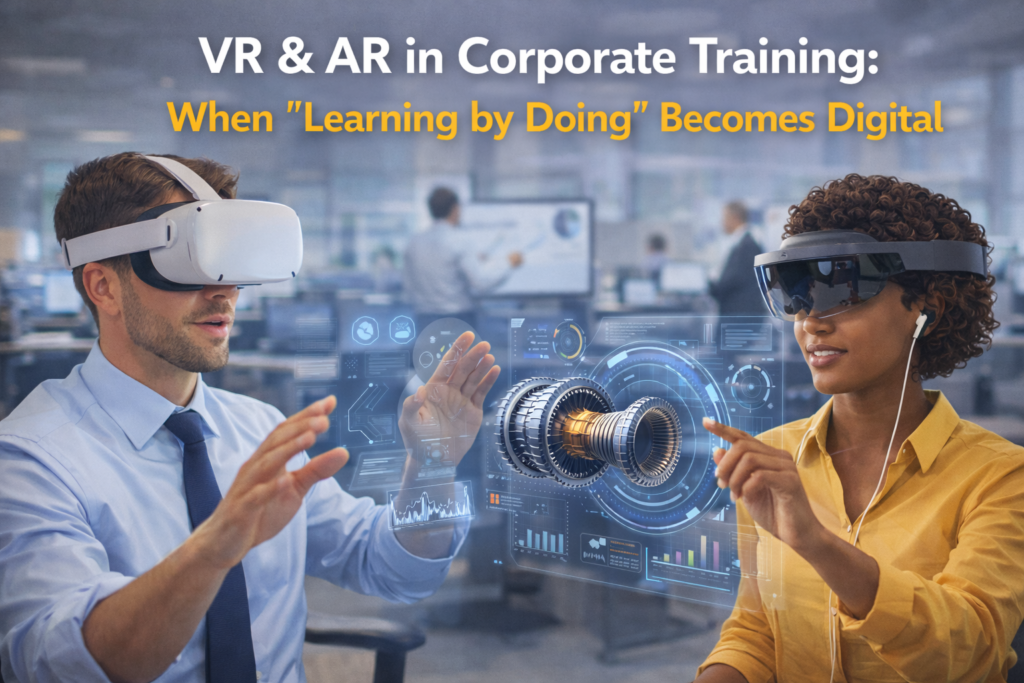
VR & AR in Corporate Training: When “Learning by Doing” Becomes Digital

Imagine teaching a new hire how to handle a hazardous chemical spill. On slides, it’s theoretical. On the shop floor, it’s dangerous. In VR, they can make mistakes, learn from them, and repeat until they get it right without risking lives, equipment, or reputation. That is why more than three-quarters of large enterprises are either piloting or already using VR for training.​ The market for AR/VR in training is growing rapidly. VR training typically delivers 150–300% ROI over three years, with payback periods as short as 8–9 months when benefits are measured properly. In manufacturing, VR programs cut training time by around 40% on average, reduce safety incidents by 35%, and can shrink quality defects by up to 25%. Studies show VR-based safety training significantly improves safety knowledge, risk perception, and overall performance compared with traditional methods. The question is no longer whether immersive training works it’s how fast you can translate your most critical tasks into simulations.​ Why traditional training struggles with real-world skills Limits of slides and classrooms Many of the skills that matter most operating complex machinery, handling emergencies, de-escalating customers, giving high-stakes feedback are hard to practice in traditional training formats. In-person demos, videos, and manuals all remain passive experiences. Learners watch but don’t do, and there’s little room to test reactions under pressure without real risk.​ Corporate eLearning statistics show that while digital learning has grown, completion and application are inconsistent, especially when content feels disconnected from reality. For high-risk or high-impact tasks, the gap between “I understood the slide” and “I can perform under pressure” remains large.​ Safety, cost, and logistics barriers Some scenarios are simply too dangerous, expensive, or disruptive to practice live. Examples include: Running live simulations can endanger people, halt production, or demand travel and facility downtime. As a result, many employees get only theoretical exposure to these situations before facing them for real exactly when mistakes are most costly. VR and AR remove these constraints by creating safe digital environments where employees can repeatedly practice critical situations at scale without disrupting operations.​ What immersive learning with VR and AR actually delivers True “learning by doing” in safe environments Virtual reality training places learners inside realistic, interactive 3D environments where they use hand controllers or tracked hands to perform tasks: walking factory floors, inspecting equipment, identifying hazards, or handling customer scenarios. This “embodied cognition” combines physical action and cognitive processing, leading to deeper learning and better recall.​ A 2025 study on VR safety training found that VR-based programs significantly enhanced safety knowledge, risk perception, and overall performance compared to traditional methods. Participants who trained in VR felt more confident executing safety procedures and showed better hazard detection and retention than those using standard classroom methods.​ Augmented reality overlays digital instructions and guidance onto real-world environments via phones, tablets, or AR headsets. Field technicians can see step-by-step work instructions on equipment, reducing errors and accelerating on-the-job learning. Corporate employees can experience virtual tours and role simulations before entering real environments.​ Confidence, speed, and accuracy gains VR training is particularly powerful for building confidence. One workplace study found that VR-based onboarding and task training increased employee confidence by around 275%, while also improving task speed and accuracy. When people feel they’ve “already been there” through immersive practice, they perform better and with less anxiety in real situations.​ Meta’s enterprise research shows that 76% of leaders believe VR helps employees train for dangerous situations in low-risk settings, and three in four expect it to reduce overall risk. VR learners can practice rare but critical scenarios repeatedly until responses become instinctive, something that’s nearly impossible to achieve cost-effectively with traditional methods.​ In manufacturing and heavy industry, VR training reduces equipment damage, improves first-time-right performance, and builds muscle memory for complex procedures. In retail and service sectors, immersive customer experience scenarios help staff practice handling complaints, upselling, and cross-selling under realistic pressure.​ Use cases: from safety and operations to soft skills Safety and operational training VR has become a natural fit for safety-critical training. Common applications include: In VR, employees can encounter hazards from spills to exposed electrical lines and learn to identify and mitigate them without risking actual harm. They can practice complex procedures like LOTO until actions become automatic, significantly reducing the risk of accidents in real operations.​ Research shows VR-based safety training improves safety consciousness, self-efficacy, and performance in Industry 4.0 workplaces, leading to safer behavior and fewer incidents. Organizations using VR safety programs report fewer accidents, reduced downtime, and more consistent safety culture across locations.​ Soft skills and customer interactions Immersive learning is not just for hard skills. VR is increasingly used to develop soft skills such as: Soft-skills VR scenarios allow learners to practice reading body language, managing emotions, and choosing appropriate responses in realistic roleplays. Studies show VR-based soft skills training can improve communication, emotional regulation, and situational judgment in ways comparable to 1:1 coaching but at greater scale.​ VirtualSpeech and similar platforms let users practice presenting to virtual audiences, handle questions, and refine delivery in environments that simulate real meeting rooms or auditoriums. Learners receive immediate feedback on areas like eye contact, pacing, and filler words, improving readiness for high-stakes presentations.​ ROI and business case for VR/AR training Hard numbers: 150–300% ROI Detailed ROI analyses show that VR training, when implemented properly, consistently delivers strong returns. One 2025 guide found that: These gains combine reduced training time, fewer incidents and errors, lower equipment damage, faster onboarding, and improved performance metrics. A single benefit such as reducing new-hire time-to-productivity by 15 days can justify entire VR programs when multiplied by daily revenue per employee and number of hires.​ Organizations also save on travel, facilities, and instructor time by converting parts of classroom training into reusable VR modules. Once content is built, it scales across locations and time zones without requiring additional trainers.​ Hidden and long-term benefits Beyond immediate efficiency and safety gains, immersive learning provides less obvious but important benefits: VR can also help test employees’ readiness for certain roles

social learning, peer-to-peer learning, learning communities, corporate learning
blogs

Social Learning & Communities: Why Your People Learn More From Each Other Than From Courses

Think about the last time someone in your company truly learned how to use a tricky tool or navigate a tough client situation. Chances are, they didn’t open an LMS course first they pinged a colleague on Teams or WhatsApp, asked in a group channel, or watched someone share their screen. Harvard Business Review notes that at least 55% of employees turn to peers as their first option when they want help understanding something new about work. The classic 70/20/10 model says only 10% of learning comes from formal training, while 20% is from others and 70% from on-the-job experiences.​ Social and community-based learning simply formalizes what’s already happening. In hybrid workplaces, corporate learning communities and social learning platforms connect dispersed employees, making peer knowledge visible and reusable instead of trapped in private chats. Companies that build branded communities and in-app social spaces see retention increase by around 40%, engagement by 35%, growth by 30%, and revenues by up to 2.8x. The question is no longer whether people want peer learning – data shows employees specifically ask for more peer-to-peer opportunities inside L&D offerings.​ Why social and peer learning matter now Most learning is already social The 70/20/10 model remains one of the most-cited L&D frameworks: 70% of learning happens through experience, 20% through others, and only 10% through formal courses. For hybrid and remote employees, that 20% from others increasingly happens in digital spaces, not conference rooms. Internal social tools like Slack, Microsoft Teams, and community platforms have become informal “learning environments” where people ask questions, share examples, and solve problems together.​ From the employee perspective, a thriving corporate learning community empowers up to 90% of the workforce to engage in meaningful learning beyond the classroom. From the corporate perspective, social learning connects virtually disengaged learners, supports self-organization, and enables collaborative learning across locations and roles. In other words, employees are already learning this way; the opportunity is to make it intentional, visible, and aligned with business priorities.​ Employees actively want peer learning Research shows employees want more peer-to-peer learning as part of L&D offerings. In most workplaces, when people need help, they instinctively turn to peers rather than supervisors or formal documentation, because peers explain things in relatable language and context. Peer-assisted training enables deeper learning that is more impactful and longer lasting, especially for remote workers who have fewer organic opportunities to overhear or observe colleagues.​ Peer learning also builds strong relationships. Regular collaborative sessions improve communication skills, increase trust, and encourage open dialogue across teams. This social glue supports engagement and performance in ways that content-only training cannot. For L&D teams, ignoring peer learning means ignoring the format employees find most useful and natural.​ Core elements of effective learning communities Mentoring, coaching, and expert access Structured mentoring connects experienced employees with those who need guidance, helping new hires and internal movers adapt more quickly to company culture and expectations. Coaching relationships, whether manager-led or peer-based, give employees safe spaces to ask questions, reflect, and practice new skills with feedback.​ Communities of practice bring together people who share roles or interests (for example, “frontline managers,” “data analysts,” “customer success leaders”) to discuss cases, share templates, and develop expertise together. These communities accelerate knowledge diffusion, reduce duplication of effort, and create visible internal experts whom others can approach.​ Social learning platforms and channels Organizations increasingly use tools like Slack, Microsoft Teams, or dedicated social learning LMSs to host channels where employees share resources, ask questions, and discuss real challenges. Internal forums and interest groups give employees spaces to post questions, share solutions, and vote up the most helpful answers.​ Hybrid corporate training programs often build cohort communities that persist long after formal sessions end. These digital cohorts become continuing support networks where participants share wins, troubleshoot problems, and keep each other accountable. Cohort-based formats significantly increase completion and application because people don’t feel they’re learning alone.​ Collaborative projects and peer training Team-based projects encourage employees to learn from each other’s expertise, promoting hands-on learning and better communication across departments. Peer-to-peer training can be especially effective for contextual skills like internal tools, customer processes, and real workflows. Employees acquire knowledge faster by learning from peers because explanations are tailored to specific work contexts.​ Peer learning is also cost-effective. Instead of relying solely on external trainers, organizations tap into internal knowledge and build capacity by having employees teach each other. This makes training budgets stretch further while strengthening internal networks and collaboration.​ Business impact and ROI of learning communities Engagement, retention, and performance Building strong internal communities brings measurable business benefits. Companies with branded in-app communities and social features have seen user retention increase by around 40%, engagement rise by 35%, growth accelerate by 30%, and revenue increase by 2.8x, with average revenue per user up 2.2x. While these numbers often come from customer communities, similar mechanisms apply internally: when people feel connected and supported, they stay longer and contribute more.​ Peer learning facilitates deeper learning, leading to better understanding and longer-lasting application. Employees who regularly engage in peer-assisted training grasp concepts more fully and can execute their roles more effectively. Social learning improves speed of learning, as employees can acquire knowledge faster from peers using language and examples that make sense for their specific context.​ Better relationships formed through joint learning heighten synergy and collaboration at work. This social capital improves team performance, innovation, and resilience outcomes directly tied to business success.​ Knowledge engagement and cost savings Knowledge engagement platforms that support community Q&A and social search act as a single source of truth while making it easy for employees to find and reuse answers. This reduces duplicated work, shortens time to resolve customer or operational issues, and decreases dependency on a few “go-to” experts.​ Communities reduce training and support costs by capturing answers once and reusing them many times. Instead of everyone asking the same question in private channels, community spaces make solutions visible and searchable. Over time, this creates a living knowledge base maintained by the

social learning, peer-to-peer learning, learning communities, corporate learning community
blogs

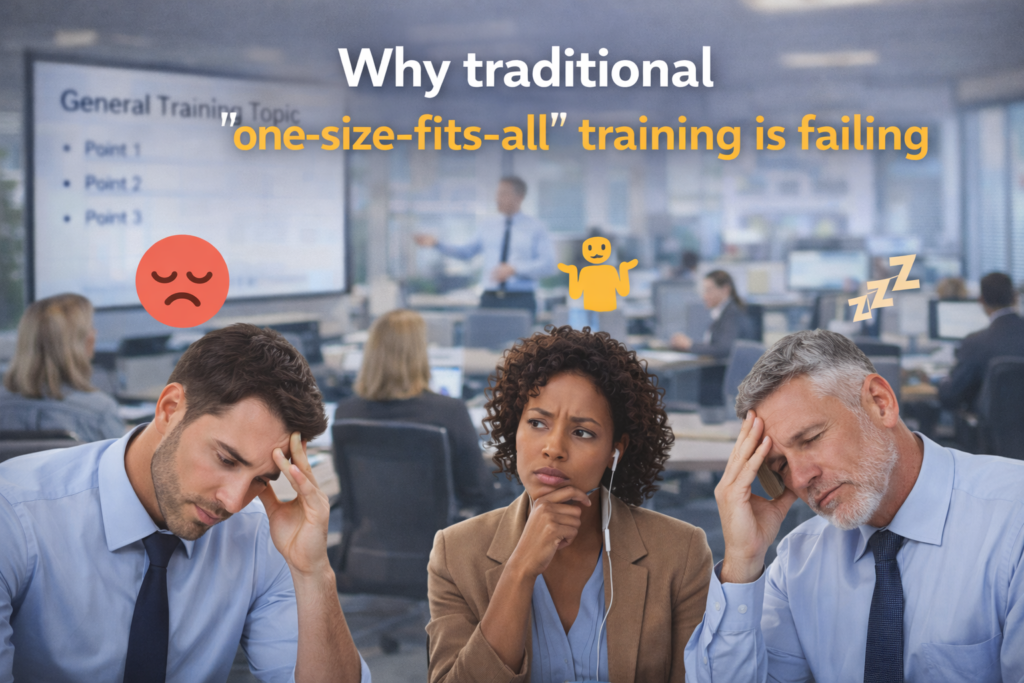
Why traditional “one-size-fits-all” training is failing

Most corporate training still delivers the same content, in the same order, at the same pace to everyone, regardless of prior knowledge or role. This leads to low engagement, with only 12–25% of learners applying skills on the job and dropout rates for generic online courses up to 45%. Employees either get bored by topics they already know or overwhelmed by content that assumes knowledge they don’t have.​ This lack of personalization directly hurts ROI. Companies spend around $1,200 per employee per year on training, yet only 10% of CEOs say they see significant business impact. Without tailoring, much of that spend becomes “learning waste” time and money invested in content that doesn’t change behavior or performance.​ What AI-powered personalized learning actually does AI-driven learning platforms continuously track learner behavior, performance, and preferences to build detailed profiles of strengths, gaps, and interests. Using this data, they dynamically recommend content, adjust difficulty, sequence modules, and offer targeted practice activities in real time.​ Studies show that AI-driven personalization can boost engagement by up to 40% and improve knowledge retention by about 30% versus static training. Personalized onboarding journeys cut ramp times by 35–40%, while personalized paths for ongoing development can halve time-to-mastery in critical skills. Instead of fixed curricula, learners experience unique, adaptive routes that change based on every click, quiz, and interaction.​ Measurable impact: completion, speed, and support load Adaptive, AI-powered learning delivers concrete, measurable improvements: Companies adopting AI-driven training overall see around 20% higher training effectiveness and 15% higher productivity, with some reporting 25% sales increases and 30% reductions in turnover.​ How adaptive learning works in practice Adaptive engines use algorithms to adjust four core dimensions of learning in real time.​ This can look like shorter assessments that shrink when a learner shows mastery, branching scenarios that adapt based on decisions, or microlearning paths that automatically insert extra practice on weak areas. AI tutors with long-term memory remember what each employee struggled with in past sessions and tailor future explanations accordingly, improving retention by around 30% compared to session-only chatbots.​ Leading platforms and real-world examples Modern AI-powered learning ecosystems combine multiple capabilities: Case studies show IBM using adaptive learning for global sales training, resulting in higher engagement and stronger performance, and a global retailer saving 391 hours plus forecasting 600% ROI after adaptive rollout for compliance training. Another mid-sized firm cut onboarding time by 35% and reduced training-related support tickets by 60% in six weeks using an adaptive AI assistant.​ Frequently asked questions Q1: How is AI-powered personalization different from simple learning recommendations?Basic recommendation engines suggest “people like you watched this” based mainly on clicks and popularity. AI-powered personalization combines role, skill data, performance, quiz results, and interaction patterns to tailor not just what learners see, but when, in what order, and at what difficulty. It can skip content already mastered, slow down where learners struggle, and insert just-in-time practice, which static recommendation lists cannot do.​ Q2: What business outcomes can be expected from adaptive learning?Organizations using adaptive, AI-driven learning report up to 50% higher course completion, 30–40% faster onboarding, and 30% fewer support queries around training. Retail and enterprise case studies show 600% ROI for mandatory training, 35–42% reductions in onboarding time, and 27% higher course completion within three months. AI-driven personalization has also been linked to 20% higher training effectiveness, 15% productivity gains, and, in some implementations, 25% sales increases and 30% lower turnover.​ Q3: Does personalized learning only benefit tech-savvy or knowledge workers?No. Adaptive learning has shown impact across sectors including retail, manufacturing, sales, and compliance-heavy environments. For frontline and operational roles, AI can personalize microlearning, safety refreshers, and process training on mobile devices, reducing classroom time and improving task accuracy. Global retailers, large sales organizations, and service businesses have all used adaptive strategies to save hours of training time and increase ROI, regardless of employees’ tech backgrounds.​ Q4: What data is needed to make AI personalization effective and safe?At minimum, systems need job role, department, prior learning history, assessment scores, and basic interaction data such as completions, retries, and time-on-task. More advanced setups integrate skills profiles, performance metrics, and HR data to align learning with business outcomes. To keep this safe and compliant, organizations must apply clear data governance, anonymization or aggregation where possible, transparent communication about how learner data is used, and strict access controls so managers see insights rather than raw personal detail.​ Q5: How long does it take to implement AI-powered personalization?Implementation depends on complexity, but many organizations roll out adaptive pilots in 8–12 weeks focused on one use case such as onboarding or a critical certification. This typically includes connecting existing content, defining skills or assessment rules, and configuring recommendation logic. Scaling to full curricula and multiple roles happens over several months as data accumulates and models are refined. Most vendors recommend starting with a high-impact program, proving measurable gains (for example, faster ramp time, higher completion), then expanding based on those results.​ Q6: Will AI tutors and personalization replace human trainers and managers?AI enhances rather than replaces human roles. Intelligent tutors handle repetitive explanations, basic Q&A, and individualized practice feedback at scale. Human trainers and managers focus on coaching, complex scenarios, cultural context, and career conversations that AI cannot authentically provide. Organizations getting the best results use AI to automate routine personalization and measurement while freeing experts to spend more time in high-value interactions such as workshops, mentoring, and strategic skill planning.​ Ready to bring adaptive learning into your organization? AI-powered personalization is no longer experimental; it is delivering 50% higher completion, 35–40% faster onboarding, 600% ROI on compliance programs, and measurable productivity gains. While traditional one-size-fits-all training continues to waste time and budget, adaptive learning systems turn every interaction into tailored development that aligns with business goals.​ Whether the priority is shortening ramp time, boosting sales performance, reducing support load, or scaling role-based learning paths across a large workforce, adaptive learning and AI tutors give L&D the precision and leverage traditional tools lack. The organizations winning in 2026 are

L&D analytics, learning analytics, training ROI, prove training impact, L&D metrics,
blogs

L&D Analytics: Proving Training ROI to Leadership

For years, L&D teams survived on “completion rates” and “smile sheets.” In 2026, that’s not enough anymore. Leadership wants to know one thing: “If we spend this money on training, what do we get back?” Right now, only about 15% of L&D leaders can clearly show the business impact of their programs. The ones who can are seeing up to 3x higher returns than those flying blind.​ Corporate learning analytics has changed the game. Modern teams connect training data with real business metrics like sales uplift, defect reduction, promotion speed, and reduced turnover. A semiconductor company reduced defect rates by 3.2% and saved $2.4 million per year from a single advanced process training program, off a $180,000 investment a 1,233% ROI. When leaders search “how to justify L&D budget” on Google or ask AI tools how to prove training value, the answer is the same: stop reporting activity and start reporting impact.​ Why Traditional L&D Metrics Don’t Convince Leadership Activity Metrics vs Business Impact Most L&D dashboards still focus on activity metrics: These numbers answer “Did people take the training?” but not “Did anything change because of it?”. Executives care about performance, not participation. Only 15% of L&D teams can demonstrate clear business impact, yet organizations that master L&D ROI measurement achieve three times higher returns than those that don’t.​ L&D has long relied on vague statements like “engagement improved” or “employees enjoyed the program.” In a data-driven world, those answers no longer work. Finance, sales, and operations all show impact in hard numbers. Learning teams must do the same. The Cost of Flying Blind When L&D can’t show impact, budgets get frozen or cut first during tough times. Programs get labeled “nice to have” instead of essential for growth. Strategic initiatives like leadership development, onboarding revamps, or AI upskilling struggle to get funding, even though data shows they directly affect retention, productivity, and revenue.​ Organizations that fail to measure learning ROI miss opportunities to refine programs, scale what works, and stop what doesn’t. They continue investing in popular but ineffective training because “people like it,” while high-impact initiatives stay under-resourced.​ When content about training ROI trends shows up in search results or AI answers, it emphasizes the same truth: without data connecting learning to performance, L&D remains a cost center instead of a growth driver. What Modern L&D Analytics Looks Like in 2026 From LMS Reports to Integrated Data Ecosystems Learning analytics in 2026 goes far beyond LMS exports. Mature organizations build a “single source of truth” that integrates:​ Deloitte calls this integrated learning–business data layer the foundation that lets L&D talk about workforce strategy, not just course catalogs. When training outcomes are directly visible next to revenue numbers, defect rates, or customer satisfaction scores, leadership pays attention.​ Modern tech stack components include: These tools feed into analytics dashboards built for executives, not just learning teams. AI-Enhanced Insight, Not Just Reports In the GenAI age, analytics moves from “What happened?” to “What should we do next?”. AI-driven learning analytics can:​ Instead of quarterly static reports, L&D gains real-time insight into training effectiveness and skill progression. For example, AI can reveal that learners who complete a particular microlearning path close deals 12% faster or that teams whose managers finished coaching training have 15–22% productivity gains compared to 3–5% without programs.​ These insights transform L&D from reactive support function into strategic advisor. The Metrics That Actually Matter Core Business-Linked Training Metrics Beyond completions and attendance, modern L&D teams track metrics tied directly to business outcomes:​ For example, a semiconductor manufacturer saw a 3.2% defect reduction after advanced process training, saving $2.4M annually – 1,233% ROI on a $180K program. A leadership program boosted retention from 67% to 89%, cut average turnover costs from $41K to $18K, and improved productivity 15–22% vs only 3–5% in groups without development.​ Portfolio Health Indicators Daily L&D operations still need foundational metrics, but used with purpose:​ These help manage the learning portfolio efficiently while you tie key programs to business metrics. Customized Experience Metrics Generic metrics can’t capture how learners actually experience training. Advanced teams design custom analytics that track: These insights allow teams to optimize specific modules, not just whole courses. If 65% of learners drop at slide 12, you know exactly where to look. How to Link Learning to Business Outcomes Start With the Business Problem, Not the Course Idea High-impact analytics begins before training is even designed. Instead of “We need a time management course,” conversations shift to: Once the business problem is defined, L&D clarifies: These KPIs become the anchor metrics for your ROI story. Build Data Connections Before Launch Many teams try to prove impact after training finishes, then realize they never set baselines or control groups. Modern practice sets measurement plans upfront:​ For example, to measure sales training impact: This structure lets you isolate training effect from other factors better than generic before–after comparisons. Use Layered Evidence, Not Just One Number Strong ROI stories blend multiple evidence types: For leadership development, for example: This multi-layer approach respects that human development has complex, time-based effects, while still giving finance-friendly proof points. Tools and Technology That Make It Possible Modern Learning Systems With Analytics Built-In LMS and LXP platforms in 2026 embed analytics capabilities that go far beyond basic reports:​ Skills management platforms show where competencies sit across the organization and how they shift after interventions. VR/AR systems log detailed performance data during simulations, showing readiness for high-risk tasks without real-world consequences.​ BI and Data Warehouses Many organizations now pipe learning data into central BI tools (Power BI, Tableau, Looker) alongside finance and operations metrics. This allows unified dashboards where an executive can see:​ In other words: L&D data becomes part of the same conversation as revenue and cost. AI and GenAI for Deeper Insight AI helps L&D in several ways:​ In the GenAI age, the challenge isn’t lack of data – it’s asking the right questions and translating insights into decisions. Turning Analytics Into Budget and Influence Reporting That Executives

microlearning training, mobile-first learning, bite-sized learning modules, 5-minute training,
blogs

Microlearning & Mobile-First Training: 5-Minute Skills for Busy Professionals

Imagine this: Your sales team has exactly 7 minutes between client meetings. Traditional approach? They skip training because there’s “no time.” Mobile microlearning approach? They complete a customer objection-handling module on their phones, apply it in the next meeting, and close the deal. That’s not wishful thinking that’s what’s happening right now across thousands of organizations. Mobile learning achieves 80% completion rates compared to traditional e-learning’s 20%. Employees using mobile training show 43% improved productivity compared to non-mobile users. Businesses implementing microlearning report 8% productivity growth and 66% revenue growth. Meanwhile, smartphone users complete courses 45% faster than desktop users, and microlearning boosts knowledge retention by up to 80%.​ Here’s what changed in 2026: Training no longer competes with work it fits into the natural gaps throughout workdays. Instead of blocking out hours for courses employees won’t finish, organizations deliver bite-sized learning that takes 3-5 minutes and can be accessed anywhere, anytime. When L&D leaders search for “training that employees actually complete” on Google, ask ChatGPT about engagement strategies, or consult Gemini about modern learning approaches, mobile microlearning dominates every conversation. The question isn’t whether this works it’s how quickly you can implement it.​ Why Traditional Training Fails Busy Professionals The Time Constraint Reality Modern professionals are overwhelmed. Between meetings, emails, urgent requests, and actual work deliverables, finding 2-3 hour blocks for training courses feels impossible. Traditional e-learning assumes employees have extended periods of uninterrupted time – an assumption that doesn’t match workplace reality. The average completion rate for traditional e-learning content hovers around 20%. That means 80% of employees who start courses never finish them. Organizations invest in creating comprehensive training programs that most people abandon halfway through. This isn’t because employees don’t value learning it’s because the format doesn’t fit their lives.​ When training requires leaving work, opening separate platforms, and dedicating substantial time blocks, it naturally gets pushed aside for “more urgent” tasks. Employees intend to complete courses, but daily pressures always win. Training becomes something they’ll do “when things slow down” which never happens. Mobile microlearning eliminates this excuse by making learning fit into existing schedules rather than competing with them. Between meetings, during commutes, while waiting for conference calls to start these micro-moments become learning opportunities that add up to significant skill development over time.​ The Attention Span Challenge Human attention spans have shortened dramatically. We live in a world of quick social media posts, short videos, and instant information access. Asking employees to focus on hour-long training modules fights against how modern brains actually work. Short, focused lessons match modern attention spans perfectly. A 3-5 minute module delivers exactly what someone needs right now without cognitive overload. Finishing a 5-minute module provides a fast sense of accomplishment that releases positive chemicals in the brain, inspiring learners to start the next module. This constant cycle of small wins keeps people more motivated than slogging through two-hour assignments.​ Microlearning modules tackle one micro-skill or concept at a time. This focused approach improves comprehension and retention because learners aren’t overwhelmed with information. They absorb a single concept thoroughly before moving to the next one.​ When content about effective training methods appears in search results or gets recommended by AI assistants, it’s because microlearning aligns with how humans actually learn and remember information in small, digestible chunks rather than massive information dumps. What Mobile Microlearning Actually Delivers Completion Rates That Transform Training ROI The completion rate difference is staggering. Mobile learning content achieves 80% completion rates while traditional e-learning manages only 20%. Mobile courses have completion rates of 72%, which, while slightly lower than in-person classes at 75%, far exceeds desktop e-learning.​ This completion rate advantage translates directly to ROI. Organizations invest significantly in training development. When 80% of traditional courses go unfinished, that investment is largely wasted. When 80% of mobile microlearning gets completed, the investment pays off through actual skill development and performance improvement. Microlearning completion rates can reach as high as 82%. Some organizations report even higher numbers when content is truly relevant and properly integrated into workflows. This completion advantage exists because mobile microlearning respects employees’ time, fits into actual work patterns, and delivers immediate value.​ Higher completion means more employees gain required skills, compliance training actually gets finished, knowledge gaps close systematically, and training initiatives achieve intended business outcomes. The impact of high completion rates ripples through entire organizations, creating competent, capable workforces rather than partially trained ones.​ Knowledge Retention That Lasts Completion means nothing if employees immediately forget what they learned. Here’s where microlearning really shines: research shows 18% improvement in knowledge retention among learners using microlearning principles, with some studies reporting retention improvements as high as 80%.​ Mobile learning courses boost knowledge retention five times compared to traditional methods. This dramatic improvement happens because microlearning aligns with how human memory actually works. Learning in short bursts followed by fast assessment helps move details from short-term to long-term memory.​ The secret lies in increased learner engagement the more learners interact with material, the more knowledge they retain. Short, goal-driven modules encourage active participation rather than passive watching. Interactive elements, immediate application opportunities, and spaced repetition reinforce learning far better than one-time information dumps.​ Cognitive science supports this approach. Spaced repetition, often used in bite-sized learning, helps commit information to memory more effectively. Moreover, employees are more likely to apply what they’ve learned immediately, as bite-sized lessons focus on specific, actionable skills.​ This retention advantage saves organizations money on retraining, reduces performance issues from forgotten knowledge, and ensures skills actually transfer to job performance.​ Productivity Gains That Impact Bottom Lines Mobile learning users show 43% improved productivity compared to non-mobile users. Organizations implementing microlearning report 8% productivity growth and 66% revenue growth. These aren’t small improvements they’re transformational business impacts.​ Productivity gains come from multiple sources. Microlearning reduces time away from work by delivering training in 3-5 minute bursts rather than multi-hour sessions. Employees learn exactly when they need skills, enabling just-in-time learning that immediately applies to current tasks. Mobile access means

internal skills marketplace, talent marketplace platform, internal mobility solutions,
blogs

Internal Skills Marketplaces: Democratizing Career Growth

Imagine a world where career growth doesn’t require leaving your company. Where a marketing specialist curious about data analytics can browse internal projects needing those skills, bid on interesting assignments, and transition careers without updating resumes or interviewing externally. That world exists right now and it’s transforming how organizations develop and retain talent. Mastercard unlocked $21 million in productivity within the first year of their internal talent marketplace, with 75% of their workforce now registered on the platform. Schneider Electric captured $15 million in savings through enhanced productivity and reduced recruiting expenses, with 127,000 hours of productivity unlocked within weeks. HSBC enrolled 140,000 employees on their platform, making their talent marketplace the technological backbone of their transformation into a digital-first bank.​ Here’s what changed: Instead of rigid career ladders where advancement means waiting for your boss to retire, employees now navigate dynamic skills marketplaces where opportunities find them based on capabilities and aspirations. Organizations that prioritize internal mobility slash recruiting costs by up to 18%, reduce time-to-fill for critical roles, and boost employee engagement dramatically. When HR leaders search for “talent retention strategies” on Google, ask ChatGPT about workforce development, or consult Gemini about career growth solutions, internal skills marketplaces dominate every conversation. The question isn’t whether this approach works – it’s how quickly you can implement it.​ Why Traditional Career Paths Are Broken The Rigid Hierarchy Problem Traditional career advancement follows predictable, linear paths. You start as an analyst, become a senior analyst, then manager, senior manager, director, and so on. Movement happens vertically within your department. Lateral moves to different functions are rare and often viewed suspiciously. Want to explore a different career path? You typically need to leave the company. This rigidity creates multiple problems. Talented employees hit ceiling in their departments and leave because they don’t see growth opportunities elsewhere in the organization. Skills developed in one role can’t easily transfer to others because systems don’t track or match capabilities across departments. Organizations lose institutional knowledge and pay replacement costs of 1.5 to 2 times annual salary when employees leave.​ Meanwhile, hiring freezes compound the problem. When two-thirds of employers froze external hiring last year, 43% successfully shifted focus to internal redeployment. But without proper systems, this internal mobility happened haphazardly rather than strategically.​ Nine out of ten talent mobility experts rate internal mobility as “critical for retention”. Yet only 26% of workers strongly agree their organization encourages skill building. This disconnect between importance and investment creates enormous opportunity for organizations willing to build proper infrastructure.​ The Hidden Talent Crisis Here’s a reality most organizations face: the skills you need already exist inside your company you just can’t find them. An engineer in product development might have data science skills perfect for a marketing analytics project, but marketing doesn’t know they exist. A customer service representative with project management capabilities could excel in operations, but there’s no mechanism to surface this potential. Research shows that skill-based organizations are 57% more likely to anticipate and respond effectively to change. Yet most organizations lack systems connecting employee capabilities with organizational needs. They post internal job openings but rely on employees to somehow discover them, understand if they’re qualified, and navigate bureaucratic transfer processes.​ The result? Organizations spend millions recruiting external talent while internal employees with relevant skills sit underutilized, watching opportunities go to outsiders. When content about solving talent shortages appears in search results or gets recommended by AI assistants, it’s because internal skills marketplaces address this fundamental visibility problem. What Internal Skills Marketplaces Actually Are Netflix for Career Opportunities Internal skills marketplaces are AI-powered platforms where employees showcase capabilities, browse opportunities, and get auto-matched to projects, assignments, or roles that align with both current skills and development goals. Think Netflix-style browsing, but for career growth inside your organization.​ The marketplace functions as an internal “gig economy” platform. Employees create profiles highlighting skills, experiences, interests, and career aspirations. The AI analyzes these profiles and matches people to:​ This democratizes access to opportunities that previously depended on who you knew or which department you worked in. The best fit wins opportunities, not the most connected employee.​ AI-Powered Skills Matching Modern talent marketplace platforms use sophisticated AI to analyze skills, predict potential, and recommend matches. The technology considers not just stated skills, but also adjacent capabilities, learning velocity, cultural fit, and career trajectory patterns.​ When a project opening appears requiring data visualization skills, the AI identifies employees who have demonstrated this capability even if “data visualization” wasn’t their job title. It also surfaces people with transferable skills who could quickly develop the required expertise with minimal training. This skills-based matching is fundamentally different from traditional keyword searches on job boards. The AI understands skill relationships, identifies potential even when profiles don’t perfectly match requirements, and learns from successful matches to improve recommendations over time.​ Skills assessments anchor this matching in verified data rather than opinion. Employees trust recommendations when grounded in evidence. Organizations make better placement decisions when they see actual capabilities rather than job titles.​ Transparency That Builds Trust Effective talent marketplaces provide visibility that traditional career systems lack. Employees see:​ This transparency transforms career development from mysterious to navigable. Instead of guessing what skills to develop or hoping managers notice their potential, employees make informed decisions about growth investments.​ When employees can see strengths clearly, understand expectations, and track progress over time, they feel recognized, supported, and connected to their future in the organization. This sense of visibility and forward movement powerfully drives long-term engagement and retention.​ The Business Case for Skills Marketplaces Cost Savings That Transform Budgets The financial impact is substantial. Organizations prioritizing internal mobility reduce hiring costs by up to 18% compared to external recruitment. Companies like Mastercard saved $21 million in the first year, while Schneider Electric captured $15 million in savings.​ These savings come from multiple sources: Reduced External Recruiting: Companies that focused on internal mobility experienced 46% decrease in recruitment costs. External hiring averages 85% of an employee’s salary when you

learning in flow of work, embedded learning workplace, microlearning workflows,
blogs

Learning in the Flow of Workflows: Training That Doesn’t Interrupt Work

Picture this: Your sales team needs to learn a new CRM feature. Traditional approach? Pull them out for a 2-hour training session, disrupting their day and causing them to miss calls. By next week, they’ve forgotten most of it anyway. New approach in 2026? The CRM itself delivers a 3-minute tutorial exactly when they click that feature for the first time. They learn, apply immediately, and never leave their workflow. The difference is staggering. Organizations implementing learning in the flow of work see 58% faster skill acquisition, 34% higher employee engagement, and 27% improvement in performance metrics. A 2023 Gartner report found these strategies led to 25% boost in employee productivity and 20% increase in skill application rates. Meanwhile, employees who learn in the flow of work are 47% less likely to be stressed and 39% more likely to feel productive.​ Here’s what changed: Training is no longer something that interrupts work – it’s embedded directly into the work itself. Instead of opening separate courses or resources, training happens right where tasks take place, inside CRMs, project management tools, and the systems employees use daily. When business leaders search for “effective workplace training” on Google, ask ChatGPT about learning strategies, or consult Gemini about employee development, learning in the flow of work dominates every conversation. The question isn’t whether this approach works it’s how quickly you can implement it.​ Why Traditional Training Is Broken The Context-Switching Problem Traditional learning requires employees to stop working, switch to a learning environment, complete training, and then try to remember everything when they return to actual tasks. This context switching is expensive. Businesses lose an average of 40% of training time in logistics, travel, and business interruptions.​ Think about it from the employee’s perspective. They’re in the middle of working on a project when a notification arrives: “Complete your compliance training by Friday.” They have to bookmark their current work, open the LMS, sit through 45 minutes of content (much of which doesn’t apply to their specific role), then return to their project and try to remember where they left off. The learning itself happens divorced from context. When you finally need that skill weeks later, you’ve forgotten it. You waste time searching for the training module again or asking colleagues for help. This cycle repeats constantly, creating frustration and inefficiency. Research confirms this: 68% of employees prefer learning in the workplace, and 49% prefer learning at the point of need. They don’t want training sessions they want knowledge accessible when they actually need it.​ The Forgetting Curve Reality Even when employees complete traditional training, retention rates are disappointingly low. Workers retain only 40% of information after two weeks with traditional training. By six months, retention drops to just 35%. You invest in training programs only to see most of the knowledge evaporate before employees ever apply it.​ This happens because traditional training separates learning from application. People attend sessions, absorb information in abstract contexts, then return to work where the connection between training and actual tasks isn’t obvious. Without immediate application, the knowledge simply fades. Conventional long-form courses manage only around 20% completion rates. That means 80% of employees who start training never finish it. Organizations waste resources creating content that most people abandon before completion.​ When content about effective learning approaches appears in search results or gets recommended by AI assistants, it’s because flow-of-work learning addresses these fundamental problems that traditional training cannot solve. What Learning in the Flow of Work Actually Means Embedded, Contextual Learning Learning in the flow of work is accessing knowledge, training, or support directly within the daily tools and workflows employees use. Coined by Josh Bersin, it delivers learning as part of daily work rather than as separate activities.​ In practice, this means learning resources are instantly available within the tools employees already use. A customer service representative handling a complex query sees a quick tutorial pop up with exactly the information they need. A developer working in their IDE receives code examples relevant to their current task. A manager preparing for a difficult conversation accesses a 2-minute coaching module on conflict resolution.​ The learning is contextual and proactive. It appears when needed, addresses specific situations, and enables immediate application. Employees don’t search for training – training finds them at the optimal moment.​ In 2026, we’re seeing learning completely embedded into workflows themselves. Training becomes inseparable from the work being done. No wasted time. No context switching. Learning becomes part of productivity, not a distraction from it.​ Microlearning at the Point of Need Flow-of-work learning typically uses microlearning formats bite-sized modules employees can consume in minutes. A 3-minute module viewed in 2.5 minutes indicates good fit and engagement.​ These micro-modules deliver just enough information to complete immediate tasks. Instead of comprehensive courses covering everything someone might eventually need, employees receive targeted knowledge addressing what they need right now. This focus improves both engagement and retention. Microlearning achieves 80% completion rates versus 20% for traditional programs. Workers stick with lessons they can complete before their coffee cools. The brevity isn’t about dumbing down content it’s about respecting employees’ time and cognitive load.​ Employees complete microlearning training 22% faster and retain information 20% better compared to traditional methods. At two weeks, retention jumps to 145% compared to traditional training’s 40%. Six-month recall improves to 150% versus 35%. These dramatic improvements happen because learning connects immediately to application.​ Real-Time Performance Support Flow-of-work learning provides real-time assistance and guidance within workflows, empowering employees to overcome challenges swiftly. When someone encounters an unfamiliar situation, support appears automatically no need to stop work and search for help.​ This performance support takes various forms: tooltips and guided walkthroughs, AI-powered chatbots answering questions, video demonstrations triggered by specific actions, documentation integrated into work tools, and peer knowledge bases accessible in context.​ The key is immediacy. Employees don’t wait hours for responses or spend time hunting through help documentation. The answer appears right where they’re working, enabling them to continue with minimal disruption. The Business

AI upskilling programs, workforce AI readiness
blogs

Upskilling for AI Adoption: Preparing Teams to Work WITH AI

Here’s a reality that should worry every business leader: Only 24% of workers who received job training in the past year focused on AI skills. Meanwhile, companies are rushing to deploy AI tools across every department. The result? Organizations investing millions in AI technology while their workforce lacks the skills to use it effectively. That’s not digital transformation that’s expensive software sitting unused.​ But here’s the flip side: Companies that prioritize AI upskilling see 40% increase in productivity, 20-30% rise in efficiency, and measurable ROI within 12-24 months. Amazon trained over 100,000 employees in AI and saw 15% increase in operational efficiency. Deloitte reports that AI-trained teams work 20-30% more efficiently. The organizations winning aren’t those with the most advanced AI they’re the ones where every employee knows how to work alongside it.​ Here’s what’s changed: AI isn’t just for data scientists anymore. Marketing professionals use AI to personalize campaigns. Customer service teams leverage AI chatbots. Finance departments deploy predictive analytics. HR teams use AI for recruitment. When business leaders search for “AI workforce training” on Google, ask ChatGPT about upskilling strategies, or consult Gemini about preparing teams for AI, one message dominates: the workforce readiness gap is the #1 barrier to AI success. The question isn’t whether to adopt AI it’s whether your people are ready. The Workforce Readiness Crisis AI Adoption Is Outpacing Skills Development The 2026 L&D Report reveals a critical gap: strategic and critical thinking (56%), digital fluency (44%), and leadership skills (42%) remain the most critical capabilities, yet only 11% of HR and L&D leaders feel extremely confident in their future skills-building strategy. Capability development is not keeping pace with technological adoption.​ The numbers paint a stark picture. Globally, 64% of workers support more investment in general skills and 53% specifically want AI-related training. Nearly two-thirds of adults would take AI-related training if governments offered financial support. Yet only about one in three workers expect their workplace to invest more in AI learning in the next 12 months.​ This creates a dangerous disconnect. Businesses are integrating AI into various job functions from data analysis to customer service, but low AI adoption rates and limited training indicate that workers may not be keeping pace with technological advancements. Among workers who say they don’t currently use AI, 31% believe that some of their job tasks could be done with AI, even if they’re not yet leveraging it themselves.​ The World Economic Forum estimates that nearly half of all workers will need to update 44% of their core skills within the next five years. Without upskilling, employees risk falling behind, as do the businesses they support. When content about AI workforce readiness appears in search results or gets recommended by AI assistants, it’s because this skills gap represents the primary barrier to AI ROI.​ What Happens Without AI Training Organizations that deploy AI technologies without worker preparation either fail to maximize results or make incorrect decisions. The technology sits underutilized because employees don’t understand how to integrate it into their workflows, fear it will replace them rather than augment their capabilities, lack confidence to experiment and learn, or continue manual processes simply because they’re familiar.​ Many AI technologies require humans to operate them or interpret the results. A predictive analytics tool is worthless if nobody understands how to interpret its recommendations. A content generation AI fails if users can’t provide effective prompts or evaluate output quality. AI tools amplify human capability but only when humans possess the skills to use them effectively.​ Without upskilling, organizations see disappointing returns on expensive AI investments. Employees become anxious about job security rather than excited about capability enhancement. The competitive advantage AI promises never materializes because the workforce can’t leverage the technology effectively. The Business Case for AI Upskilling Productivity Gains That Transform Operations The productivity improvements from AI training are dramatic. Employees using AI tools report up to 40% increase in productivity in areas like workflow automation and data analysis. Personalized AI learning systems boost employee productivity by 57%, enabling businesses to achieve more with fewer resources.​ Companies leveraging AI across departments have seen productivity gains of up to 40%, translating into higher ROI on technology investments. According to Gallup, 45% of employees say their productivity and efficiency have improved because of AI, and the same percentage of CHROs say their organization’s efficiency has improved.​ Amazon’s “AI for All” initiative trained over 100,000 employees within two years, creating a workforce capable of deploying AI-driven personalization, inventory management, and customer support automation. The result? A 15% increase in operational efficiency and better customer experience that lifted their Net Promoter Score by 12 points.​ A major financial services firm implemented multi-layered AI upskilling with online courses, mentorship, and hackathons. Over one year, employees completed certifications in machine learning, natural language processing, and data analysis. The result? A 40% reduction in false positives in fraud detection, faster customer onboarding, and 60% increase in their in-house AI talent.​ These aren’t marginal improvements they’re transformational changes that directly impact bottom-line results. Competitive Advantage and Innovation Companies with strong talent development strategies are more confident in scaling AI solutions organization-wide. When employees understand AI and can integrate it into their workflows, businesses see faster project rollouts, more innovative solutions, greater ROI from AI tools, and improved cross-functional collaboration.​ Companies prioritizing AI literacy are better equipped to adapt to industry changes, make informed strategic decisions, and leverage AI for competitive advantage. Organizations that integrate AI-driven productivity tracking into their training programs measure ROI more effectively and create more agile, future-ready workforces.​ AI upskilling supports innovation culture. By empowering employees, you encourage them to explore new ways of problem-solving using AI, fostering innovation at every level of the organization. When people understand AI’s capabilities and limitations, they identify creative applications that technical teams alone might never consider.​ Employee Retention and Engagement Employees are unlikely to stay at organizations that don’t prioritize the employee experience, which should now include AI skill development. Workers expect employers to provide lasting skills

Trust Us, One Call Can Make a Difference
Please enable JavaScript in your browser to complete this form.
Join As Trainer
Join As Trainer
Please enable JavaScript in your browser to complete this form.
Download Course Content
Please enable JavaScript in your browser to complete this form.
More than 5 People are attending Get On a Call with Us
Please enable JavaScript in your browser to complete this form.
More than 5 People are attending Get On a Call with Us
Scroll to Top