TechnoEdge

Free Master Class

How to Plan Your AI Training Budget for FY26? (For CHROs & L&Ds)

AI workforce development

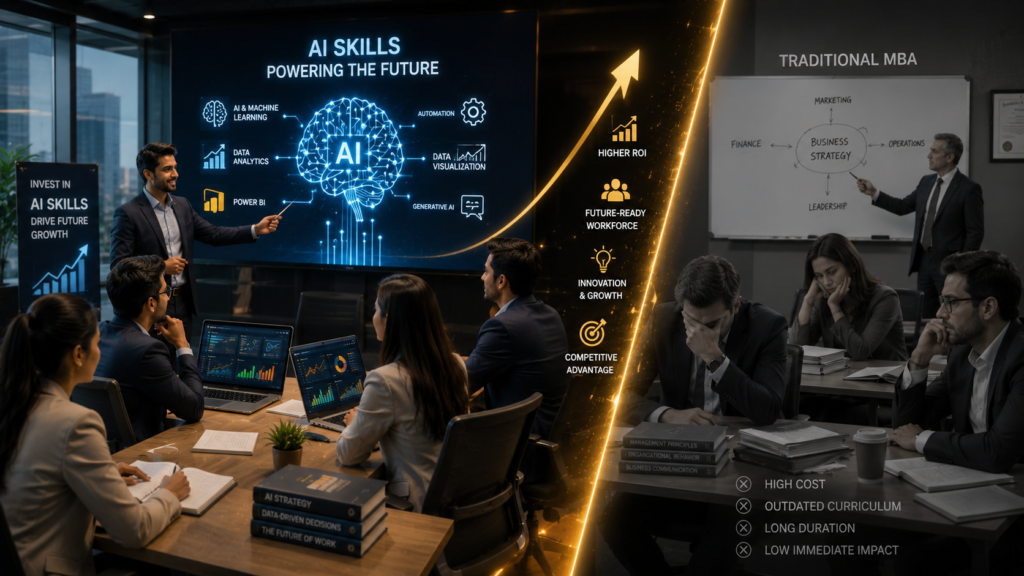
Corporate employees learning AI skills, data analytics, and automation tools during modern workplace training instead of traditional MBA-style programs.
blogs

Why Companies Are Investing More in AI Skills Than MBA Programs

Introduction: Corporate Learning Is Undergoing Its Biggest Transformation in Decades For many years, MBA programs were considered one of the most valuable investments for professionals and organizations. Companies regularly sponsored employees for executive MBA programs because leadership teams believed traditional management education was the key to building future business leaders. An MBA was often associated with: And for a long time, this model worked effectively. But in 2026, the corporate world is changing at an extraordinary pace. Businesses are no longer competing only through: Modern companies now compete through: This has fundamentally changed how companies think about employee training and workforce development. Today, organizations increasingly realize:👉 traditional business education alone is no longer enough. A company may have highly educated managers, but if employees do not understand: the business can still struggle to compete in modern markets. This is why corporate training priorities are shifting dramatically toward:👉 AI skills👉 analytics capabilities👉 Power BI expertise👉 automation systems👉 cloud technologies👉 digital transformation skills The modern workplace is no longer asking:👉 “Who has the best degree?” Instead, companies increasingly ask:👉 “Who can improve productivity, automate workflows, and help us scale faster?” This shift is changing: And businesses that fail to modernize their workforce capabilities may struggle to survive in the coming years. Why Traditional MBA-Focused Workforce Development Is Losing Strategic Importance MBA programs still provide valuable knowledge about: But the modern corporate environment is evolving much faster than traditional education systems. Today’s business challenges increasingly involve: These areas require practical and continuously evolving technical understanding. Traditional MBA programs often focus heavily on: But modern enterprises now need employees who can: This creates a major shift in corporate learning priorities. Modern Businesses Need Execution, Not Just Management Theory In earlier business environments, organizations could operate successfully with slower decision-making and traditional operational structures. But in 2026: Businesses now require employees who can: Organizations increasingly prioritize:👉 practical execution capabilities over theoretical credentials alone. The Digital Economy Rewards Technical Productivity Modern companies generate enormous amounts of data every day. Businesses now depend heavily on: Employees who understand these systems help organizations: This directly impacts profitability and competitiveness. Traditional Degrees Cannot Evolve Fast Enough Technology changes every few months. AI systems, automation tools, analytics platforms, and cloud ecosystems evolve continuously. Traditional academic structures often take years to adapt curriculum changes. Corporate upskilling programs, however, can evolve much faster. This is why businesses increasingly prefer: over relying only on long-term theoretical education systems. Why AI Skills Have Become One of the Most Valuable Corporate Assets Artificial Intelligence is now deeply integrated into modern business operations. Companies are using AI for: As AI adoption increases, organizations are discovering something important:👉 employees who understand AI significantly improve business performance. This is why AI skills are now considered strategic workforce assets. The Rise of the AI-Augmented Employee One of the biggest workforce transformations happening in 2026 is the rise of:👉 AI-augmented professionals. These are employees who use AI tools to: The productivity difference between AI-powered employees and traditional employees is becoming extremely noticeable. Example: Marketing Teams Traditional marketing workflows often involve: AI-powered marketers can now: This dramatically improves execution speed. Example: Analytics Teams Traditional analysts often spend large amounts of time on: AI-powered analytics professionals use: to generate insights much faster. This allows businesses to make better decisions in real time. Example: HR & Operations Teams AI systems now help HR teams: Operations teams use AI for: This increases organizational efficiency significantly. Why Companies Are Investing Aggressively in AI Workforce Upskilling Modern organizations now understand:👉 buying AI tools alone is not enough. Employees must also understand: This is why corporate AI training budgets are increasing rapidly worldwide. AI Skills Create Competitive Advantage Companies with AI-skilled employees often: This creates major competitive advantages. Organizations increasingly view AI upskilling as:👉 a strategic business investment rather than a training expense. Hiring Alone Cannot Solve Workforce Gaps Recruiting new talent constantly is expensive and difficult. Many businesses now prefer: This approach is: AI Productivity Directly Impacts Revenue Growth AI-powered employees often: This directly impacts: which is why organizations aggressively invest in workforce transformation. Why Power BI + AI Training Is Becoming Extremely Popular in Enterprises One of the fastest-growing areas in corporate training today is:👉 AI-powered analytics and business intelligence. Modern organizations rely heavily on: This makes:Microsoft Power BI + AI integration extremely valuable. Companies increasingly want employees who can: This is why Power BI + AI corporate training programs are growing rapidly worldwide. How Corporate Learning Is Changing in 2026 Corporate education itself is evolving dramatically. Earlier, learning programs focused mainly on: Modern corporate learning now focuses on: Learning is becoming:👉 faster👉 practical👉 technology-focused👉 business-driven because companies need measurable outcomes from workforce training. The Most Valuable Skills Companies Want Employees to Learn in 2026 Organizations increasingly prioritize hybrid skill sets that combine: 1. AI Productivity Skills Employees should understand: These capabilities improve operational efficiency significantly. 2. Analytics & Data Literacy Modern businesses increasingly depend on: Employees who understand data-driven operations become much more valuable. 3. Automation Thinking Companies want professionals who can: This mindset is becoming critical. 4. Cloud & Modern Data Platforms Knowledge of: is becoming highly valuable across industries. 5. Business + Technology Combination The future belongs to professionals who combine: This hybrid skill set creates enormous career and business advantages. How TechnoEdgels Helps Companies Build Future-Ready Workforce Capabilities TechnoEdgels helps organizations and professionals prepare for the future AI-driven business environment. Instead of focusing only on theoretical education, TechnoEdgels focuses on: For companies: For professionals: The goal is not simply learning technology. The goal is:👉 building intelligent, scalable, and future-ready organizations. Frequently Asked Questions 1. Why are companies investing more in AI skills than MBA programs in 2026? Companies are prioritizing AI skills because modern business success increasingly depends on digital productivity, automation, analytics, and operational intelligence. While MBA programs still provide valuable leadership and business understanding, organizations now need employees who can directly contribute to AI-driven transformation initiatives. AI skills improve efficiency, scalability, and competitiveness much faster in modern business


Personalized Career Pathing: Using AI to Map Employee Growth Journeys
blogs

Personalized Career Pathing: Using AI to Map Employee Growth Journeys

Michael had been working at his company for five years. He was good at his job, but he felt stuck. Every performance review, his manager would say, “Keep up the good work.” But no one ever talked about where he could go next. He had skills, ambition, and loyalty. What he didn’t have was a clear path forward.  Six months later, Michael left for a competitor. Not because of money. Not because of benefits. He left because he couldn’t see his future.  Stories like Michael’s happen every single day. In fact, 94% of employees say they would stay at their company longer if it invested in their career development. Yet most organizations still treat career growth as an afterthought, offering generic advice and hoping for the best.   But something is changing. Companies are now using artificial intelligence to map personalized career journeys for every employee. They’re showing people exactly where they can go, what skills they need, and how to get there. And it’s transforming how organizations keep their best people.  What is AI-Powered Career Pathing?  AI-powered career pathing uses technology to create customized growth roadmaps for each employee based on their unique skills, interests, and career goals. Instead of one-size-fits-all career ladders, AI analyzes individual capabilities and suggests multiple pathways forward.   Think of it like a GPS for your career. Traditional career planning was like driving with a paper map from 20 years ago. AI career pathing is like having Google Maps that updates in real time, shows you multiple routes, warns you about roadblocks, and adjusts based on where you actually want to go.   The system continuously monitors learning engagement, skill mastery, and role movement, allowing for adaptive pathing over time. It factors in internal talent movement, performance data, and market benchmarks to suggest not just the next role, but the best-fit future paths.   Research shows that 76% of employees are actively looking for opportunities to expand their careers. Companies that meet this need see dramatic results. Organizations with strong learning cultures have 2 times higher retention rates. Retention is 34% higher among employees who have opportunities for professional development. Why Traditional Career Planning Fails Employees  The old way of career planning had serious problems. HR would create rigid career ladders that worked for maybe 10% of employees. Managers gave vague advice during annual reviews. People had to guess what skills mattered for advancement.   Here’s what went wrong with traditional approaches:  One Size Fits All Everyone in the same role got the same career advice, ignoring individual strengths, interests, and learning styles.   Slow and Static Career paths were updated every few years, even though business needs changed every few months.   Hidden Opportunities Employees never knew about internal openings, projects, or mentorships that matched their potential.   Lack of Transparency People couldn’t see what skills they needed for their next role or how to acquire them.   The result? 86% of employees say they would switch jobs for one with more chances to grow. Two-thirds of employees report receiving poor career advice from their managers. Career development gaps are now one of the leading drivers of employee turnover.   How AI Transforms Career Development  Artificial intelligence changes everything about career pathing by making it dynamic, personalized, and connected to real business needs. Here’s how it works.  Skills-Based Mapping AI analyzes employee skills, learning history, and career aspirations to identify logical next steps. Instead of focusing on rigid job titles, it maps capabilities. This means employees can grow by acquiring new skills, making lateral moves across functions, or stepping into roles created around emerging business needs.   Personalized Learning Recommendations The system suggests specific training, courses, and experiences tailored to each person’s career goals and current skill level. A significant 91% of employees want training that is personalized and relevant to their roles.   Internal Opportunity Marketplaces AI showcases internal openings, projects, and mentorships customized to each employee’s potential. This helps people discover paths they never knew existed within their own organization.   Real-Time Path Adjustments As employees gain skills and business priorities shift, AI continuously updates career recommendations. The journey adapts to reality rather than forcing people down predetermined tracks.   Predictive Career Intelligence AI identifies employees who are ready for new challenges before they start looking elsewhere. It spots the growth ceiling early, allowing managers to act proactively rather than reactively.   Real Results from Companies Using AI Career Pathing  Organizations implementing AI-powered career pathing see measurable improvements across multiple dimensions:  Higher Retention Rates Companies investing in employee development saw a 58% increase in retention. When employees see clear paths forward, they stay longer and contribute more.   Increased Engagement Personalized learning paths significantly enhance employee engagement by making training relevant and meaningful. When people see the direct impact of their training on career progression, they become more motivated and committed.   Faster Skill Development AI personalizes the learning path based on career aspirations and current skill levels, significantly improving training effectiveness and reducing time to learn.   Stronger Diversity and Inclusion Skills-based career pathing strengthens diversity, equity, and inclusion efforts. AI reduces biases inherent in traditional promotion processes by focusing on skills rather than backgrounds, credentials, or rigid experience requirements.   Better Workforce Planning Organizations benefit from continuously developing workforces that meet evolving business demands. AI aligns employee learning journeys with business priorities, future workforce needs, and emerging industry trends.   The Key Components of Effective AI Career Pathing  Successful AI-powered career development systems share several essential features.  Comprehensive Skills Assessment The foundation starts with understanding what skills each employee currently has. AI tools parse resumes, certifications, performance reviews, and project records to build dynamic skill profiles.   Career Aspiration Mapping The system asks employees about their interests, goals, and preferences. It learns whether someone wants to move into management, deepen technical expertise, or explore adjacent functions.   Gap Analysis and Recommendations AI identifies the difference between current capabilities and target role requirements, then recommends specific actions to close those gaps.   Adaptive Learning Experiences Personalized platforms use data analytics to create customized learning experiences that adjust content, pace, and feedback to match each learner’s unique style.   Progress Tracking and Visibility Both employees and managers can see clear metrics on skill development, course completion, and readiness for new roles. Manager Enablement Tools AI equips managers with insights to support career conversations and guide their teams with data-backed advice.   Building a Culture of Growth with AI  Technology alone doesn’t create great career development. The best organizations combine AI tools with human support and cultural commitment.  Start with

Trust Us, One Call Can Make a Difference
Please enable JavaScript in your browser to complete this form.
Join As Trainer
Join As Trainer
Please enable JavaScript in your browser to complete this form.
Download Course Content
Please enable JavaScript in your browser to complete this form.
More than 5 People are attending Get On a Call with Us
Please enable JavaScript in your browser to complete this form.
More than 5 People are attending Get On a Call with Us
Scroll to Top