
TechnoEdge

Free Master Class

How to Plan Your AI Training Budget for FY26? (For CHROs & L&Ds)

Corporate Training

IT team in India participating in AWS cloud training with hands-on labs and certification prep.
blogs

AWS Cloud Training for Employees: Complete Guide for Indian IT Organizations

Indian IT organisations are accelerating cloud adoption across IT services, BFSI, manufacturing, and GCCs, but many teams still lack structured AWS training India programmes that connect learning to real delivery work. Without this, cloud initiatives stall, certifications become checkbox exercises, and teams struggle to operate securely and efficiently at scale. A focused AWS cloud training for employees strategy, built around roles, use cases, and certification paths, is what enables enterprises to move from pilot projects to enterprise-wide cloud capability. At Technoedge, we design AWS learning programmes for Indian enterprises that combine role-based learning paths, certification readiness, and practical use-case training aligned to real engineering workflows Why AWS training India matters for enterprise capability building Cloud is no longer an “IT experiment” for Indian enterprises; it is the default platform for new applications, data platforms, and digital services. AWS dominates this space, and organisations that invest in structured AWS training India are better positioned to: Without structured training, organisations often face: Structured AWS cloud training for employees turns cloud from a costly experiment into a predictable, scalable capability that supports business outcomes. Which employee groups should start with AWS first Not everyone needs the same depth of AWS knowledge. Prioritising the right groups first accelerates adoption and reduces risk. Engineering and DevOps teams These teams should start first because they: Infrastructure and platform teams Infrastructure teams need AWS training to: Architects and solution designers Architects need AWS training to: Developers Developers need AWS training to: Security and compliance teams Security teams need AWS training to: Leadership and programme managers Leadership teams benefit from AWS awareness training to: Prioritising engineering, infrastructure, and architecture teams first creates a strong foundation that other groups can build on. Core AWS training modules for enterprise teams A comprehensive enterprise AWS programme should cover core modules that align to real work. Cloud fundamentals Networking and security Compute and storage Databases and data services Serverless and application integration DevOps and automation on AWS Operational excellence and governance These modules should be adapted by role and depth, not delivered as a single monolithic course. AWS certification for employees: beginner, associate, and role-based options AWS certification for employees is a powerful way to validate skills and build credibility, but it must be aligned to roles and career pathways. Beginner level For employees new to cloud or AWS: Associate level For technical staff who design and operate AWS solutions: Professional and specialty levels For advanced practitioners: Best for senior architects, lead DevOps engineers, and specialists. Role-based certification paths Map certifications to roles: Role Recommended path Leaders / PMs Cloud Practitioner Junior developers Cloud Practitioner → Developer Associate Senior developers Developer Associate → Solutions Architect Associate Architects Solutions Architect Associate → Professional DevOps engineers Cloud Practitioner → SysOps or Developer → DevOps Engineer Professional Infrastructure teams Cloud Practitioner → SysOps Associate → DevOps Engineer Professional Security teams Cloud Practitioner → Security Specialty This structured approach to AWS certification for employees ensures that certifications align with job roles and business needs. Delivery formats for AWS training India across enterprise environments Indian IT organisations operate across onsite, offshore, and hybrid models, so AWS training must be flexible and scalable. Instructor-led virtual training (VILT) Onsite workshops Blended learning Hands-on labs and sandbox environments Certification bootcamps A typical enterprise AWS programme uses a blend of these formats, depending on audience size, role, and urgency. Expected outcomes from structured AWS cloud training for employees When AWS training is structured and role-based, organisations see measurable outcomes across capability, cost, and quality. Capability outcomes Operational outcomes Business outcomes These outcomes are difficult to achieve with ad-hoc training or self-learning alone. Structured AWS training India programmes make them achievable at enterprise scale. How Technoedge helps with enterprise AWS learning paths, certification readiness, practical use-case training, and scalable cloud capability development At Technoedge, AWS training is designed as an enterprise capability-building journey, not just a certification course. Our approach includes: 1. Enterprise AWS learning paths 2. Certification readiness 3. Practical use-case training 4. Scalable cloud capability development This ensures that AWS cloud training for employees translates into real capability, not just certificates. FAQs 1. AWS training India: what should be included in enterprise AWS learning programs? Enterprise AWS learning programs should include cloud fundamentals, networking and security, compute and storage, databases, serverless, DevOps on AWS, and operational excellence. They should also cover certification paths, hands-on labs, and industry-specific use cases. The content should be role-based, with different depth for developers, architects, DevOps engineers, and infrastructure teams. 2. AWS certification for employees: which certification path fits different IT roles? Leaders and project managers start with Cloud Practitioner. Developers follow the Developer Associate path, architects follow Solutions Architect Associate to Professional, and DevOps engineers move toward DevOps Engineer Professional. Infrastructure teams focus on SysOps Associate, and security teams on Security Specialty. Mapping certifications to roles ensures that AWS certification for employees supports career growth and business needs. 3. AWS cloud training for employees: how to roll out training at scale in Indian IT organizations? Roll out training at scale using blended learning: self-paced fundamentals, virtual instructor-led sessions, hands-on labs, and certification bootcamps. Prioritise critical teams first (engineering, DevOps, infrastructure), then expand to other groups. Use a phased approach with pilots, then scale across locations and functions. 4. AWS training India: which teams should be prioritized first for cloud certification? Engineering, DevOps, infrastructure, and architecture teams should be prioritized first because they directly design and operate cloud environments. Security teams come next, followed by developers and leadership. This ensures that the teams with the highest impact on cloud success are certified first. 5. Cloud training for corporate teams: how to measure AWS training outcomes? Measure outcomes using certification pass rates, participation and completion rates, pre/post assessment scores, and operational metrics like cost savings, security incidents, and deployment frequency. Track these before and after training to demonstrate impact. This turns AWS training into a measurable business investment. Connect with us For Indian IT organizations planning AWS training India programs, a role-based approach usually leads to better adoption than one-size-fits-all learning. Technoedge can help shape that journey with structured AWS learning paths, certification alignment,
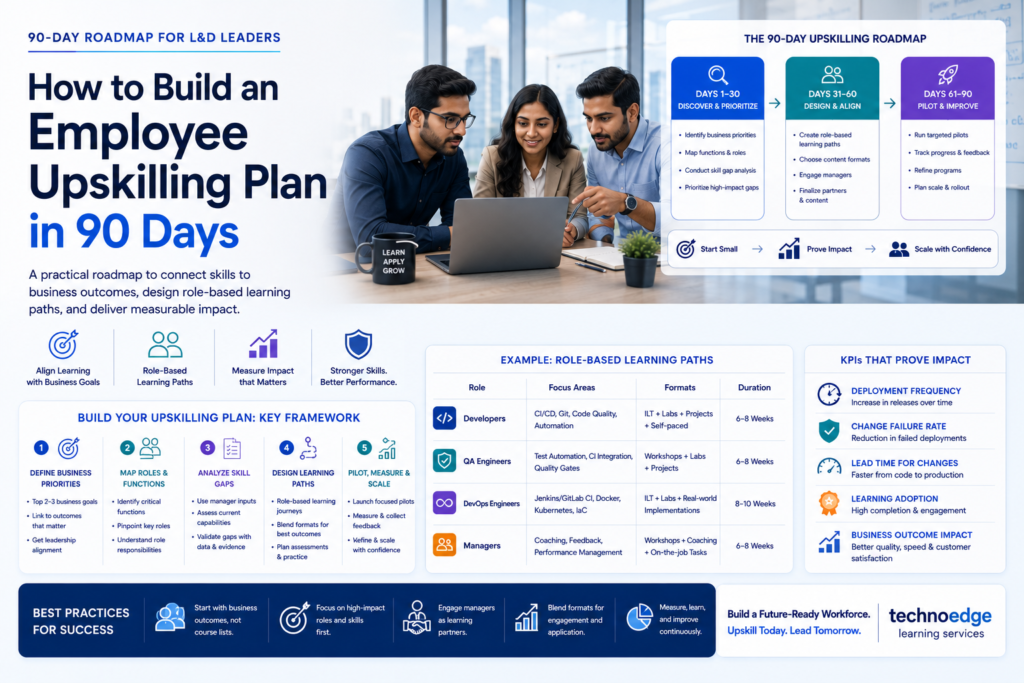
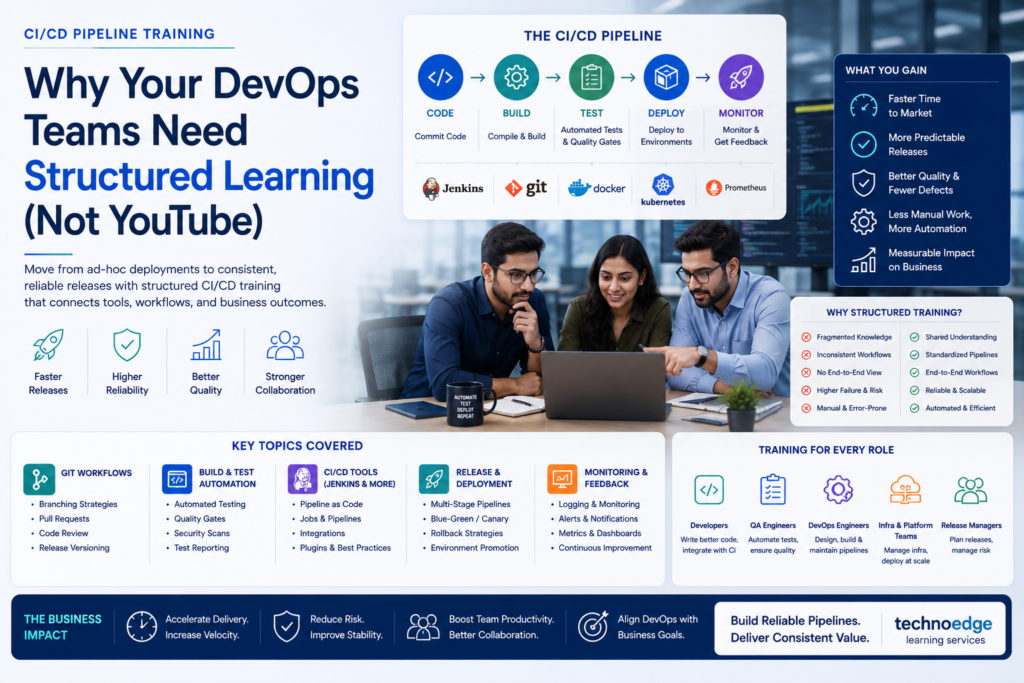
Chart showing a 90-day employee upskilling timeline with skills assessment and learning milestones.
blogs

How to Build an Employee Upskilling Plan in 90 Days?

L&D teams in Indian enterprises often start upskilling with good intent but struggle to move from planning to measurable impact. The problem is usually not a lack of content, but a lack of structure, clarity, and alignment with business priorities. A disciplined workforce upskilling plan built over 90 days can turn that around. It gives you a practical way to connect skills to business outcomes, define learning paths by role, and launch pilots that prove value before scaling. In this guide, you’ll get a clear 90-day roadmap and a practical template for how to build employee upskilling plan initiatives that L&D leaders, CHROs, and business heads can actually execute. Why workforce upskilling plan initiatives often stall Many upskilling programmes start strong but lose momentum within weeks. The most common reasons include: As a result, pilots don’t scale, participation drops, and leadership loses confidence in L&D’s ability to deliver business value. A structured 90-day approach fixes this by forcing clarity on priorities, roles, and measurable outcomes from day one. Days 1–30: identify business priorities and critical skill gaps The first 30 days are about diagnosis and prioritisation, not content selection. Step 1: Clarify business priorities Work with business leaders to identify 2–3 key priorities for the next 6–12 months, such as: These priorities become the anchor for your upskilling plan. Step 2: Map priorities to functions and roles For each priority, identify: This narrows the scope from “upskill everyone” to “upskill these roles for these outcomes.” Step 3: Conduct targeted skill gap analysis Use a mix of: The goal is to identify specific gaps like: Step 4: Prioritise gaps by impact and feasibility Not all gaps can be addressed at once. Prioritise using: Focus the first 90 days on the highest-impact, feasible gaps. Days 31–60: map roles, learning paths, managers, and content formats Once gaps are clear, the next 30 days are about designing the learning journey and aligning stakeholders. Step 1: Define role-based learning paths For each priority role, create a learning path that includes: Example for developers: Step 2: Decide on content formats Match format to learning objective: Avoid over-reliance on one format. A blended approach works best for most enterprise programmes. Step 3: Involve managers early Managers are critical for: Engage managers by: Step 4: Select partners and content At this stage, decide: This is where how to build employee upskilling plan becomes concrete: you now have clear requirements to evaluate providers. Days 61–90: launch pilots, review progress, and refine implementation The final 30 days are about execution, learning, and refinement. Step 1: Run targeted pilots Start with a focused pilot: Pilot goals: Step 2: Track progress and gather feedback Use a simple dashboard to track: Collect feedback through: Step 3: Refine and prepare to scale Based on pilot results: Then plan the next phase: A practical template for how to build employee upskilling plan initiatives Use this template as a starting point for your workforce upskilling plan. 1. Business alignment 2. Skill gap summary Role Current level Target level Key gaps Priority (H/M/L) DevOps engineer Intermediate Advanced CI/CD, Kubernetes, automation H Mid-level manager Basic Intermediate Coaching, performance management H QA engineer Basic Intermediate Test automation, CI integration M 3. Learning path design Role Learning path name Formats Duration Provider Role Learning path name Formats Duration Provider DevOps engineer CI/CD Pipeline Track Instructor-led + labs + project 8 weeks External partner Mid-level manager Manager Effectiveness Track Workshops + coaching + on-job tasks 10 weeks Internal + external 4. Manager involvement plan 5. Measurement plan This template makes how to build employee upskilling plan initiatives concrete and actionable. KPIs for measuring workforce upskilling plan success To prove value, track KPIs that connect learning to business outcomes. Learning KPIs Behaviour KPIs Business KPIs Track these before and after the programme, ideally over 30–90 days post-training. How Technoedge helps with skill gap discovery, structured learning pathways, content mapping, training execution, and progress measurement At Technoedge, we support L&D teams through the full lifecycle of a workforce upskilling plan, from discovery to measurement. Our approach includes: 1. Skill gap discovery 2. Structured learning pathways 3. Content mapping 4. Training execution 5. Progress measurement This ensures that how to build employee upskilling plan initiatives move smoothly from planning to action, with clear evidence of impact. FAQs 1. How to build employee upskilling plan initiatives for enterprise teams? Start by clarifying 2–3 business priorities and mapping them to critical roles and functions. Then conduct a targeted skill gap analysis to identify specific capability gaps by role. Use this to design role-based learning paths with clear formats, timelines, and managers’ involvement. Launch pilots with focused teams, track progress using learning and business KPIs, and refine before scaling. This structured approach is the core of how to build employee upskilling plan initiatives that deliver real value. 2. Workforce upskilling plan: what should be included in a 90-day model? A 90-day model should include: Each phase should have clear outputs: prioritised gaps, learning path designs, pilot results, and a scaling plan. 3. How to build employee upskilling plan frameworks aligned with business goals? Align frameworks by starting with business goals, not learning topics. For each goal, identify the functions, roles, and capabilities needed to achieve it. Then design learning paths that directly support those capabilities. Measure success using business KPIs, not just learning metrics. This ensures the framework is business-driven and defensible to leadership. 4. Workforce upskilling plan: which KPIs matter most for L&D teams? The most important KPIs are those that connect learning to business outcomes: L&D teams should track these before and after the programme and report on them consistently. 5. Employee skill gap analysis India: how to connect skill gaps with upskilling priorities? Connect skill gaps with priorities by starting with the business problem, then identifying which roles and capabilities are bottlenecks. Use manager input, performance data, and assessments to validate gaps. Prioritise gaps based on impact on business goals and feasibility to address. This ensures that upskilling efforts focus on the areas that matter most for the organisation. Connect with us For L&D teams building a workforce

Professionals learning CI/CD pipeline design with hands-on labs instead of watching YouTube tutorials.
blogs

CI/CD Pipeline Training: Why Your DevOps Teams Need Structured Learning (Not YouTube)

Your DevOps team can watch hours of CI/CD tutorials on YouTube, but that still won’t give you consistent pipelines, reliable releases, or a shared understanding of how code moves to production in your organisation. The missing piece is structured CI/CD training for employees that connects tools, workflows, and business outcomes in a way that video tutorials cannot. In enterprise settings, this is what separates ad-hoc deployments from repeatable, high-quality delivery. At Technoedge, we design DevOps corporate training programmes where CI/CD is taught as an end-to-end practice, not just a set of tools. Teams learn to build, test, and deploy with the same discipline that their production environment demands. Why informal CI/CD learning creates inconsistent execution Informal learning through videos, blogs, and random tutorials often leads to fragmented knowledge. One person learns Jenkins from a tutorial, another learns GitFlow from a different source, and a third tries to connect them using trial and error. What usually goes wrong: This creates a pipeline that works “sometimes” and fails unpredictably. When something breaks, it’s hard to diagnose whether the issue is in code, configuration, pipeline logic, or environment. In enterprise environments, inconsistency is expensive. It leads to: Structured learning solves this by establishing a common baseline for how CI/CD should work in your organisation. What structured ci cd training for employees should include Effective CI/CD training for employees must cover concepts, tools, and real-world workflows, all tied together in a coherent journey. A strong programme should include: Core CI/CD concepts Version control and Git workflows Build and test automation Release management and deployment pipelines Tooling and integration What usually goes wrong in training: What good looks like: This is what structured DevOps corporate training delivers, not ad-hoc knowledge. Jenkins, Git workflows, test automation, release management, and deployment pipelines A focused CI/CD curriculum should give teams hands-on experience with these core areas. Jenkins (or equivalent CI server) Git workflows Test automation Release management Deployment pipelines In enterprise training, these topics are best taught through labs where teams build and break pipelines, then fix them. That is how capability sticks. Role-based ci cd training for employees across DevOps functions One-size-fits-all CI/CD training rarely works well. Different roles need different depth and focus within the same pipeline ecosystem. Developers QA teams DevOps engineers Infrastructure and platform teams Release managers Common mistake: Better approach: This ensures that CI/CD training for employees is relevant and practical for each team member. Business impact of stronger pipeline maturity Stronger CI/CD pipeline maturity is not just a technical win; it directly impacts business outcomes. Organisations with mature pipelines typically see: From a business perspective, pipeline maturity translates to: What usually goes wrong: What good looks like: This is why structured DevOps corporate training is a business investment, not just a learning activity. Metrics to track after devops corporate training Training impact should be measured using engineering and business metrics, not just completion rates. Key metrics to track after CI/CD training include: Metric category Key metrics Speed Deployment frequency, lead time for changes  Reliability Change failure rate, rollback frequency Quality Defect escape rate, test coverage, build failure rate Efficiency Manual steps eliminated, pipeline execution time Confidence Deployment success rate, mean time to recovery (MTTR) What usually goes wrong: What good looks like: This approach turns DevOps corporate training from a learning event into a performance improvement programme. How Technoedge helps with structured CI/CD learning journeys, lab-based training, workflow standardization, and project-relevant upskilling for DevOps teams At Technoedge, CI/CD training is designed as a capability-building journey, not a one-day workshop. We focus on structured learning paths, hands-on labs, and real-world pipeline implementation. Our approach includes: 1. Structured CI/CD learning journeys 2. Lab-based training 3. Workflow standardisation 4. Project-relevant upskilling This ensures that CI/CD training for employees translates into consistent, measurable improvements in how your teams deliver software. FAQs 1. CI CD training for employees: why is structured learning better than self-learning? Structured learning ensures that all team members share a common understanding of CI/CD concepts, workflows, and tools. Self-learning through videos and blogs often leads to fragmented knowledge, inconsistent practices, and gaps in critical areas like testing, security, and rollback. Structured DevOps corporate training provides a coherent curriculum, hands-on practice, and alignment to your organisation’s actual workflows. It also enables teams to learn from each other and adopt shared standards. 2. DevOps corporate training: what tools should be included in CI/CD pipeline training? CI/CD pipeline training should cover at least one major CI tool (Jenkins, GitLab CI, GitHub Actions), version control (Git), testing frameworks, container registries, and orchestration platforms like Kubernetes. It should also include tools for monitoring and logging post-deployment. The exact tools should match your stack, but the principles (branching, testing, pipeline design, deployment strategies) should be consistent regardless of the toolset. 3. CI CD training for employees: which employee groups need pipeline training the most? The groups that need pipeline training the most are developers, QA engineers, DevOps engineers, infrastructure teams, and release managers. Each group interacts with the pipeline differently, so role-based training is essential. Developers need to understand how to integrate code and tests. QA needs to embed automation. DevOps and infrastructure teams need to design and maintain the pipeline. Release managers need to coordinate deployments and manage risk. 4. DevOps corporate training: how does CI/CD training improve release quality and deployment speed? CI/CD training improves release quality by instilling practices like automated testing, quality gates, and consistent deployment strategies. It improves speed by reducing manual steps, automating repetitive tasks, and enabling more frequent, predictable releases. Training also helps teams diagnose and fix pipeline issues faster, reducing downtime and deployment delays. 5. CI CD training for employees: how to measure impact after enterprise pipeline training? Impact is best measured using metrics like deployment frequency, lead time for changes, change failure rate, mean time to recovery, and test coverage. Baseline metrics should be taken before training, and improvements tracked over 30–90 days afterward. Training impact should also be assessed through qualitative feedback from teams on confidence, collaboration, and ease of delivery. Connect with us For enterprises trying to improve CI/CD maturity, consistent team capability is usually

Engineers reviewing a DevOps upskilling roadmap with CI/CD and cloud tools.
blogs

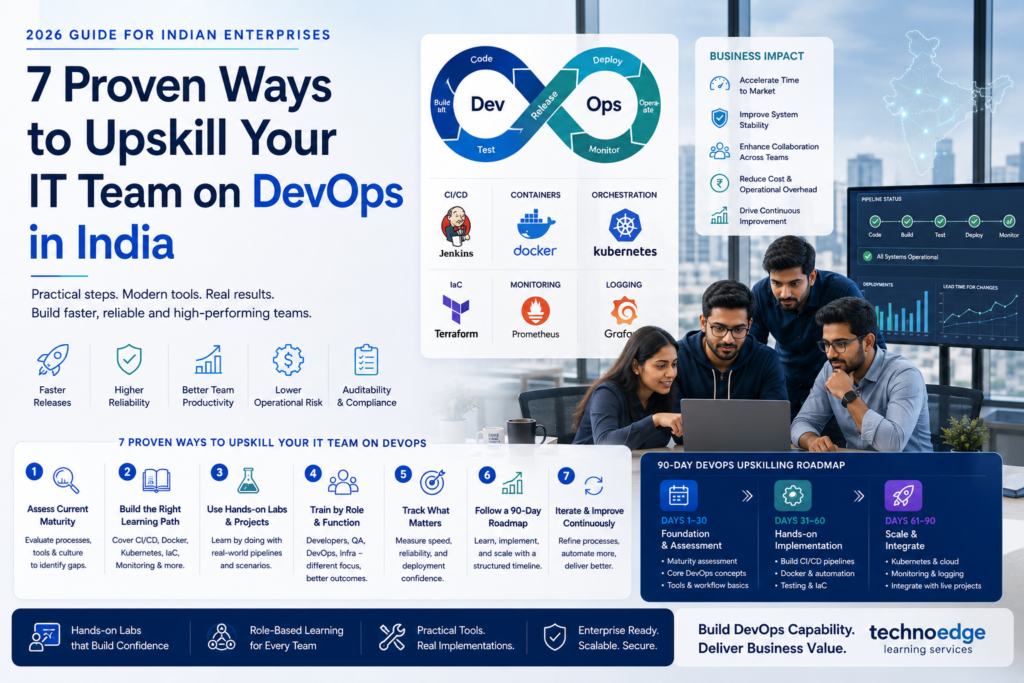
7 Proven Ways to Upskill Your IT Team on DevOps in India (2026 Guide)

Indian enterprises are under constant pressure to release faster, improve reliability, and scale digital platforms without increasing operational risk. Yet many IT teams are still constrained by fragmented tooling, manual processes, and siloed responsibilities between development, QA, and operations. This is where structured DevOps training India initiatives become a business priority, not just a technical upgrade. Organisations that invest in the right CI CD training for employees are seeing measurable gains in release velocity, system stability, and team productivity. At Technoedge Learning Services, we work closely with enterprise IT teams to design DevOps upskilling programmes that are practical, role-based, and aligned to real delivery environments in India. Why devops training India is now a business priority DevOps is no longer optional for enterprises operating in IT services, BFSI, SaaS, and GCC environments. It directly impacts how quickly and reliably organisations can deliver value to customers. Key business drivers include: What often goes wrong: What works better: Assess current engineering and release management maturity Before starting any DevOps corporate training initiative, organisations need a clear view of their current state. This involves evaluating: Common mistake: Better approach: This ensures that DevOps training is not generic but targeted and measurable. Build a learning path around CI/CD, Docker, Kubernetes, automation, and monitoring Effective CI CD training for employees must go beyond isolated topics and follow a structured progression. A robust DevOps learning path typically includes: What usually goes wrong: What good looks like: Use hands-on labs and project-based practice in devops corporate training DevOps cannot be learned through theory-heavy sessions. Teams need hands-on exposure to build confidence and capability. Effective DevOps corporate training should include: Common pitfalls: Better approach: Example: Instead of just explaining CI/CD, teams build a working pipeline that automatically tests and deploys code to a staging environment, including rollback mechanisms. Train by role: developers, QA teams, DevOps engineers, infrastructure teams A one-size-fits-all approach does not work for DevOps upskilling. Different roles require different depth and focus: What usually goes wrong: What works better: This ensures that DevOps becomes a shared capability rather than a specialised function. Track speed, reliability, and deployment confidence after training Training effectiveness must be measured in business and engineering outcomes. Key metrics to track: Common mistake: Better approach: This shifts DevOps training from a learning activity to a performance improvement initiative. A 90-day roadmap for devops training India A structured timeline helps organisations move from learning to implementation. Typical 90-day roadmap: Days 1–30: Foundation and assessment Days 31–60: Hands-on implementation Days 61–90: Scaling and integration What makes this effective: How Technoedge helps with hands-on DevOps upskilling, enterprise labs, role-based learning design, practical tool coverage, and real-world implementation support At Technoedge, DevOps training is designed as a capability-building journey, not a one-time intervention. Our approach includes: 1. Evaluation and diagnosis 2. Role-based learning design 3. Hands-on enterprise labs 4. Practical tool coverage 5. Real-world implementation support This ensures that DevOps capability is embedded into day-to-day engineering workflows. FAQs 1. DevOps training India: how to upskill IT teams on DevOps in a structured way? A structured approach starts with assessing current maturity, followed by defining clear business goals such as faster releases or improved system reliability. Based on this, organisations should design role-based learning paths covering CI/CD, containerisation, automation, and monitoring. The key is to combine conceptual learning with hands-on implementation. Teams should work on real pipelines, not just simulations. Progress should be tracked using engineering metrics like deployment frequency and failure rates to ensure tangible outcomes. 2. CI CD training for employees: what topics should be included in enterprise DevOps training? Enterprise CI CD training should cover: It is important to connect these topics into an end-to-end workflow rather than teaching them in isolation. Employees should understand how code moves from development to production in a controlled and automated manner. 3. DevOps corporate training: which format works best for engineering teams in India? The most effective format is blended learning, combining: In the Indian enterprise context, training must align with live project constraints and delivery timelines. Flexibility and contextualisation are critical for adoption. 4. DevOps training India: how long does enterprise DevOps upskilling usually take? Most organisations see meaningful outcomes within 8–12 weeks when training is structured and hands-on. However, full maturity can take several months depending on the complexity of systems and scale of teams. The focus should not be on duration alone but on continuous improvement and integration into daily workflows. 5. CI CD training for employees: how to connect pipeline training with business delivery goals? To connect training with business outcomes: This ensures that CI/CD training directly contributes to faster delivery, improved quality, and reduced risk. 6. Strengthen your DevOps capability with the right partner For organizations planning DevOps training India initiatives, practical execution matters more than theory-heavy sessions. Technoedge can support structured DevOps upskilling through hands-on learning paths, enterprise-ready labs, and training plans aligned with real engineering workflows. To explore how this can work for your context, you can connect with Technoedge at: https://technoedgelearning.com

Corporate team planning a ChatGPT training rollout for an Indian enterprise.
blogs

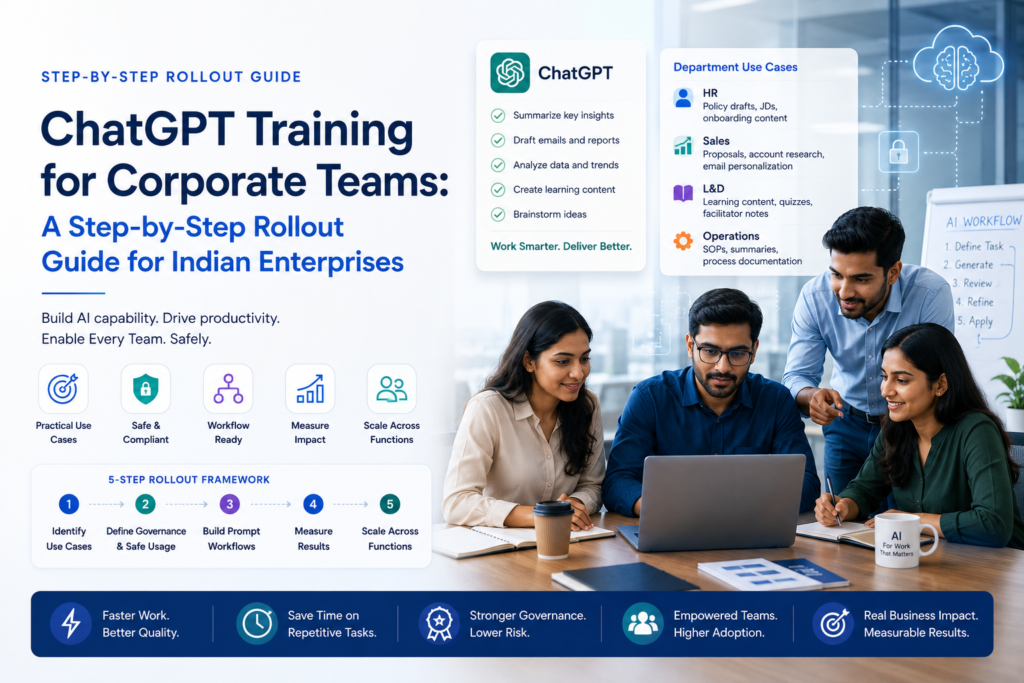
ChatGPT Training for Corporate Teams: A Step-by-Step Rollout Guide for Indian Enterprises

Indian enterprises are moving past the “should we use AI?” stage and into the harder question: how do we use it safely, consistently, and with measurable business value? That is why chatgpt training for teams has become a practical capability-building priority, not just a technology experiment. For HR, L&D, sales, operations, and support teams, the real challenge is not access to AI tools. It is turning those tools into repeatable workflows that improve speed, quality, and decision-making without creating privacy, compliance, or quality risks. That is where structured ai tools training for workforce becomes essential. Why chatgpt training for teams matters in 2026 In 2026, AI is no longer a side topic in corporate learning. It is becoming part of everyday work across writing, analysis, ideation, summarization, and internal communication. Teams that know how to use ChatGPT well can move faster, but only if they understand where it helps, where it fails, and how to use it responsibly. For Indian enterprises, this matters even more because use cases are often distributed across functions. A sales team may need proposal support, an L&D team may need content drafts, HR may need policy communication assistance, and operations may need process documentation. Without structured training, employees tend to use AI inconsistently, which reduces output quality and increases risk. The strongest training programmes focus on practical use, not abstract AI theory. They help people learn how to ask better questions, review outputs critically, and apply the tool to real work. Common mistakes in ai tools training for workforce Many enterprises begin AI training with excitement but no rollout discipline. The result is usually awareness without adoption, or experimentation without control. Common mistakes include: Another common issue is overestimating what employees can safely do on day one. If teams are not shown clear boundaries, they may paste sensitive information into public tools or rely too heavily on generated outputs without review. Good training reduces this risk by making safe use part of the learning design. Step 1: identify department-specific AI use cases The first rollout step is to identify where ChatGPT can create the most value in each function. A single enterprise-wide use case list is usually too broad to drive adoption. Start by asking each department where time is spent on repetitive, text-heavy, or research-supported work. For example: The goal is not to automate everything. The goal is to find the tasks where AI can save time, improve consistency, or help teams start faster. Step 2: define governance, data privacy, and acceptable usage Once use cases are clear, governance must come next. Enterprises need rules for what employees can and cannot enter into AI tools, how outputs should be reviewed, and where human approval is mandatory. A practical governance framework should cover: This is especially important in regulated sectors and in organisations handling customer, employee, financial, or proprietary data. Training should not just explain policy in theory; it should show employees how the policy affects day-to-day work. Step 3: build prompt workflows for HR, sales, L&D, and operations Prompting works best when it is connected to a workflow, not treated as a standalone skill. Employees should learn prompt patterns that map to their actual tasks, review steps, and expected output formats. For HR, a prompt workflow may include drafting, refinement, and compliance review. For sales, it may include research, personalization, proposal structure, and final human editing. For L&D, the workflow may include content creation, simplification, knowledge checks, and learner-level adaptation. A useful training approach is to create: This makes training more practical and easier to retain because people learn by doing work they already recognise. Step 4: measure productivity and output quality If the enterprise cannot measure results, AI training will remain a feel-good initiative. Measurement should look at both productivity and quality, because speed alone can create poor outputs. Useful metrics include: It also helps to compare outputs before and after training on real business tasks. For example, measure how long it takes to create a client email, a training outline, or an internal memo before the rollout and after employees begin using ChatGPT with a workflow. Step 5: scale chatgpt training for teams across business functions Scaling should happen after pilot groups prove value and governance is stable. The best programmes begin with a few functions, refine the content, and then expand into other teams. A scalable rollout usually includes: This is also where leadership support matters. When managers show what good AI-assisted work looks like, adoption becomes much stronger than when training is left only to the L&D team. How Technoedge helps with AI readiness, use-case-based ChatGPT training, workflow-oriented prompting, safe adoption practices, and business team enablement Technoedge helps enterprises move from AI awareness to structured adoption. That starts with identifying the highest-value use cases by function, so training is relevant to the work teams actually do. From there, we design learning journeys that combine practical prompting, governance awareness, and workflow application. We also support safe adoption by helping organisations define boundaries, review practices, and department-level use scenarios that reduce risk. Our delivery approach focuses on business enablement, not just skill transfer. That means teams learn how to use ChatGPT in ways that improve speed, quality, and consistency in daily work. For enterprises exploring chatgpt training for teams, the biggest challenge is usually turning generic AI enthusiasm into safe, useful workflows. Technoedge can help shape that journey through role-specific training, practical prompts, and adoption frameworks that support everyday work without adding complexity. FAQs 1. ChatGPT training for teams: what should be included in a corporate rollout plan? A corporate rollout plan should include use-case discovery, governance rules, department-wise learning paths, prompt practice, and measurement. It should also include leadership alignment so the training is seen as a business capability initiative rather than a one-time workshop. The rollout plan works best when it balances speed and control. That means employees get enough freedom to explore value, but also enough structure to protect data, quality, and compliance. 2. AI tools training for workforce: which departments benefit

AI training budget planning FY26 India webinar for CHROs and L&D leaders
blogs

How to Plan Your AI Training Budget for FY26 A Guide for CHROs & L&D Heads

What You’ll Learn:What to fund, what to skip, and how to show ROI to leadership Duration: 45 Minutes (Live)Mode: Online (Free) Bonus: Free 20-minute AI Training Budget Review join link- https://events.teams.microsoft.com/event/c4a1ca71-79d4-4ae6-bb27-77ef76036007@8b38681f-2496-48ab-8c82-87404e17b322 What Is AI Training Budget Planning? AI training budget planning means deciding how much money to invest in training employees to use AI, and more importantly, how to spend that money correctly. It includes: Most companies only focus on tools and ignore real usage. That is where problems start. Why Most AI Training Budgets Fail Most companies follow this approach: But after that: Result: Money is spent, but there is no real business impact. This happens because companies focus more on vendor training and less on actual workflow change. Why FY26 Budget Planning Is Critical Right Now In India, most companies plan budgets between April and June. This is important because: If wrong decisions are made now, companies may waste their full yearly budget. That is why planning at the right time is very important. Common Mistakes in AI Training Budget 1. Spending Too Much on Tools Companies invest heavily in tool training like ChatGPT and Copilot, but employees don’t know how to use them in real work. 2. Ignoring Workflow Training Very little focus is given to how AI can improve actual daily tasks and processes. 3. No ROI Measurement Companies do not track: So they cannot justify the investment. 4. No Alignment with Leadership Leadership wants results, but L&D teams often provide only training reports. What Smart Companies Do Differently Successful companies follow a smarter approach. They focus on outcomes, not just tools. They train employees on: They also: Instead of asking “Which tool should we train?”, they ask “How will work improve?” Step-by-Step Framework to Plan AI Training Budget Step 1: Identify Scope Decide how many employees need training and which departments will use AI. Step 2: Define Business Goals Set clear goals like reducing manual work or improving productivity. Step 3: Allocate Budget Smartly Spend more on workflow training and less on basic tool training. Step 4: Choose the Right Training Approach Avoid generic courses. Choose customized and practical programs. Step 5: Measure Results Track: Step 6: Report to Leadership Show clear ROI using simple reports and metrics. Why L&D Leaders Struggle With ROI Many L&D leaders complete training programs successfully. But when leadership asks, “What business results did we get?”, there is no clear answer. This is not a training problem. It is a measurement and reporting problem. Who Should Attend This Webinar This webinar is designed for: Best suited for companies: What You Will Learn in This Webinar In this 45-minute session, you will learn: You will get practical knowledge, not just theory. Free Bonus: AI Training Budget Review After the webinar, you can book a free 20-minute session. In this session: Limited slots are available. Why You Should Join This Webinar This webinar helps you: FAQs What is AI training budget? It is the amount a company spends on training employees to use AI effectively in their work. Why do AI training programs fail? Because companies focus on tools instead of real work usage and do not track results. How to measure AI training ROI? By tracking time saved, productivity improvement, and employee adoption. Who should attend this webinar? CHROs, L&D Heads, and HR leaders planning AI training budgets. Final Thought Most companies do not fail because they lack budget. They fail because: This webinar will help you fix all these problems. Register Now (Free) If you want: Register now and secure your spot – https://events.teams.microsoft.com/event/c4a1ca71-79d4-4ae6-bb27-77ef76036007@8b38681f-2496-48ab-8c82-87404e17b322

Trust Us, One Call Can Make a Difference
Please enable JavaScript in your browser to complete this form.
Join As Trainer
Join As Trainer
Please enable JavaScript in your browser to complete this form.
Download Course Content
Please enable JavaScript in your browser to complete this form.
More than 5 People are attending Get On a Call with Us
Please enable JavaScript in your browser to complete this form.
More than 5 People are attending Get On a Call with Us
Scroll to Top