

TechnoEdge

Free Master Class

How to Plan Your AI Training Budget for FY26? (For CHROs & L&Ds)

Microsoft Power BI

Before-and-after visualization showing messy Excel data on one side and clean Power BI KPI dashboard on the other.
blogs

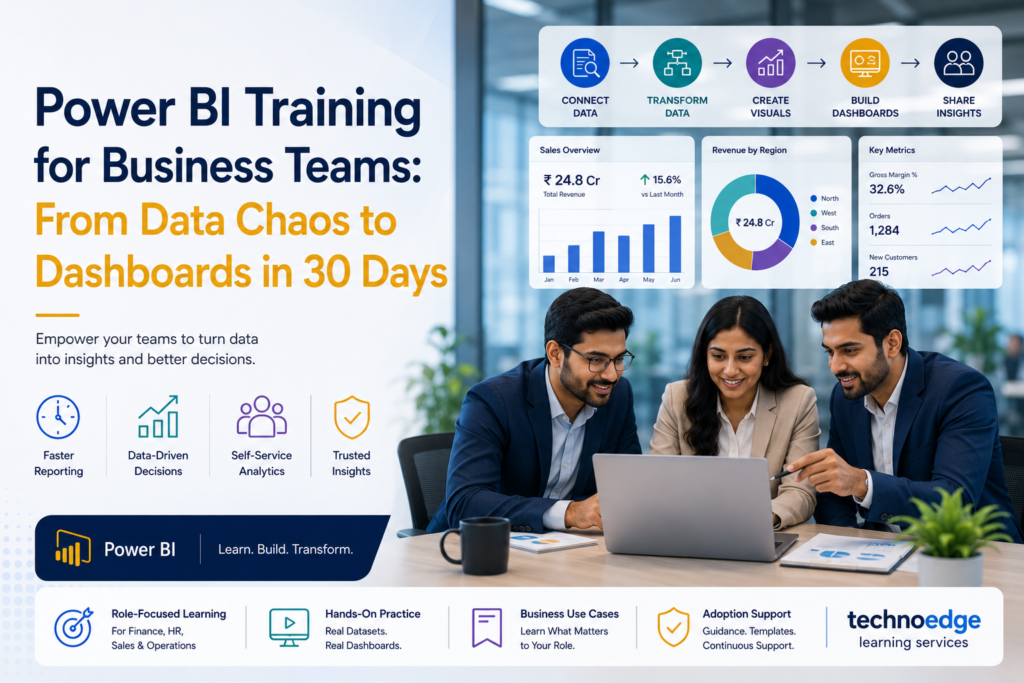
Power BI Training for Business Teams: From Data Chaos to Dashboards in 30 Days

Most Indian enterprises in IT, BFSI, manufacturing, and GCCs have data in abundance but insights in short supply. Finance teams spend days compiling spreadsheets, HR leaders chase manual headcount reports, sales managers struggle with inconsistent pipeline data, and operations leaders rely on static dashboards that are outdated by the time they’re reviewed. The problem is not lack of data—it’s lack of structured Power BI training for business teams that connects analytics to real reporting pain points. A focused 30-day programme can transform how non-technical teams consume and create data, turning data chaos into actionable dashboards. At Technoedge, we design Power BI training India programmes specifically for business teams, with role-focused learning, business-use-case dashboards, and adoption support that helps non-technical users become confident analytics practitioners. Why business teams need structured Power BI training now Data-driven decision-making is no longer optional for enterprise leaders. Yet many business teams still rely on Excel-heavy workflows, manual consolidation, and static reports that delay decisions and introduce errors. Structured Power BI training for business teams addresses this by: What usually goes wrong: What good looks like: This is why Power BI training India for business teams must be practical, use-case driven, and supported beyond the classroom. Common reporting problems across finance, HR, sales, and operations Different functions face different reporting challenges, but some patterns are consistent across Indian enterprises. Finance teams HR teams Sales teams Operations teams What these problems have in common: Power BI, when taught with business use cases in mind, directly addresses each of these pain points. A 30-day roadmap for power bi training for business teams A structured 30-day roadmap helps business teams move from zero to confident dashboard creators without overwhelming them. Days 1–7: Foundations and data literacy Goal: Learners can connect to a data source and build a basic report. Days 8–14: Building functional dashboards Goal: Learners build a dashboard for their actual reporting need. Days 15–21: Advanced visuals and business logic Goal: Learners create polished, function-specific dashboards. Days 22–30: Adoption and reinforcement Goal: Learners are confident users who can maintain and improve their dashboards. This roadmap ensures Power BI training for business teams is practical and outcome-focused. Core modules in power bi corporate training Effective Power BI corporate training for business teams should cover these core modules, prioritised by business relevance rather than technical depth. Power BI fundamentals Data preparation with Power Query Visualisation best practices Measures and basic DAX Dashboard design and publishing Data governance and security These modules should be taught with business use cases, not abstract examples. Function-wise dashboard use cases To make Power BI training India practical, training should include function-specific dashboard use cases that learners can adapt to their context. Finance dashboards HR dashboards Sales dashboards Operations dashboards These use cases make training immediately relevant and increase the likelihood of adoption. How to improve adoption after training Training alone does not guarantee adoption. Business teams need ongoing support to translate learning into everyday use. Strategies for improving adoption What usually goes wrong What good looks like This approach ensures Power BI training for business teams leads to sustained adoption. How Technoedge helps with practical Power BI training, business-use-case dashboards, role-focused learning, and adoption support for non-technical teams At Technoedge, Power BI training is designed for business teams, not just technical analysts. We focus on practical learning, real use cases, and adoption support that helps non-technical users become confident. Our approach includes: 1. Practical Power BI training 2. Business-use-case dashboards 3. Role-focused learning 4. Adoption support This ensures that Power BI training India for business teams translates into real-world impact. FAQs 1. Power BI training India: what should be covered in enterprise training programs? Enterprise Power BI training should cover fundamentals, data preparation with Power Query, visualisation best practices, basic DAX measures, dashboard design, publishing, and data governance. It should also include function-specific use cases for finance, HR, sales, and operations. The content should be practical and business-focused, not overly technical. 2. Power BI training for business teams: can non-technical teams learn dashboard creation effectively? Yes, non-technical teams can learn dashboard creation effectively when training is designed for them. The key is to focus on business use cases, avoid deep technical complexity, and provide hands-on practice with real data. With the right approach, managers and functional leaders can build dashboards without coding experience. 3. Power BI corporate training: which departments benefit most from dashboard skills? Finance, HR, sales, and operations departments benefit most from dashboard skills because they rely heavily on reporting and data-driven decisions. These functions typically have the most manual reporting processes and the highest potential for improvement. Other departments like marketing, supply chain, and customer success also benefit significantly. 4. Power BI training India: how long does business team training usually take? Business team training typically takes 4–6 weeks for a comprehensive programme, with a 30-day roadmap being a common model. This includes foundational learning, dashboard building, and adoption support. Intensive bootcamps can compress this into 1–2 weeks, but longer programmes tend to have better adoption. 5. Power BI training for business teams: how to improve dashboard adoption after training? Improving adoption requires linking dashboards to real reporting pain points, creating champions in each function, providing templates, scheduling follow-up sessions, integrating dashboards into workflows, and measuring usage. Training alone is not enough; ongoing support is critical for sustained adoption. Connect with us For organizations investing in Power BI training for business teams, the biggest improvement often comes from linking dashboards to real reporting pain points. Technoedge can help make that shift through business-focused Power BI learning journeys and practical analytics use cases. To explore how this can work for your context, you can connect with Technoedge at: https://technoedgelearning.com


AI-powered Power BI expert analyzing automated business dashboards and real-time analytics while replacing traditional reporting teams in a modern corporate office environment.
blogs

Why Companies Are Replacing Traditional Reporting Teams with AI-Powered Power BI Experts in 2026

Introduction: The End of Traditional Reporting Teams Has Already Started For years, companies relied heavily on traditional reporting teams to collect data, create Excel reports, prepare dashboards, and present business insights to management. These teams played a crucial role in helping businesses understand performance, sales, customer trends, and operational metrics. But in 2026, the business intelligence landscape is changing dramatically. Companies are no longer satisfied with slow reporting cycles, manual dashboard creation, and static reports that become outdated within hours. Modern businesses operate in a fast-moving digital environment where decisions must be made instantly, accurately, and based on real-time insights. This shift has created a major transformation inside organizations: 👉 Companies are moving away from traditional reporting teams👉 And moving toward AI-powered Power BI experts This does not mean reporting is disappearing. It means the way reporting is done is evolving rapidly. Today, businesses want professionals who can: This evolution is not just a technology trend—it is a business survival strategy. Companies that fail to modernize their reporting systems are struggling with slower decision-making, operational inefficiencies, and missed opportunities. This blog explains: Why Traditional Reporting Teams Are Becoming Less Effective in Modern Businesses Traditional reporting systems were designed for a different business era. Earlier, companies could afford to wait days or even weeks for reports because business environments moved more slowly. Data volumes were smaller, competition was lower, and decision-making cycles were longer. But modern businesses generate enormous amounts of data every second. This includes: Traditional reporting teams often struggle with this scale because their workflows are heavily manual. Many reporting teams still spend large amounts of time on: These processes create several business problems. 1. Slow Decision-Making Hurts Business Growth In competitive industries, delays in decision-making can directly impact revenue and customer satisfaction. If leadership teams receive reports days later, they are making decisions based on outdated information. Modern businesses need: Traditional reporting models cannot support this speed effectively. 2. Manual Reporting Creates High Operational Costs Large reporting teams require significant operational investment. Companies spend money on: AI-powered systems reduce much of this manual dependency. This allows companies to: 3. Static Reports Are No Longer Enough Traditional dashboards mostly explain:👉 “What already happened” But modern companies also want to know: This requires predictive analytics and AI-driven intelligence. Static reports cannot provide this level of insight. Why AI-Powered Power BI Experts Are Becoming Extremely Valuable The rise of AI-powered Power BI professionals is directly connected to the changing needs of businesses. Companies no longer want professionals who only create dashboards. They want experts who can: This changes the role completely. An AI-powered Power BI expert is not just a dashboard creator. They become:👉 a business intelligence strategist What Makes AI-Powered Power BI Experts Different? Traditional reporting professionals focus mostly on data presentation. AI-powered Power BI experts focus on: They use: to create smarter business ecosystems. Example: Traditional Reporting vs AI-Powered Reporting Traditional Workflow: AI-Powered Workflow: The difference in speed and efficiency is massive. How AI Is Transforming Power BI in 2026 Power BI itself is evolving rapidly because of AI integration. Microsoft is heavily investing in: This means users can now: The role of reporting professionals is changing from:👉 report buildersto:👉 insight interpreters and business advisors Real Business Impact: Why Companies Prefer AI-Powered Analytics Teams Businesses are not adopting AI-powered analytics just because it is trendy. They are doing it because it creates measurable business impact. 1. Faster Business Decisions AI-powered dashboards provide real-time visibility into operations. This allows leadership teams to respond quickly to: Speed becomes a competitive advantage. 2. Better Forecasting and Planning AI helps businesses predict: This improves strategic planning significantly. 3. Reduced Reporting Dependency Companies no longer need large teams handling repetitive reporting operations. Instead, smaller highly skilled analytics teams can manage intelligent systems efficiently. 4. Stronger Executive-Level Insights AI-powered analytics systems provide: This helps executives make smarter strategic decisions. Will Traditional Reporting Jobs Disappear Completely? This is one of the biggest questions professionals ask. The honest answer is:👉 No, reporting jobs will not disappear completely But they will evolve dramatically. Professionals who only know: may struggle in the future. However, professionals who adapt to: will become highly valuable. The future belongs to:👉 AI-augmented analytics professionals Skills Companies Are Hiring for in 2026 Modern companies are increasingly hiring professionals with hybrid skill sets. The most in-demand skills include: 1. Power BI Expertise Companies still heavily rely on Power BI for: But advanced Power BI skills are now more valuable than basic reporting. 2. AI Integration Knowledge Professionals who understand: have a significant advantage. 3. Microsoft Fabric Knowledge Microsoft Fabric is becoming a major enterprise analytics platform. Companies want professionals who understand: 4. Business Understanding Technical skills alone are no longer enough. Companies value professionals who understand: This combination creates true business intelligence experts. Career Opportunities and Salary Growth for AI-Powered Power BI Experts The demand for AI-powered analytics professionals is increasing rapidly worldwide. Roles include: These roles often offer: because businesses see them as strategic assets. How TechnoEdgels Helps Professionals Become Future-Ready Analytics Experts Most learners still follow outdated reporting-focused learning paths. But modern companies need: TechnoEdgels focuses on preparing learners for this new market reality. Instead of teaching only traditional reporting, TechnoEdgels helps learners build: The focus is not just certification. The focus is:👉 becoming job-ready and future-ready Frequently Asked Questions 1. Why are companies replacing traditional reporting teams in 2026? Companies are replacing traditional reporting teams because modern businesses require faster, smarter, and more automated analytics systems. Traditional reporting methods often rely on manual work, static dashboards, and delayed reporting cycles. This slows down decision-making and increases operational costs. AI-powered Power BI experts help businesses automate reporting, generate real-time insights, and improve forecasting. This creates higher efficiency and better business outcomes. 2. Will AI completely replace reporting analysts and BI professionals? AI will not completely replace reporting analysts, but it will significantly change their responsibilities. Repetitive tasks such as manual report creation and basic dashboard generation will become automated. However, businesses still need

Trust Us, One Call Can Make a Difference
Please enable JavaScript in your browser to complete this form.
Join As Trainer
Join As Trainer
Please enable JavaScript in your browser to complete this form.
Download Course Content
Please enable JavaScript in your browser to complete this form.
More than 5 People are attending Get On a Call with Us
Please enable JavaScript in your browser to complete this form.
More than 5 People are attending Get On a Call with Us
Scroll to Top