TechnoEdge

Free Master Class

How to Plan Your AI Training Budget for FY26? (For CHROs & L&Ds)

workplace learning

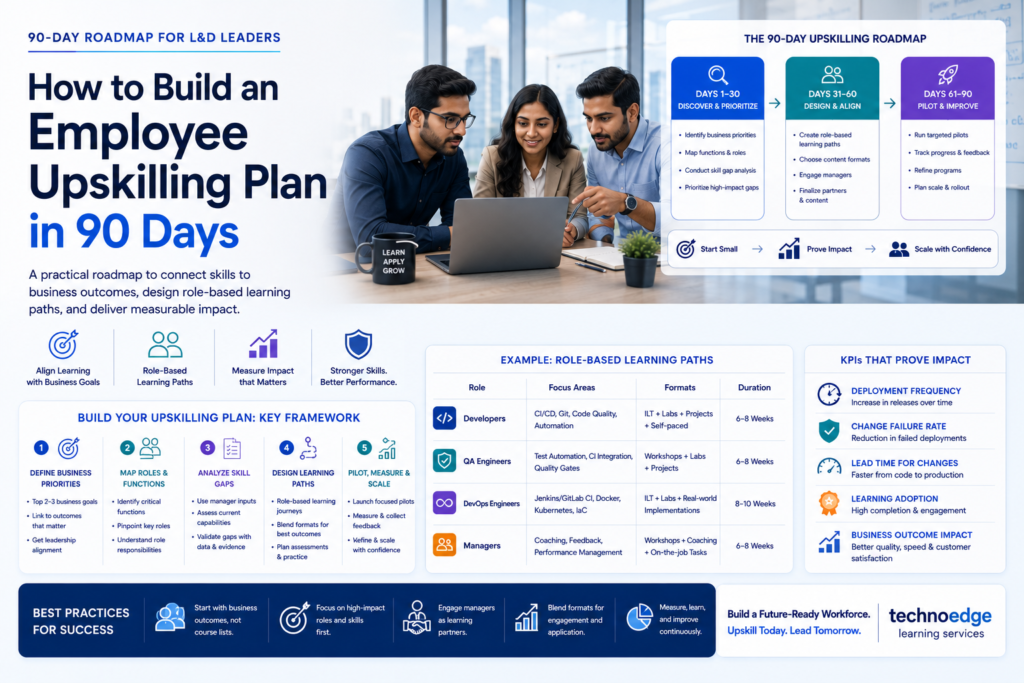
Chart showing a 90-day employee upskilling timeline with skills assessment and learning milestones.
blogs

How to Build an Employee Upskilling Plan in 90 Days?

L&D teams in Indian enterprises often start upskilling with good intent but struggle to move from planning to measurable impact. The problem is usually not a lack of content, but a lack of structure, clarity, and alignment with business priorities. A disciplined workforce upskilling plan built over 90 days can turn that around. It gives you a practical way to connect skills to business outcomes, define learning paths by role, and launch pilots that prove value before scaling. In this guide, you’ll get a clear 90-day roadmap and a practical template for how to build employee upskilling plan initiatives that L&D leaders, CHROs, and business heads can actually execute. Why workforce upskilling plan initiatives often stall Many upskilling programmes start strong but lose momentum within weeks. The most common reasons include: As a result, pilots don’t scale, participation drops, and leadership loses confidence in L&D’s ability to deliver business value. A structured 90-day approach fixes this by forcing clarity on priorities, roles, and measurable outcomes from day one. Days 1–30: identify business priorities and critical skill gaps The first 30 days are about diagnosis and prioritisation, not content selection. Step 1: Clarify business priorities Work with business leaders to identify 2–3 key priorities for the next 6–12 months, such as: These priorities become the anchor for your upskilling plan. Step 2: Map priorities to functions and roles For each priority, identify: This narrows the scope from “upskill everyone” to “upskill these roles for these outcomes.” Step 3: Conduct targeted skill gap analysis Use a mix of: The goal is to identify specific gaps like: Step 4: Prioritise gaps by impact and feasibility Not all gaps can be addressed at once. Prioritise using: Focus the first 90 days on the highest-impact, feasible gaps. Days 31–60: map roles, learning paths, managers, and content formats Once gaps are clear, the next 30 days are about designing the learning journey and aligning stakeholders. Step 1: Define role-based learning paths For each priority role, create a learning path that includes: Example for developers: Step 2: Decide on content formats Match format to learning objective: Avoid over-reliance on one format. A blended approach works best for most enterprise programmes. Step 3: Involve managers early Managers are critical for: Engage managers by: Step 4: Select partners and content At this stage, decide: This is where how to build employee upskilling plan becomes concrete: you now have clear requirements to evaluate providers. Days 61–90: launch pilots, review progress, and refine implementation The final 30 days are about execution, learning, and refinement. Step 1: Run targeted pilots Start with a focused pilot: Pilot goals: Step 2: Track progress and gather feedback Use a simple dashboard to track: Collect feedback through: Step 3: Refine and prepare to scale Based on pilot results: Then plan the next phase: A practical template for how to build employee upskilling plan initiatives Use this template as a starting point for your workforce upskilling plan. 1. Business alignment 2. Skill gap summary Role Current level Target level Key gaps Priority (H/M/L) DevOps engineer Intermediate Advanced CI/CD, Kubernetes, automation H Mid-level manager Basic Intermediate Coaching, performance management H QA engineer Basic Intermediate Test automation, CI integration M 3. Learning path design Role Learning path name Formats Duration Provider Role Learning path name Formats Duration Provider DevOps engineer CI/CD Pipeline Track Instructor-led + labs + project 8 weeks External partner Mid-level manager Manager Effectiveness Track Workshops + coaching + on-job tasks 10 weeks Internal + external 4. Manager involvement plan 5. Measurement plan This template makes how to build employee upskilling plan initiatives concrete and actionable. KPIs for measuring workforce upskilling plan success To prove value, track KPIs that connect learning to business outcomes. Learning KPIs Behaviour KPIs Business KPIs Track these before and after the programme, ideally over 30–90 days post-training. How Technoedge helps with skill gap discovery, structured learning pathways, content mapping, training execution, and progress measurement At Technoedge, we support L&D teams through the full lifecycle of a workforce upskilling plan, from discovery to measurement. Our approach includes: 1. Skill gap discovery 2. Structured learning pathways 3. Content mapping 4. Training execution 5. Progress measurement This ensures that how to build employee upskilling plan initiatives move smoothly from planning to action, with clear evidence of impact. FAQs 1. How to build employee upskilling plan initiatives for enterprise teams? Start by clarifying 2–3 business priorities and mapping them to critical roles and functions. Then conduct a targeted skill gap analysis to identify specific capability gaps by role. Use this to design role-based learning paths with clear formats, timelines, and managers’ involvement. Launch pilots with focused teams, track progress using learning and business KPIs, and refine before scaling. This structured approach is the core of how to build employee upskilling plan initiatives that deliver real value. 2. Workforce upskilling plan: what should be included in a 90-day model? A 90-day model should include: Each phase should have clear outputs: prioritised gaps, learning path designs, pilot results, and a scaling plan. 3. How to build employee upskilling plan frameworks aligned with business goals? Align frameworks by starting with business goals, not learning topics. For each goal, identify the functions, roles, and capabilities needed to achieve it. Then design learning paths that directly support those capabilities. Measure success using business KPIs, not just learning metrics. This ensures the framework is business-driven and defensible to leadership. 4. Workforce upskilling plan: which KPIs matter most for L&D teams? The most important KPIs are those that connect learning to business outcomes: L&D teams should track these before and after the programme and report on them consistently. 5. Employee skill gap analysis India: how to connect skill gaps with upskilling priorities? Connect skill gaps with priorities by starting with the business problem, then identifying which roles and capabilities are bottlenecks. Use manager input, performance data, and assessments to validate gaps. Prioritise gaps based on impact on business goals and feasibility to address. This ensures that upskilling efforts focus on the areas that matter most for the organisation. Connect with us For L&D teams building a workforce
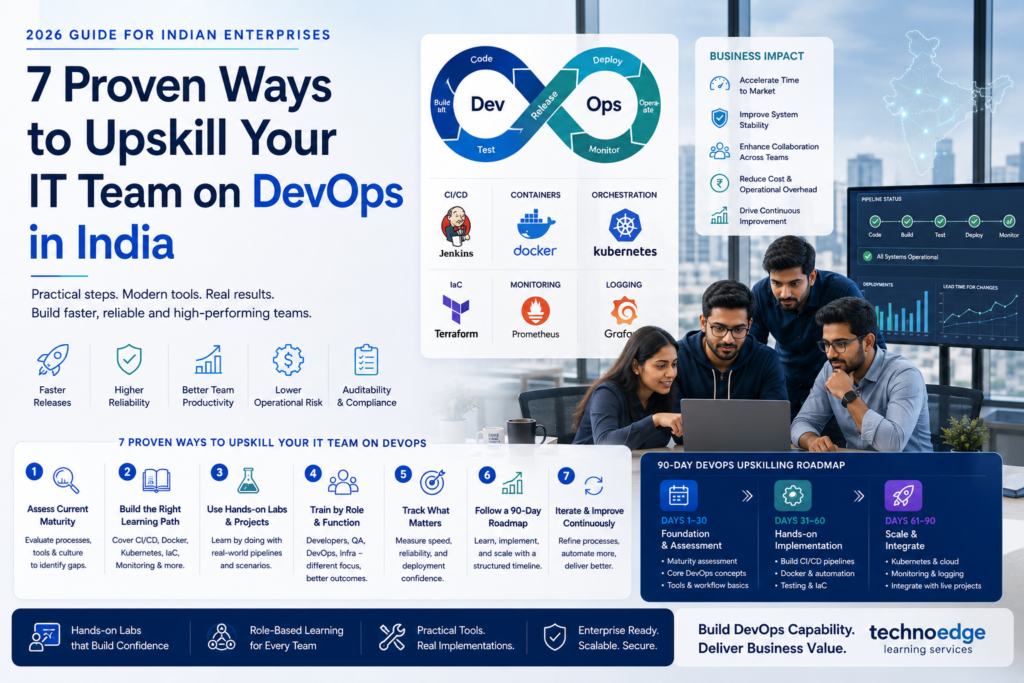
Engineers reviewing a DevOps upskilling roadmap with CI/CD and cloud tools.
blogs

7 Proven Ways to Upskill Your IT Team on DevOps in India (2026 Guide)

Indian enterprises are under constant pressure to release faster, improve reliability, and scale digital platforms without increasing operational risk. Yet many IT teams are still constrained by fragmented tooling, manual processes, and siloed responsibilities between development, QA, and operations. This is where structured DevOps training India initiatives become a business priority, not just a technical upgrade. Organisations that invest in the right CI CD training for employees are seeing measurable gains in release velocity, system stability, and team productivity. At Technoedge Learning Services, we work closely with enterprise IT teams to design DevOps upskilling programmes that are practical, role-based, and aligned to real delivery environments in India. Why devops training India is now a business priority DevOps is no longer optional for enterprises operating in IT services, BFSI, SaaS, and GCC environments. It directly impacts how quickly and reliably organisations can deliver value to customers. Key business drivers include: What often goes wrong: What works better: Assess current engineering and release management maturity Before starting any DevOps corporate training initiative, organisations need a clear view of their current state. This involves evaluating: Common mistake: Better approach: This ensures that DevOps training is not generic but targeted and measurable. Build a learning path around CI/CD, Docker, Kubernetes, automation, and monitoring Effective CI CD training for employees must go beyond isolated topics and follow a structured progression. A robust DevOps learning path typically includes: What usually goes wrong: What good looks like: Use hands-on labs and project-based practice in devops corporate training DevOps cannot be learned through theory-heavy sessions. Teams need hands-on exposure to build confidence and capability. Effective DevOps corporate training should include: Common pitfalls: Better approach: Example: Instead of just explaining CI/CD, teams build a working pipeline that automatically tests and deploys code to a staging environment, including rollback mechanisms. Train by role: developers, QA teams, DevOps engineers, infrastructure teams A one-size-fits-all approach does not work for DevOps upskilling. Different roles require different depth and focus: What usually goes wrong: What works better: This ensures that DevOps becomes a shared capability rather than a specialised function. Track speed, reliability, and deployment confidence after training Training effectiveness must be measured in business and engineering outcomes. Key metrics to track: Common mistake: Better approach: This shifts DevOps training from a learning activity to a performance improvement initiative. A 90-day roadmap for devops training India A structured timeline helps organisations move from learning to implementation. Typical 90-day roadmap: Days 1–30: Foundation and assessment Days 31–60: Hands-on implementation Days 61–90: Scaling and integration What makes this effective: How Technoedge helps with hands-on DevOps upskilling, enterprise labs, role-based learning design, practical tool coverage, and real-world implementation support At Technoedge, DevOps training is designed as a capability-building journey, not a one-time intervention. Our approach includes: 1. Evaluation and diagnosis 2. Role-based learning design 3. Hands-on enterprise labs 4. Practical tool coverage 5. Real-world implementation support This ensures that DevOps capability is embedded into day-to-day engineering workflows. FAQs 1. DevOps training India: how to upskill IT teams on DevOps in a structured way? A structured approach starts with assessing current maturity, followed by defining clear business goals such as faster releases or improved system reliability. Based on this, organisations should design role-based learning paths covering CI/CD, containerisation, automation, and monitoring. The key is to combine conceptual learning with hands-on implementation. Teams should work on real pipelines, not just simulations. Progress should be tracked using engineering metrics like deployment frequency and failure rates to ensure tangible outcomes. 2. CI CD training for employees: what topics should be included in enterprise DevOps training? Enterprise CI CD training should cover: It is important to connect these topics into an end-to-end workflow rather than teaching them in isolation. Employees should understand how code moves from development to production in a controlled and automated manner. 3. DevOps corporate training: which format works best for engineering teams in India? The most effective format is blended learning, combining: In the Indian enterprise context, training must align with live project constraints and delivery timelines. Flexibility and contextualisation are critical for adoption. 4. DevOps training India: how long does enterprise DevOps upskilling usually take? Most organisations see meaningful outcomes within 8–12 weeks when training is structured and hands-on. However, full maturity can take several months depending on the complexity of systems and scale of teams. The focus should not be on duration alone but on continuous improvement and integration into daily workflows. 5. CI CD training for employees: how to connect pipeline training with business delivery goals? To connect training with business outcomes: This ensures that CI/CD training directly contributes to faster delivery, improved quality, and reduced risk. 6. Strengthen your DevOps capability with the right partner For organizations planning DevOps training India initiatives, practical execution matters more than theory-heavy sessions. Technoedge can support structured DevOps upskilling through hands-on learning paths, enterprise-ready labs, and training plans aligned with real engineering workflows. To explore how this can work for your context, you can connect with Technoedge at: https://technoedgelearning.com

Trust Us, One Call Can Make a Difference
Please enable JavaScript in your browser to complete this form.
Join As Trainer
Join As Trainer
Please enable JavaScript in your browser to complete this form.
Download Course Content
Please enable JavaScript in your browser to complete this form.
More than 5 People are attending Get On a Call with Us
Please enable JavaScript in your browser to complete this form.
More than 5 People are attending Get On a Call with Us
Scroll to Top